

In November of 1803, people in the Hammersmith district of west London began to report sightings of a very tall ghost all dressed in white. Sometimes he was described as having glasses and horns. As people talked about this strange news, some people began to assume that the ghost was of someone who had committed suicide and then was buried in the church cemetery in Hammersmith. Back then, many people thought that someone who committed suicide should not be buried in the sacred ground of a churchyard because their soul would not be able to rest there. Not only were there reported sightings, some also claimed to have been assaulted by the ghost. This led to widespread panic and people began arming themselves with guns and patrolling the area. With tensions running high, one member of the public, Francis Smith, shot and killed a bricklayer, Thomas Millwood, because Smith thought that Millwood was the ghost.
This event became known as the Hammersmith Ghost hysteria and it is listed as one of many examples from history of mass hysteria. Wikipedia defines mass hysteria as “…a phenomenon that transmits collective illusions of threats, whether real or imaginary, through a population and society as a result of rumors and fear.” Other examples include the Salem Witch Trials in 1692-93, the Halifax Slasher hysteria in 1938, the Tanganyika Laughter Epidemic in 1962, and the large number of illnesses reported on Emirates Flight 203 in September 2018.[i]

God put the ability to feel fear both within humans and animals to protect us by helping us to be alert to danger. But one significant difference between humans and animals is that animals relax when the danger in their environment has subsided. Human beings have the ability to imagine danger in our minds and respond with fear whether the threat is real or not. Mistaken or misguided fear can have devastating effects on us and the people around us when it causes us to make poor decisions. Someone else’s misguided fear can even get you killed, as happened with Thomas Millwood. So how do we make wise decisions even when fear may be all around us or in us? That’s what we are going to be thinking about today and to guide us in our reflections we will be looking at selected verses from Numbers chapters 13 & 14. If you have a Bible or a Bible app nearby, I invite you to turn there now.
The Israelite Spies Explore & Report
As you do that, I would like to give you some context to help you better understand the passage we are looking at. In my last post, we looked at a passage in Exodus chapter 12 where God’s people were saved from losing their first-born son and were set free from slavery in Egypt by the blood of an innocent lamb. We also saw how that Passover Lamb pointed ahead to the Lamb of God, God’s Son, Jesus Christ, who saved us from death and set us free from our slavery to sin by shedding his blood for us on the cross. In the time in between the events of Exodus 12 and the passage we are looking at today, God gave his people safe passage through the waters of the Red Sea, and they began their journey through the wilderness toward the land that God promised to give to them.
With the passage we are looking at today, God’s people are on the verge of entering the Promised Land and taking possession of it, and to help them as they prepare to do that, God instructed Moses to send one leader from each of the twelve tribes of Israel to explore that land, which was the land of Canaan. Moses instructed these twelve scouts to see what the land was like—was it fertile or barren?—and to see what the people in the land were like—were they numerous, well-armed, and living in strongly fortified cities, or were they few in number, poorly-armed, and were their cities vulnerable to attack? This was critical information for the Israelites to have as they prepared to invade. Charged with this very important task, the twelve spies left. Over the course of forty days, they thoroughly explored the land and then came back, carrying with them some of the fruit of the land: grapes, pomegranates, and figs.
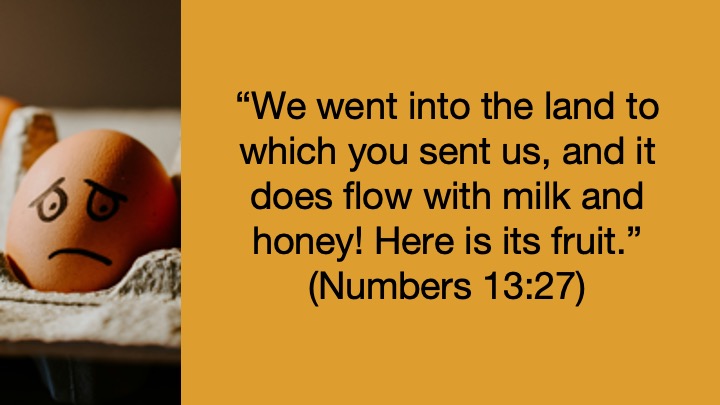
At this point, I think that it is important for us to note that all twelve of the spies explored the same territory and likely saw all the same things, but they did not all think and feel the same way about what they witnessed and experienced. That became evident when they reported on their trip before Moses, Aaron, and the entire Israelite community. The Bible tells us Exodus 12, that there were 600,000 men, plus women and children, so there could have been as many as two million people assembled as this group of twelve gave their report. The twelve spies showed the people the fruit that they brought back and then began their report to Moses before the people: “We went into the land to which you sent us, and it does flow with milk and honey! Here is its fruit.” (Numbers 13:27)
So far, the report is going well. We don’t know who is speaking, but very quickly a divergence is going to open between ten of the spies on the one side, and two spies, Caleb and Joshua, on the other. The report continued:“But the people who live there are powerful, and the cities are fortified and very large. We even saw descendants of Anak there. The Amalekites live in the Negev; the Hittites, Jebusites and Amorites live in the hill country; and the Canaanites live near the sea and along the Jordan.” (Numbers 13:28-29) In other words, there are giants in the land.
The Consequences of Anxiety
Try to imagine the impact these last words had. There are hundreds of thousands of people gathered together and, up until recently, they were defenseless slaves who were oppressed and brutalized within the cruel and powerful nation of Egypt. Now they hear that there are giants living in the land that they are supposed to invade and conquer, and they begin to get anxious and afraid.
This is what tends to happen whenever human beings are in community with each other, whether it is a family, or a country, or a church. When people get anxious, they tend to spread their anxiety to others, and that tendency of anxiety to spread within a community is especially powerful if it is the community’s leaders that are anxious. That is exactly what happened here. Ten of the spies were anxious about what they witnessed in Canaan, and they then got all the rest of God’s people anxious, as well.
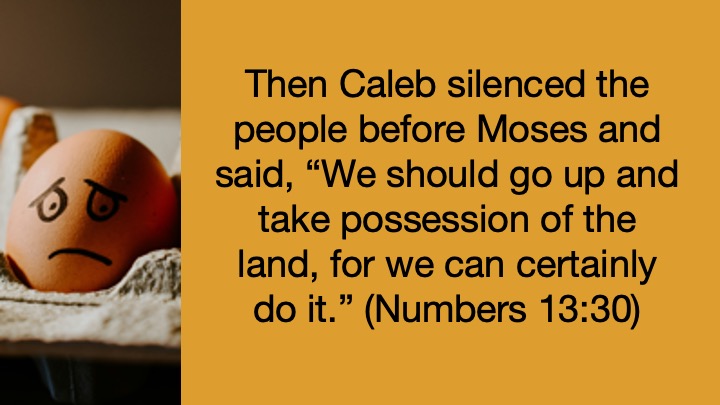
Turning back to our passage, we read: Then Caleb silenced the people before Moses and said, “We should go up and take possession of the land, for we can certainly do it.” (Numbers 13:30) Note that Caleb is not disputing the fact that there are giants in the land, he is simply trying to counter the spreading anxiety by speaking in favor of doing what God had called them to do and trusting that God would provide the victory.
The ten anxious spies recognize that Caleb is countering the spread of their anxiety and they then speak out against doing what God had called the people to do, saying: “We can’t attack those people; they are stronger than we are.” And they spread among the Israelites a bad report about the land they had explored. They said, “The land we explored devours those living in it. All the people we saw there are of great size. We saw the Nephilim there (the descendants of Anak come from the Nephilim). We seemed like grasshoppers in our own eyes, and we looked the same to them.” (Numbers 13:31-33).
Let’s identify this bad report for what it is—it is an exaggeration to the point of being a lie—and let us recognize that, if left unchecked, anxiety can have the same impact on us. Within an anxious community, where people are dividing into various opposing groups, we all want people to be on our side, and we are not above exaggerating the truth to make that happen. You see, anxiety colors how we experience things, it distorts how we process our experiences, and it can drive our responses. For example, have you ever received an email, read it, and then responded to it right away, only to read the original email a few days later and realize that it did not say what you thought it said, which means that the email you sent in response was wrong, inappropriate and uncalled for? I know that I have done that. It is like anxiety can warp my perception so much that my senses lie to me, and I don’t even realize it in real time. The best-case scenario is if I realize it later, but by then there is some damage that I have done, and I have to live with that.
There was damage caused by the anxiety-driven lies of the ten spies too. The people of God got so anxious that they rebelled against God, refused to enter the land, and threatened to kill Moses and Aaron. Moses begged the Israelites to reconsider, and he interceded for them when God threatened to destroy them for their rebellion. God relented, but there would be consequences for the Israelites. They would wander in the wilderness for forty years, and everyone over the age of twenty would die in the desert without entering the Promised Land. The ten anxious spies were struck down by a plague and died. Of the original twelve, only Caleb and Joshua survived. Belatedly, the Israelites decided to obey God and they tried to conquer the land in their own strength. But God was not with them, and they were defeated. God had set a beautiful opportunity before them, but tragically they did not step into that opportunity, because of anxiety.
Responding as a Person of Faith vs. a Person of Fear
Now, please understand me clearly. I am not saying that none of us should ever feel anxious. There are some things in life that should make us feel anxious. When people are suffering because of violence or poverty, we should feel anxious. When death threatens to claim us or someone we love, we should feel anxious. When human brokenness hurts us or others, we should feel anxious. We should feel anxious because none of those things are how God originally intended things to be, nor are they consistent with God’s will for the world or for us personally.
But there is a huge difference between feeling anxious and letting anxiety rule over our lives so that it impacts our perception, our thinking, and our actions, and, as a consequence, keeps us from the wonderful opportunities God is setting before us.
The main factor that accounts for the gap between feeling anxious and letting anxiety rule over you is faith. The stronger our faith in God to defeat the giants in our life and the more areas of our life to which we apply that giant-slaying faith, the weaker anxiety’s ability will be to rule over our lives. We will be more able to see things as they really are, and to process our experiences and respond as a person of faith, instead of a person of fear.
Anxiety & Jesus
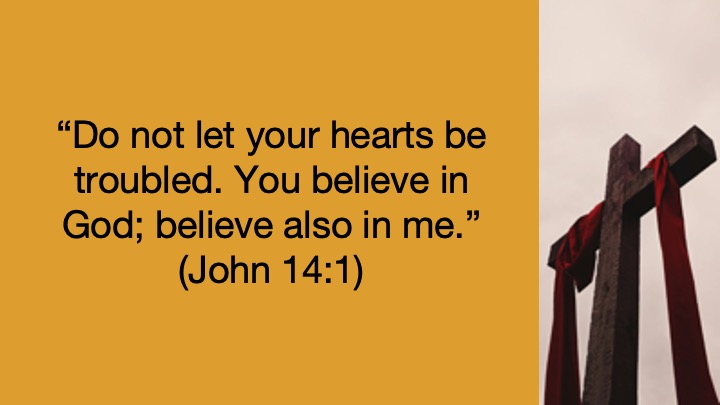
Jesus has something to teach us about anxiety. In the night before he died, Jesus told his closest followers that one of them would betray him, Peter would disown him and, after three years together, he would be leaving them. Understandably, they were upset. Then Jesus said, “Do not let your hearts be troubled. You believe in God; believe also in me.” (John 14:1) He then went on to tell them that their separation would be temporary, and that he was leaving to prepare a place for them so that they could be with him forever.
Later, in the Garden of Gethsemane, Jesus’ followers were so calm that they fell asleep, but Jesus was very anxious. He said, “My soul is overwhelmed with sorrow to the point of death.” (Matthew 26:38). Now the opportunity that was set before Jesus in that moment was to suffer for the sins of the whole world, including those sins we unknowingly commit in anxiety, in order that all who look to him in faith could enter the Promised Land of life as a child of God forever. With Jesus as our Lord and Savior, the words that were spoken over him at his Baptism are spoken over us at ours. Our heavenly Father says to each one of us, “You are my child, whom I love; with you I am well pleased.” (see Mark 1:11).

The cause of Jesus’ anxiety was the cross that lay before him, and that cross was the cost of our salvation. How would Jesus respond? He prayed, “My Father, if it is not possible for this cup to be taken away unless I drink it, may your will be done.” (Matthew 26:42) The Bible does not tell us what, if any, answer God the Father gave to Jesus. But we do have Jesus’ response to the situation he was in. He willingly went to that cross, and then suffered and died to set us free to be with him forever.
In Jesus, we have the sure and certain promise of resurrection life, and his presence and his promise are now the bedrock of our lives. We can feel anxiety and yet respond in faith because Jesus is in us and we are in him, today, tomorrow, and forever. The cross of Jesus is our assurance that the giants in our life will not win, because he has conquered them all for us.
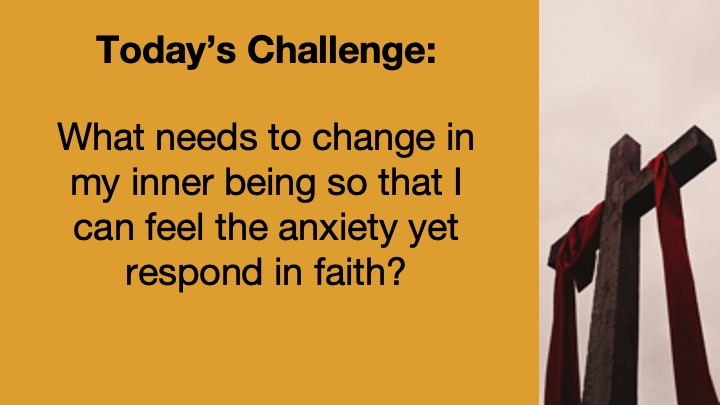
So the challenge that I wish to leave with you today is this, the next time you become anxious, ask yourself this question: What needs to change in my inner being so that I can feel the anxiety yet respond in faith? Amen.
[i] “List of mass hysteria cases,” Wikipedia: The Free Encyclopedia (Internet; available at: https://en.wikipedia.org/wiki/List_of_mass_hysteria_cases; accessed January 31, 2024).
(This message was shared at Walnut Grove Lutheran Church in Langley BC on February 18, 2024. For more info about WGLC, please go to wglc.org.)

 Farewell to Shadowlands