

If you go on YouTube, and search for “brain games waiting room”, you will find a video of what I think is a fascinating social experiment from a program called “Brain Games” on the National Geographic Kids channel. The video is recorded in the waiting room for an eye doctor. As the video starts, everyone in the room is a paid actor and they are waiting for the test subject to arrive. Right on time, that test subject, a woman, walks into the waiting room for what she thinks is a free eye exam. After a few moments, a tone comes over the speakers and all the actors in the waiting room silently stand up and then sit down. The woman wonders what is going on but doesn’t say anything. After only three beeps, the test subject starts standing up and sitting down just like everyone else does.
The tone keeps repeating and one-by-one all the actors leave the waiting room to go into their “appointments” until the test subject is all alone in the waiting room. What do you think she does the next time the tone sounds? She stands up, even though she is all alone.

Then another test subject enters the waiting room and takes a seat to wait for their “appointment.” When the tone sounds, the first test subject stands up. When she stands up again when another tone sounds, the second person asks her why she stands up. She then teaches the second person to also stand up. More and more test subjects enter the room, and with enough repetitions of the tone, all of the test subjects, even the most rebellious, are trained to stand up when the tone sounds, even though no actors are among them.
What’s happening here is something called social conformity. Beginning when we are very young, when we see other members of our group carry out a task, our brain rewards us if we perform the same task. This subconscious function of our brain can be good in that it helps us become part of a group which supports us, but it can be bad when it leads us into bad behaviour that we repeat.[i] Social conformity might be the reason that the Calgary Flames used to be my favourite NHL hockey team, but now I cheer for the Vancouver Canucks. I will let you decide if that is a good or bad effect of social conformity.

We human beings are far more like sheep than we want to admit. Not only do we tend to follow the crowd, like sheep do, we wander away from protection into danger, like sheep do, we are susceptible to parasites and problems, like sheep are, and we are almost totally defenceless against attacks from enemies that seek to destroy us, like sheep are. And not only are we vulnerable and helpless, like sheep are, we are also stubborn like sheep are. Our pride prevents us from admitting our weaknesses and seeking help until our life collapses in catastrophe when our best efforts at a self-guided life fail, as they inevitably will for all of us.
We, like sheep, need a shepherd, and there is a wide variety of “shepherds” out in the world who are willing to guide us. Not all of them have our best interests at heart. Many are inadequate, or misguided. Some intend to defraud or destroy us. How do we know which shepherd to follow and what does following that shepherd look like? That’s the question that we are going to be thinking about today, and to help us as we do that, let’s take a look at one of the most well-known passages in the Bible, Psalm 23. If you have a Bible or a Bible app nearby, I invite you to turn there now.
The Sheep and the Shepherd (verse 1-3)
The Psalms were written between 1000 and 300 years before the time of Christ and they have been the hymn book of God’s people for centuries. Even today, Jews and Christians read or recite the Psalms.Some of the Psalms, including Psalm 23, were written by David. So as we read this Psalm and apply it to our lives, we have the background of life in the ancient Near East and events in David’s life informing us.
As we look at this Psalm, we can see that there are three sections, each with a different relational metaphor. All three of these metaphors have significance for David 3,000 years ago and for us today. As we go through the Psalm, we will look at each metaphor, its background and meaning, and then how it applies to us.

The first relational metaphor is the sheep and the shepherd.
In verses one to three, we read, “The Lord is my shepherd; I shall not want. He makes me lie down in green pastures. He leads me beside still waters. He restores my soul. He leads me in paths of righteousness for His name’s sake.” (Psalm 23:1-3)
Being a shepherd in the Middle East, both today and back in David’s time, is a very challenging role to fulfill. We might think of sheep walking in grass up to their bellies, but in the Middle East, the vegetation is very sparse. There might be one clump of grass right beside you and the next one is three feet away. So the sheep are constantly on the move, grabbing a mouthful and then moving on to the next clump of grass. A shepherd really has to work hard to find enough food for his sheep.
Water is also an important issue because it is a very arid part of the world and you want to have good quality water for your sheep.
You don’t want stagnant water from an algae-infested pond. You also don’t want to feed your sheep by a fast-moving river where they can be swept away. These opening verses of the Psalm speak to us about how a shepherd leads the sheep to safe, still waters where all the sheep can drink all at once and have their thirst quenched.

This shepherd provides not only for our physical needs but also for our spiritual needs, restoring our soul and nourishing our inner being.
David tells us the shepherd also leads us in paths of righteousness. What does that mean? These are paths that align with God’s moral will and character, so they are the right paths for us to walk on. But they are also the right paths for us. As we follow the shepherd, he leads us into lives that allow us to flourish, not in a this-worldly sense, but in an other-worldly, heavenly, forever and ever, sense.
And just as when a shepherd’s sheep flourish, they are a testament to his love and care, so also when we flourish as we follow God in the paths he sets before us, our lives glorify God. Our flourishing is not because of anything we do or generate, but solely because of God’s shepherding love and care for us.
So, what does this all mean for us? We human beings tend to hunger and thirst for many things, but we are never satisfied, and there’s a reason for that. It’s because God has put within us a desire for a life that’s not of this world, it’s a desire for a life that is beyond this world. The shepherd of Psalm 23, the Good Shepherd, the Lord, is the one who gives us that otherworldly life and he invites us to rest contentedly in it.
The Traveller and the Companion (verse 4)
The second relational metaphor is the traveler and the companion. In verse four we read, “Yea, though I walk through the valley of the shadow of death, I will fear no evil; for You are with me; Your rod and Your staff, they comfort me.”
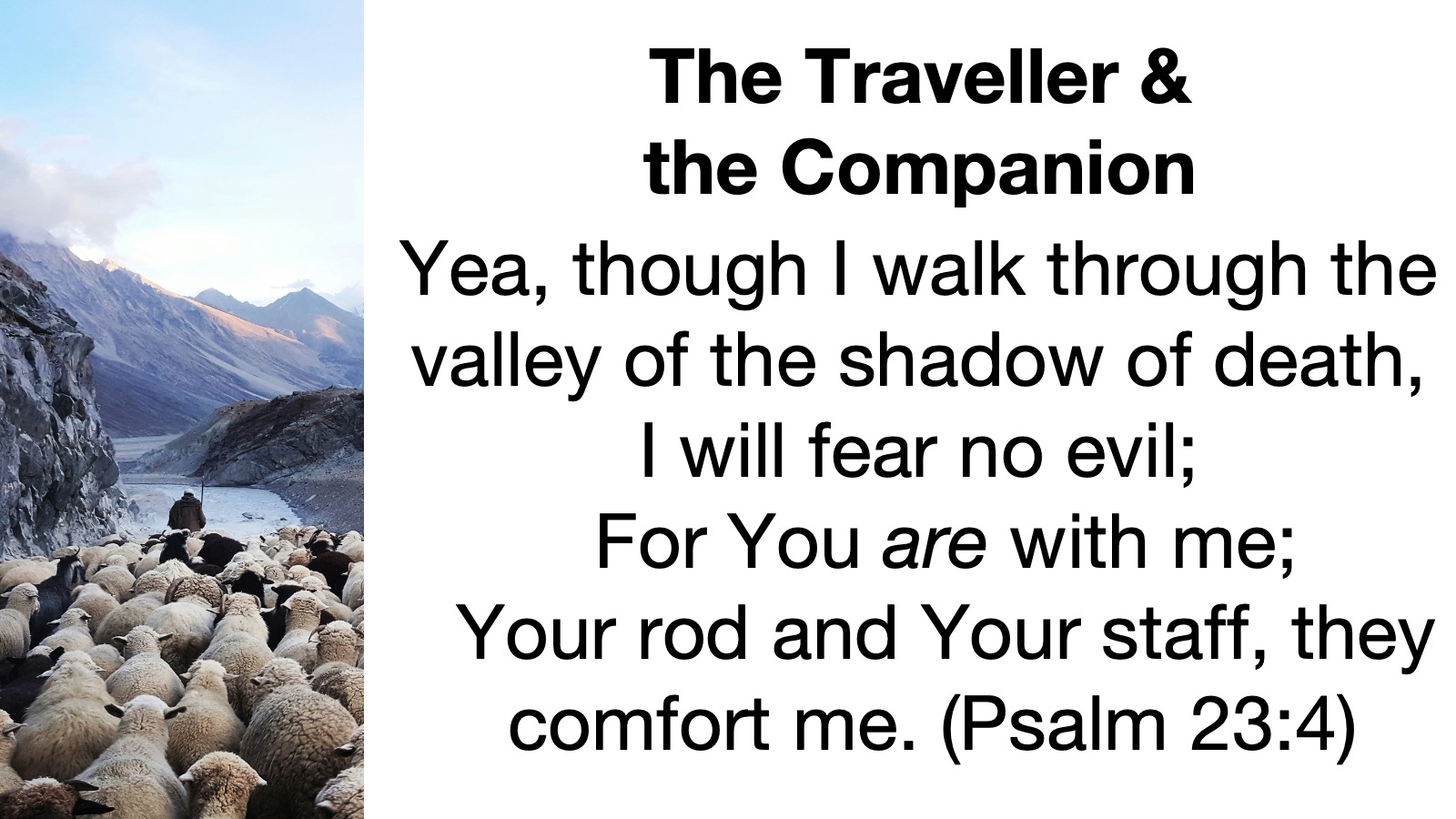
David had many dark valleys in his life. There was his adultery with Bathsheba, the guilt of realizing what he had done, the death of his infant son, and everyone knew what he had done. There was the rape of his daughter Tamar by one of his sons, Amnon, who was then murdered by another of his sons, Absalom. Then there was the revolt led by Absalom, which came very close to being successful, and which ended with the death of Absalom, whom David loved. In all these dark valleys, the Lord was always with David. That same Companion, the Lord, is with us through all the dark valleys we might be going through right now, have gone through in the past, or will go through in the future.
In verse four, we also read of some special characteristics of the Lord’s abiding presence with us. The rod represents authority and shows that he has all the power needed to keep us safe. The staff represents comfort, something that the Lord can give like no one else can. with a quality and quantity that no one else can. So, we can know that our Shepherd is always with us, guiding, supporting and protecting us through all of life’s challenges.
The Guest and the Host (verse 5-6)
The third relational metaphor is the guest and the Host. In verses 5-6, we read, “You prepare a table before me in the presence of my enemies; You anoint my head with oil; my cup runneth over. Surely goodness and mercy shall follow me all the days of my life, and I will dwell in the house of the Lord forever.”

In the Middle East, both in ancient times and still today, there is an obligation to provide hospitality when someone comes to your door. This was perhaps even more important in ancient times because traveling was dangerous. Back then, people didn’t travel for pleasure; they only traveled out of necessity. There were robbers that could attack you, as in Jesus’ story of the Good Samaritan, and there were also wild animals along the way. The concept of hospitality arose as a way to help people. If someone was traveling and needed to travel, they could call on you and expect you to take care of them.

This cultural imperative to provide hospitality was even more important for God’s people because God’s generous hospitality to them called for a response of generous hospitality from them. In Leviticus 19, we read, “When a foreigner resides among you in your land, do not mistreat them. The foreigner residing among you must be treated as your native-born. Love them as yourself, for you were foreigners in Egypt. I am the Lord your God.” (Leviticus 19:33-34)
When David and his household had to flee the palace in Jerusalem because Absalom was drawing near, they fled to the west side of the Jordan River and came to a village called Mahanaim. There, three people not related to David in any way, saw the need and provided hospitality to David and his people, bringing them food, bedding, pots and utensils.

In the same way, you and I need hospitality from God as we journey through life. God has not only brought us into life in this world, he has also prepared a home for us in the world to come. We can rely on God’s generosity and hospitality for us.
And God does more than just provide us with food and drink; the picture painted for us in Psalm 23 shows us that he throws a banquet to honor us. He anoints our head in the presence of our enemies. They see all that God is doing for us and that cannot do anything to stop it. God brings us into His life with Him and celebrates us.
We know the chesed of God through Jesus
But then there’s a word that is extremely important. In the phrase, “Surely goodness and mercy shall follow me all the days of my life,” the Hebrew word behind “mercy” is “chesed.” Chesed is a very rich, meaningful word that conveys a sense of mercy, generosity, and sacrificial compassion. It’s sometimes translated as faithful loving kindness. It’s God’s chesed that motivates us to choose the Lord as our shepherd over all the other options in this world.

And David is telling us that God’s chesed leads us to two very important realizations. First, God’s goodness and his chesed, his faithful loving kindness are always with us, no matter what our circumstances may be. Second, we will live with God in his household forever. These two truths are never at risk, regardless of what is going on in our life.
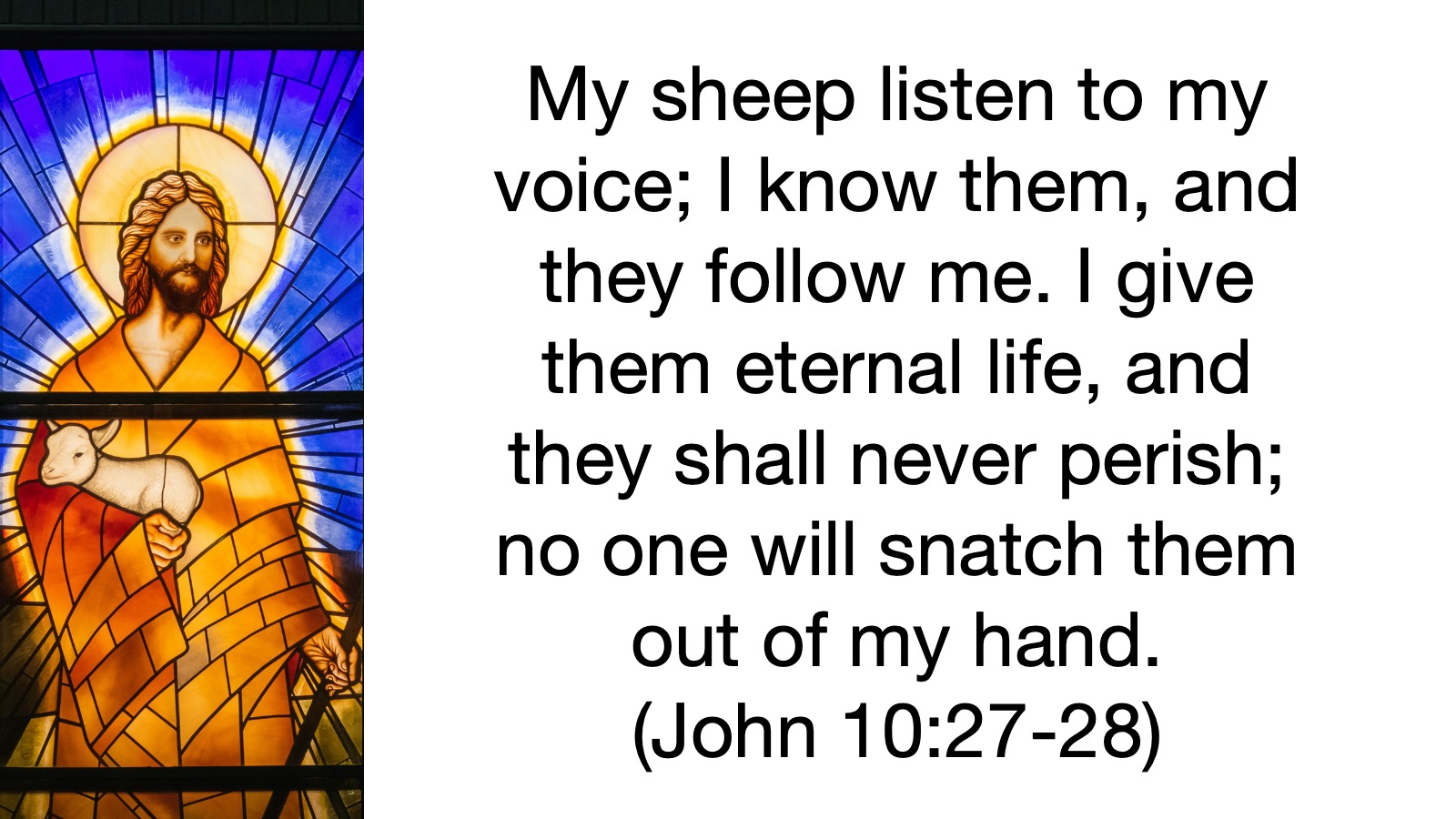
David knew the Lord as his Shepherd and experienced the Lord’s chesed, his loving-kindness. But we know even more about the Lord and his chesed. We know God’s chesed, through Jesus, our Good Shepherd. We see God’s chesed through what Jesus has done, how He lovingly and willingly went to the cross and offered Himself in our place to save us, and then rose from the dead on the third day that followed so we can be assured that he is always with us. But we also experience God’s chesed through Jesus’ abundant shepherding, his comforting companionship, and his generous hospitality.

Jesus uses the relational metaphor of shepherd and sheep himself in John 10:27-28, where he says, “My sheep listen to My voice; I know them, and they follow Me. I give them eternal life, and they shall never perish; no one will snatch them out of My hand.”
So the challenge I wish to set before you today is this: Trust in God’s chesed, his faithful loving kindness, for you and know that, because of Jesus, your Good Shepherd, you will live in God’s house as part of his family forever. Amen.
[i] “Brain Games Conformity Waiting Room,” Integration Team (Internet; available at: https://www.youtube.com/watch?v=X6kWygqR0L8; accessed May 6, 2024).

 Farewell to Shadowlands