

You might not think of a race car driver as an athlete, but they are. In fact, F1 drivers need to be incredibly fit to perform at a very high level under the punishing conditions they must endure. Their bodies are subjected to incredible G-forces as they navigate through the many twists and turns of an F1 racetrack. They must maintain a very high degree of focus, awareness, energy, and strength throughout the entire span of a two-hour race during which temperatures in the car can reach 60 Celsius. They need to be in peak physical condition to do what they do.

So they train. For example, prior to the start of testing, RB driver Daniel Ricciardo will train in the gym for two sessions a day, six days a week for seven to eight weeks. The focus of the morning session is on endurance and includes swimming, cycling, or running. The afternoon session is resistance training with squats, dead lifts, and kettlebell lunges. The purpose of the training is to prepare themselves so they can perform well on the track when the season starts.
But what about for us? Is there a way to train in our life of following Jesus, is such training beneficial and, if so, how do we do it? That’s what we are thinking about today, and to help as we do that, we are going to be looking at a passage from the Bible: 1 Timothy 4:1-10. If you have a Bible or a Bible app nearby, I invite you to turn there now.
The Challenges Timothy Faced in Ephesus
As you do that, here is a bit of background to help you better understand this passage. It is part of a letter that Paul wrote to his young friend and fellow pastor, Timothy. Paul had mentored Timothy in the Christian faith, trained him as a pastor, and appointed him to be the shepherd of the young Christian church in Ephesus. Paul is likely under house arrest in Rome when he wrote this letter, his freedom is restricted, but he is comfortable, and he has friends around him to attend to his needs. So he is writing with hope, encouragement and love for Timothy and the people he serves in Ephesus, people that Paul knew well because he spent three years there preaching the Gospel as the Ephesian church was being brought to life by the Holy Spirit.

But there is also concern in Paul’s words because Timothy is facing challenges as he leads the church in Ephesus. The biggest problem that Timothy was facing in Ephesus was an early form of a deceptive teaching that later became known as Gnosticism. This teaching falsely taught that the physical world was all evil and the spiritual world was all good. Human beings are both physical and spiritual beings, so the human task according to this false teaching, is to harness the body through rigorous abstinence and discipline, so that the divine spark within each of us could ignite and we could reach our full potential. If this is sounding familiar, it is because forms of Gnosticism are still with us today in various popular New Age teachings. The two key places where Gnosticism and all its variants go off-track is 1. They deny the inherent goodness of God’s creation, and 2. They deny our need for a Savior. So when Paul warns Timothy, The Spirit clearly says that in later times some will abandon the faith and follow deceiving spirits and things taught by demons. (1 Timothy 4:1) it’s a warning that we would do well to heed today.
Why Training is Important for Christians
And Timothy’s challenges reveal why training is very important for anyone who follows Jesus. We don’t train to earn our salvation; we train in response to the salvation and new life that Jesus has already given to us. Our training is a response to Jesus and his love. The new life Jesus gives to us is a rich, full abundant life because it is life with Jesus, but it is not a life filled with pink fluffy unicorns dancing on rainbows. We are broken people who still have our old sinful nature within us. And that means that we can easily go astray and wander from God. The risk of that wandering increases because we live in a broken world filled with false ideas, beliefs, and teachings which tap into our old nature and lure us away from God. Training in godliness helps us to discern truth from lies and create habits of holiness that help us stay on track as we follow Jesus into forever. As we grow in godliness, then we can help others train in godliness. This helps them to become more like Jesus, and then they can help others, and so on, and so on. And that’s how the Kingdom of God grows. That’s why Paul writes, Have nothing to do with godless myths and old wives’ tales; rather, train yourself to be godly. 8 For physical training is of some value, but godliness has value for all things, holding promise for both the present life and the life to come. (1 Timothy 4:7-8)
Training for Godliness
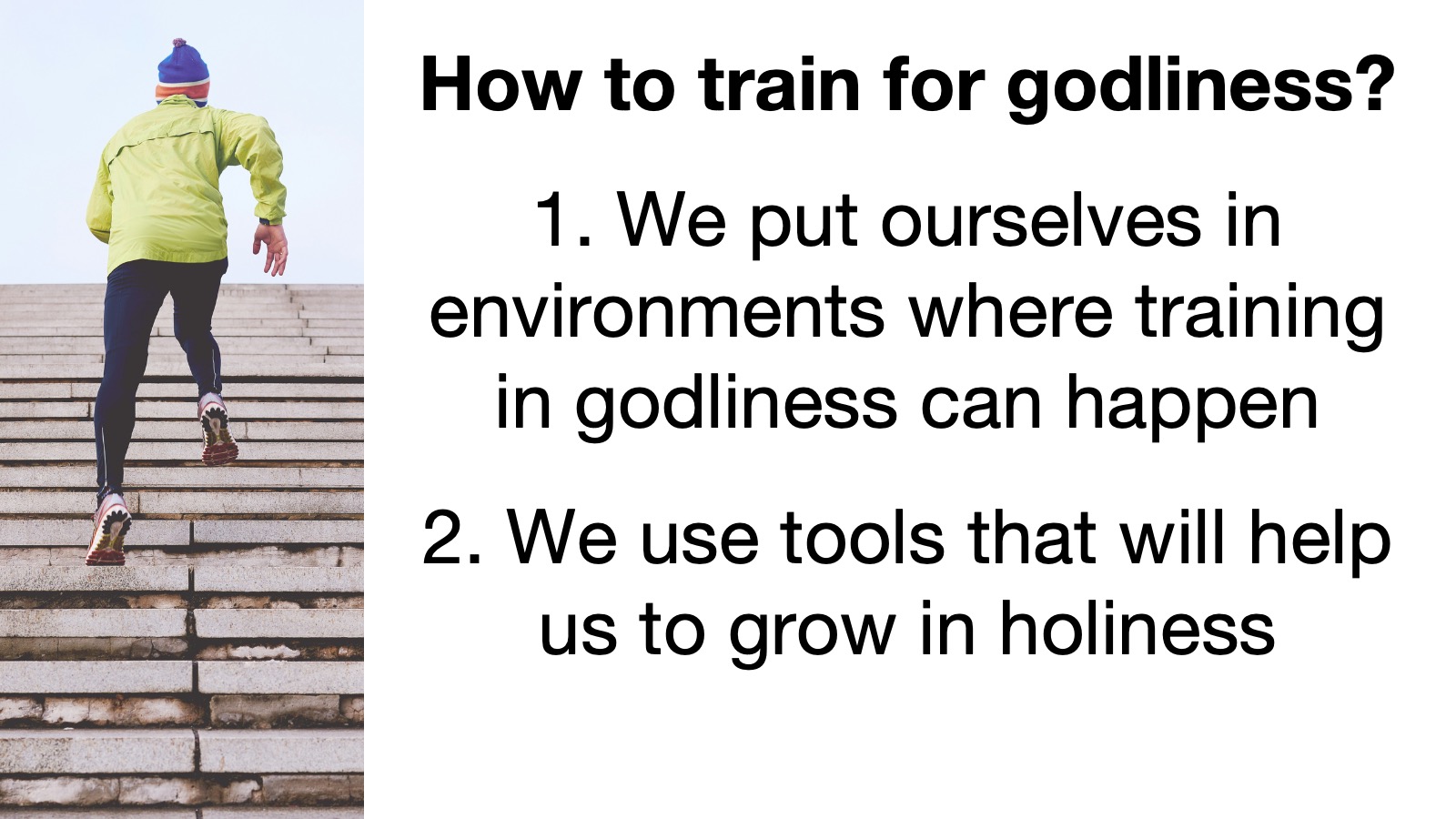
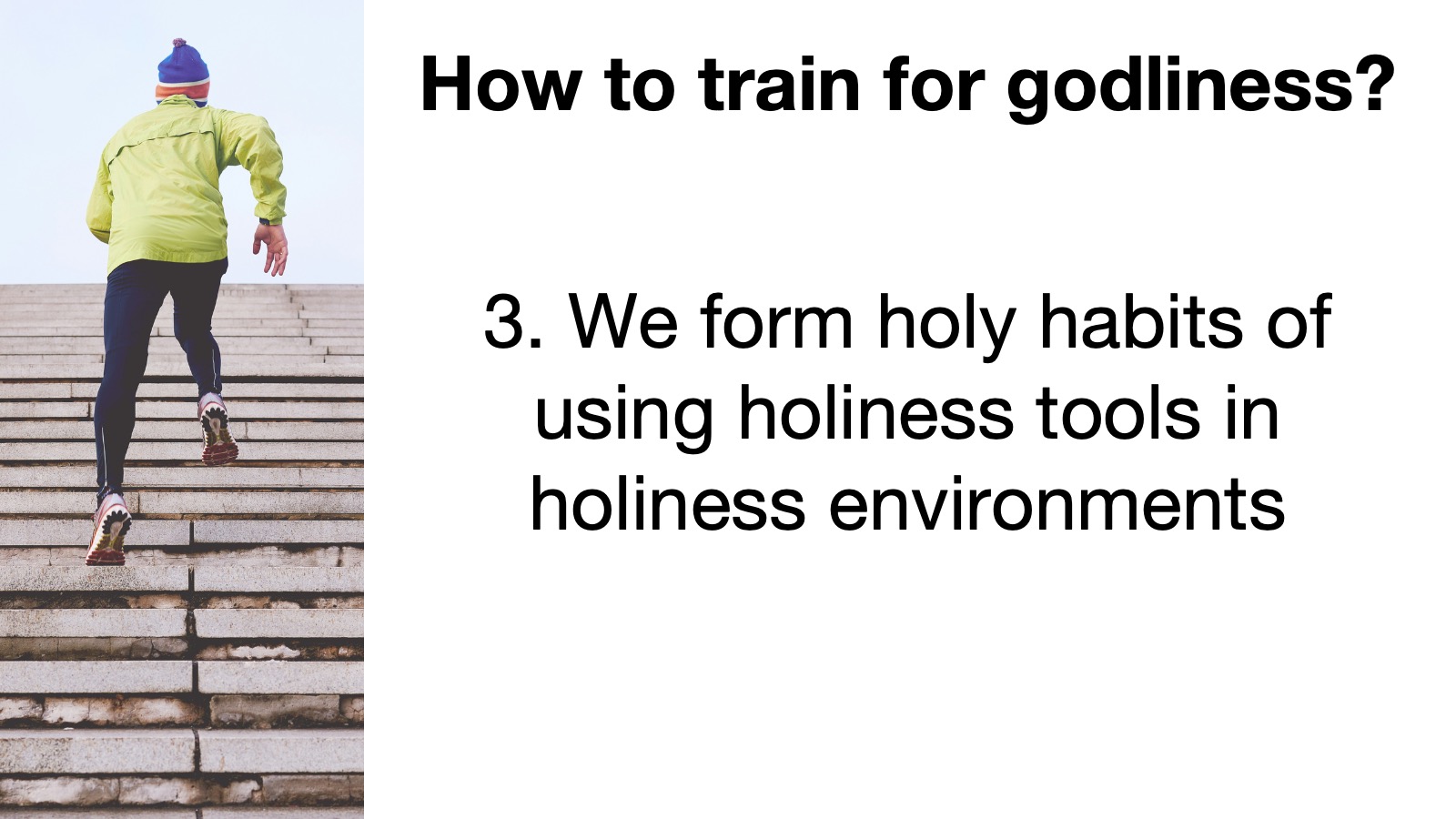
But how do we train for godliness? First, like an F1 driver who goes to the gym, we put ourselves in environments where training in godliness can happen. Examples of such environments are small groups, worship services, coffee with a Christian friend, or quiet time alone with God. Second, like any athlete in training, we use tools that will help us to grow in holiness. Examples of such tools are prayer, which is talking to God, God’s Word, which is the Bible, and the Sacraments, or sacred acts, of Holy Communion and Holy Baptism. Third, we form holy habits of using holiness tools in holiness environments. Just like going to the gym and working out, to get results, the key is consistency. We make these patterns part of our life so that we do them without even thinking.
To give you a better idea of what habits of holiness look like, we can turn to Jesus, for he is not only our Savior, he is also the only example of a perfect human being. Therefore, when we, in response to his love and grace, imitate Jesus and the holy habits he followed, we can be sure that we are on the right path. (Jesus’ 7 Habits of Holiness) So here are seven habits of holiness that Jesus used.
The first one is prayer. In Luke 5:16 we read, But Jesus often withdrew to lonely places and prayed. (Luke 5:16) It was only by being in constant communication with his Father that Jesus could do and say all that his Father was asking him to do. Second, is fasting. Jesus began his ministry with 40 days of fasting in the wilderness, and when he completed that fast, Jesus returned to Galilee in the power of the Spirit, (Luke 4:14). Fasting is saying no to the things of this world—such as food, alcohol, or electronics—that tend to capture our heart and mind so that we become less dependent on them and more dependent on God. Third is Public Worship (or Corporate Worship). In Luke 4:16, we read, “… on the Sabbath day he went into the synagogue, as was his custom.” (Luke 4:16) We can worship God anywhere anytime on our own, but public worship services are where God serves us with his Word, his forgiveness, and his sacraments in community with our sisters and brothers in Christ. Together, we are built up and encouraged in faith, hope and love.
Fourth is Bible Reading. While in the desert, when tempted by the devil to turn stones into bread, Jesus answered, “It is written: ‘Man shall not live on bread alone, but on every word that comes from the mouth of God.’” (Matthew 4:4) We humans need more than just physical nourishment for our bodies, we also need spiritual nourishment for our souls, and our souls are nourished by feasting on God’s Word, the Bible. Fifth is Solitude. Jesus not only went to quiet places to pray, he also encouraged his followers to do the same. In Mark 6:31 we read, Then, because so many people were coming and going that they did not even have a chance to eat, he said to them, “Come with me by yourselves to a quiet place and get some rest.” (Mark 6:31) Getting away from the busy-ness of the world gives us an opportunity to reset and renew with God before going back into the fray.
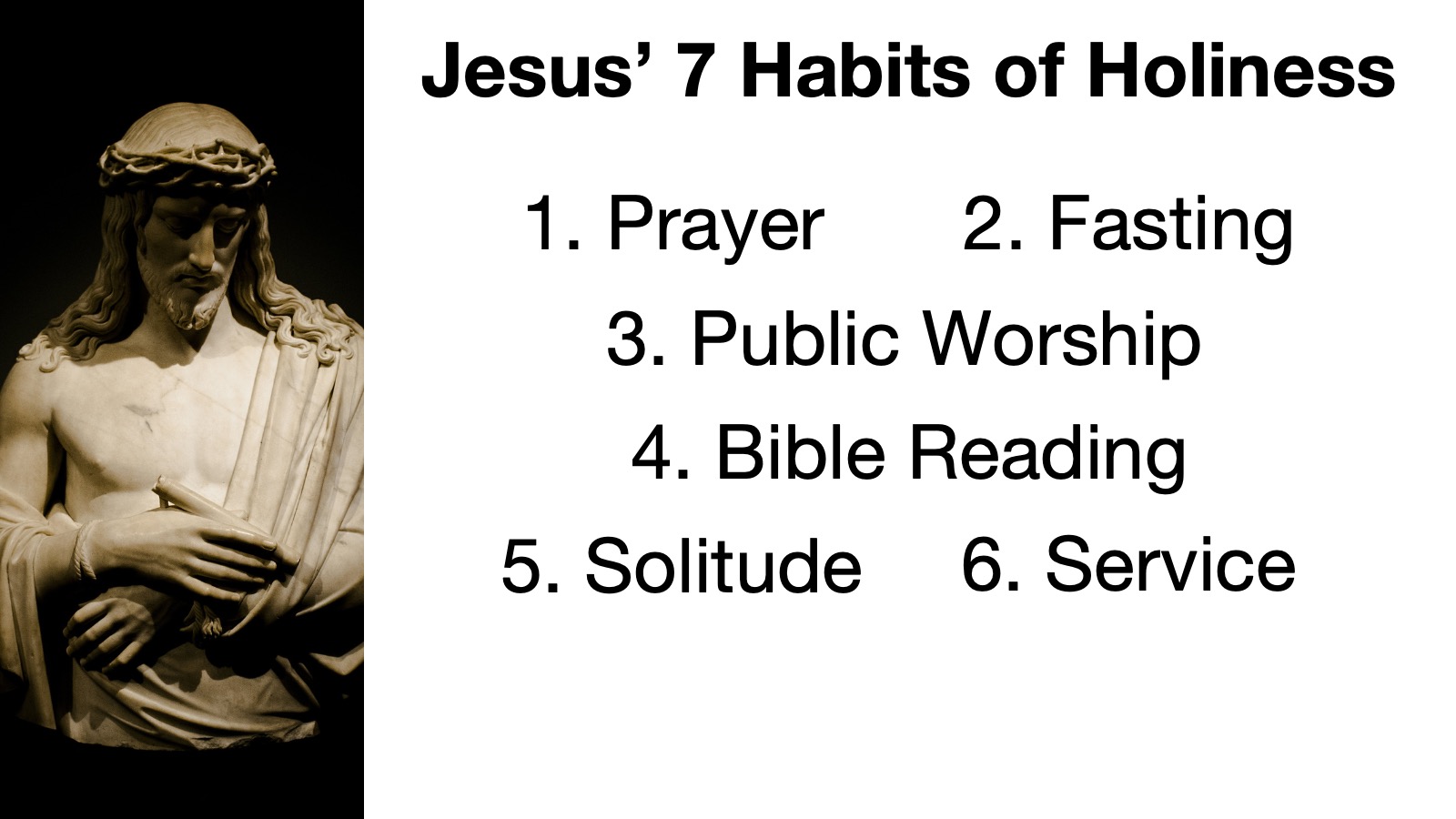
Sixth is Service. When his followers began arguing over who was the greatest, Jesus revealed the significance of being a servant with these words, “For even the Son of Man did not come to be served, but to serve, and to give his life as a ransom for many.” (Mark 10:45) Trusting that Jesus is carrying us and preserving and protecting our life, we are freed to lovingly serve others with his love. Seventh is Meditation. I am referring to meditation in the biblical sense, which is thinking about God and his Word. As we read in Psalm 119: 97, which Jesus would have known, “Oh, how I love your law! I meditate on it all day long.” (Psalm 119:97)The purpose of biblical meditation is to fill your minds with the Word and thoughts of God so that you start to think like Jesus does. As Paul writes in his first letter to the church in Corinth, for, “Who has known the mind of the Lord so as to instruct him?” But we have the mind of Christ. (1 Cor. 2:16)[i]
Training for Godliness = Love
Training for godliness may sound overwhelming, but it can be summed up in one word: love. As St. Clare of Assisi put it:

We become what we love
and who we love shapes what we become.
If we love things, we become a thing.
If we love nothing, we become nothing.
Imitation is not a literal mimicking of Christ,
rather it means becoming the image of the beloved,
an image disclosed through transformation.
This means… we are to become vessels
of God´s compassionate love for others.
~ St. Clare of Assisi[ii]
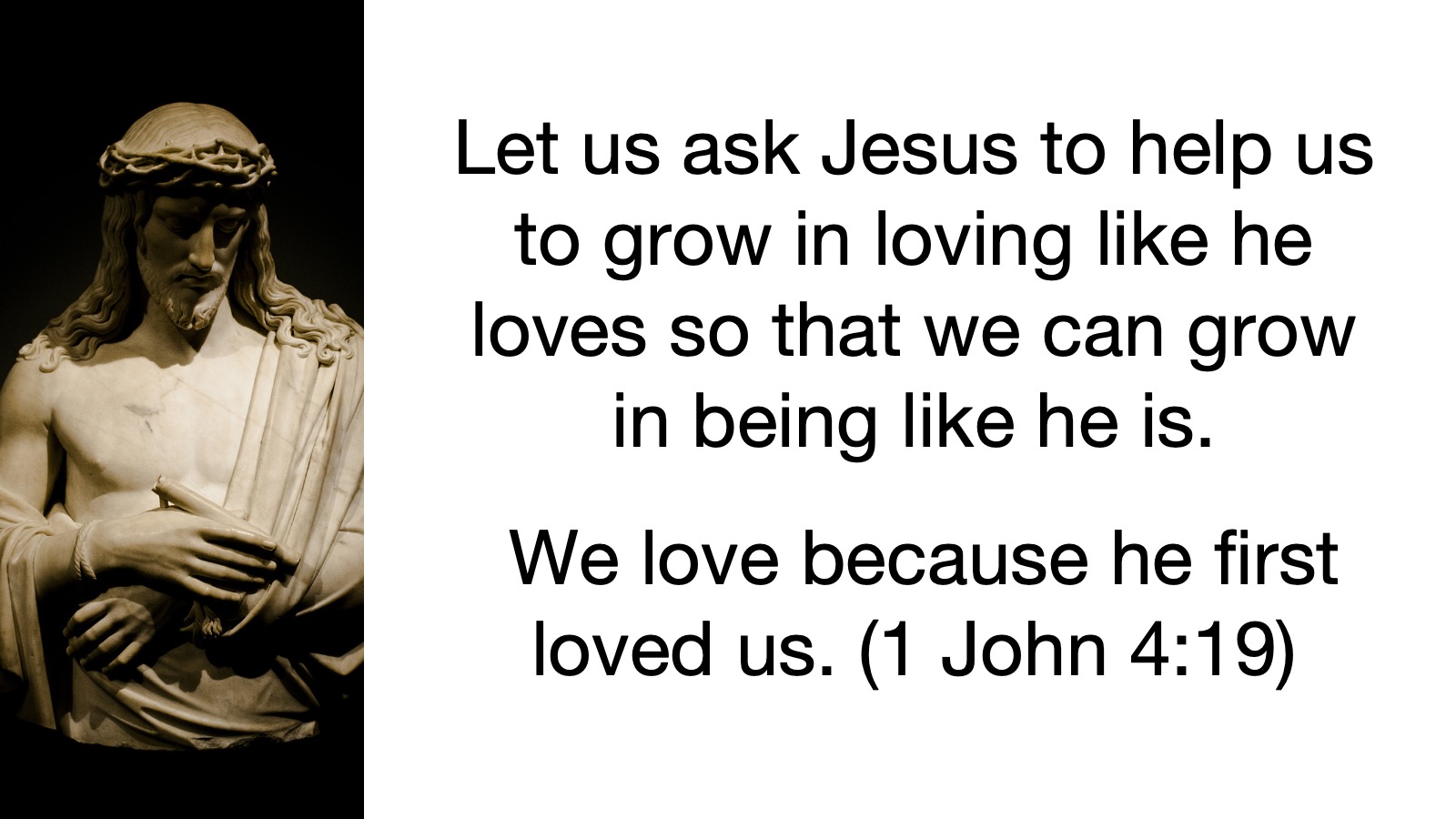
So let us ask Jesus to help us to grow in loving like he loves so that we can grow in being like he is. For as John put it, “We love because he first loved us.” (1 John 4:19). Amen.
[i] “Seven Spiritual Practices of Jesus,” Influence Magazine (Internet; available at: https://influencemagazine.com/practice/seven-spiritual-practices-of-jesus; accessed September 11, 2024).
[ii] Loretta Ross-Gotta, “Burned Out on Religion?” The Praying Life: Hearsay and Rumors about the Beloved (Internet; available at: https://theprayinglife.com/tag/st-clare-of-assisi/; accessed September 11, 2024).
(This message was shared at Walnut Grove Lutheran Church in Langley BC and St. Luke Lutheran Church in Surrey BC on September 22, 2024. For more information, please go to wglc.org or sllc.ca.)

 Farewell to Shadowlands