

Now, when I was a young kid—I grew up on a farm, for those of you who don’t know—and when you’re on a farm, you start doing things at a young age. One of the first things you learn is how to drive farm equipment, and one of those machines is a tractor.
One of the main things we used tractors for was cultivating a field. When I first started driving a tractor, my furrows looked like a worm trail going down the road. My dad quickly noticed this and gave me some advice to help. He said, “Pick something on the horizon and drive towards it.”
Now, you may not drive a tractor as part of your everyday life, but this also applies to driving a vehicle. I had the same problem when I learned how to drive a car—I was looking just ahead of the hood instead of down the road, and the same kind of thing happened. As you probably know, when you’re driving, you have to look further ahead.
The problem is, at least for me, that sometimes things happen that distract us. For example, in my vehicle right now, there’s a warning light that tells me I have low tire pressure. It tends to come on when I’m driving on a wet highway—I don’t know why—but it flashes, and it’s very distracting. I need to focus on what I’m doing because, if I don’t, I could have an accident.
This applies to the rest of life as well: your focus directs your future, and distractions can be deadly.
Take Eastern Airlines Flight 401, for example. On December 29, 1972, it crashed into the Everglades near Miami. The entire cockpit crew was distracted by a single burnt-out light on the dashboard, and because of that distraction, many people lost their lives.
For us, the same kind of thing can happen. We can become so distracted by turmoil in the present that we lose sight of what God has for us in the future. We can get so worried and upset about what’s happening around us that we fail to see the hope God has prepared.
But God’s passionate desire for us is that we live with courage, hope, and confident faith—both now and always.
So the question we’re thinking about today is this:
How do we live with courage, hope, and confident faith in the midst of turmoil and challenge?
To help us answer that, we’re eventually going to look at Revelation 7:9–17.
But first, we’re going to start in Revelation 1.
So if you have a Bible or a Bible app, I invite you to open it now to Revelation 1.
And just a bit of review to help us as we continue our look through the book of Revelation.
First of all, let’s talk about the structure of Revelation. It’s set up with:
• An introduction (chapters 1–3)
• A prophetic message (chapters 4–22, or at least the first part of chapter 22)
• An epilogue (the last part of chapter 22)
There is also a purpose that Jesus gives us right at the beginning. The purpose of Revelation is this:
“The revelation from Jesus Christ, which God gave him” (Revelation 1:1).
So, God gave this revelation to Jesus to show his servants what must soon take place.
The whole idea of the book of Revelation—the whole purpose—is that God wants you to know, in a general sense, what is going to happen in the future so that you can have resilient faith as that future unfolds.
Now, the prophetic message in the central part of the book is not meant to help us identify specific future events. Instead, it is meant to give us a general sense of how things will unfold for us and for the world.
Approaching the Book of Revelation
Revelation is a complex book. It’s hard for us to understand because it uses a lot of symbolic language. The people of the first century A.D. would have understood these symbols more easily than we do today.
There are two main approaches to reading and understanding the book of Revelation:
- The Linear Approach
• This is the most common approach today.
• It involves reading Revelation like a regular book, understanding the events as unfolding in chronological order—a straight line from beginning to end.
- The Cyclical Approach
• This approach sees the prophetic messages—particularly the visions—as repeating cycles.
• Each cycle describes the same period of time, from Jesus’ ascension to His Second Coming and the end of the world.
• Each vision adds a little more information while covering the same general time frame.
Now, I want to say something, and I hope you hear this with love in my heart.
The linear approach is the most popular today. You may have already decided that’s the approach you’re going to use, and you may hold firmly to it, believing it is the only right way to read Revelation.
However, I am going to teach you the cyclical approach.
And I want you to know that I’m not teaching it just because I agree with it—though I do, because I believe it makes sense. I’m teaching it because, when I was ordained, I made a promise to teach according to the doctrine of our church.
The cyclical approach is the one that fits with what our church teaches about the end times.
Now, there is debate about how these cycles should be understood, even within Lutheran theology. That is a debatable point.
But if you hold firmly to the linear approach, just know that while you are entitled to your opinion, you and I will not be on the same page—and there is a reason for that.
Now we begin. There’s an introduction, and as part of that, we have the seven letters to the seven churches. We talked about this last time.
Each of these seven letters describes a different kind of church, and we could say that every Christian church might find itself reflected in one of them. In fact, every Christian could perhaps find themselves described in one or more of these letters.
The main takeaway from this is that repentance prepares us for receiving prophecy.
This whole section—with the seven letters—is meant to encourage the people in those churches to repent. And then, after repentance, the prophecy comes. So while repentance is primarily about restoring our relationship with God, it also has another important role: it prepares us to hear what God is saying.
We cannot hear God if we are not turned toward Him.
Then we move into chapters 4 and 5.
In chapter 4, we get a picture of the Heavenly Court of God. It’s described in ways that seem fantastical to us, but it actually aligns with other descriptions of God’s heavenly throne room found elsewhere in the Bible—particularly in the Old Testament.
Isaiah’s vision is one example, but there are others as well.
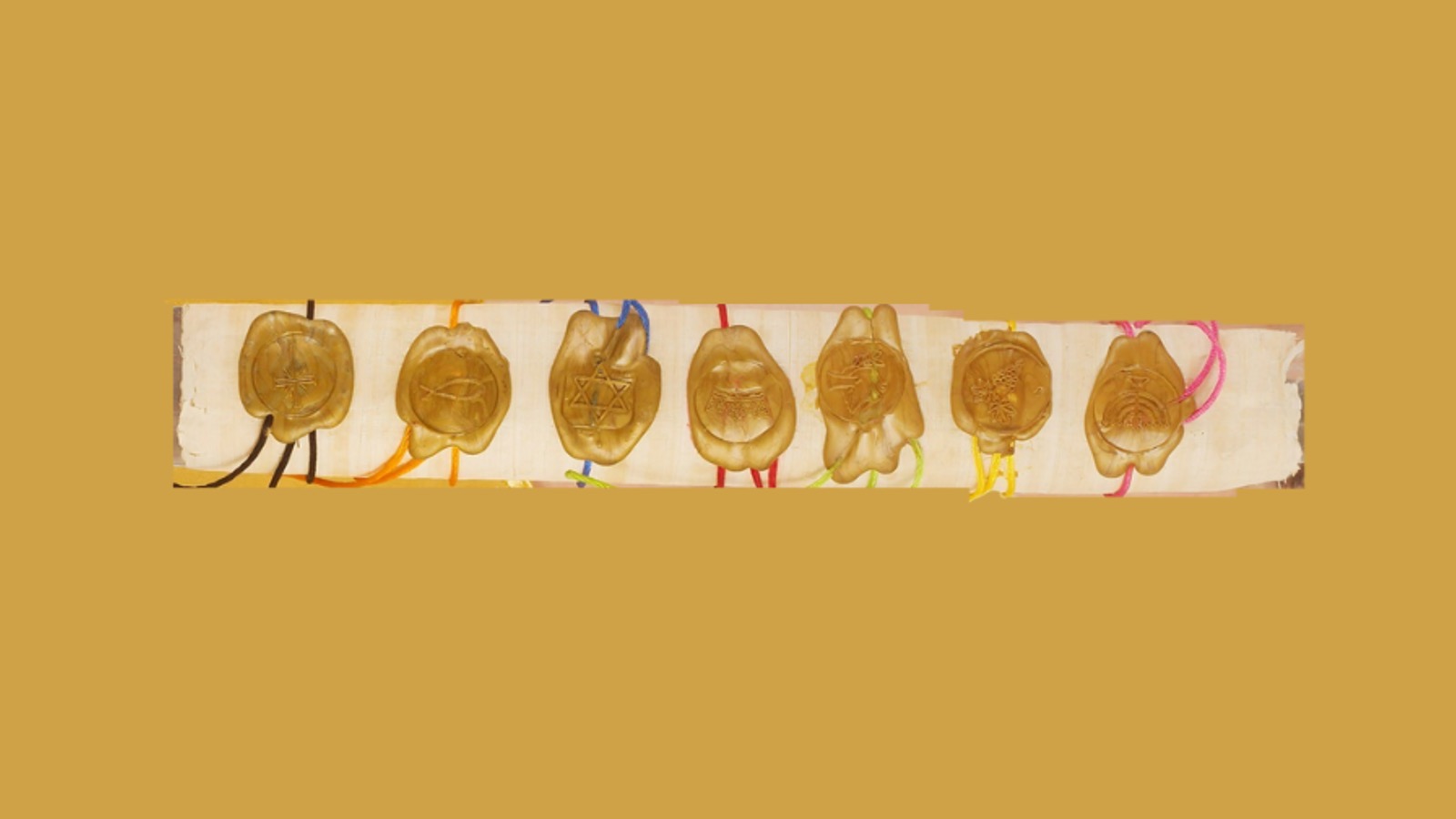
We see God the Father seated on the throne, and in His hand, He holds a scroll. But no one is found worthy to open the scroll.
John, who is witnessing all of this, begins to weep. He tells us:
“I wept and wept because no one was found who was worthy to open the scroll or look inside.” (Revelation 5:4)
Why is John weeping? Because the scroll contains a prophetic message for God’s people. If no one can open it, God’s people will never know what He wants to tell them.
But then John tells us:
“Then one of the elders said to me, ‘Do not weep! See, the Lion of the tribe of Judah, the Root of David, has triumphed. He is able to open the scroll and its seven seals.’” (Revelation 5:5)
In the Old Testament, the lion is a reference to the Messiah. So here, we are told that the Messiah has come, He has triumphed, and He alone is worthy to open the scroll.
But then something unexpected happens.
John turns to look at the lion—but he does not see a lion. Instead, he sees a lamb, looking as though it had been slain.
That Lamb is Jesus Christ, who died for us on the cross and then rose again so that we might receive:
• Forgiveness for all our sins
• Salvation and healing
• Eternal life with Him
After 40 days on earth following His resurrection, Jesus ascended into heaven.
And now, in Revelation 4 and 5, we see Him appear in heaven once again.
We could say that this moment in Revelation is Jesus’ coronation as the King of kings and Lord of lords.
He alone is worthy to open the scroll—because of His suffering, death, and resurrection on our behalf.
Each of the seals, when broken, unveils a new scene. This is what’s called the vision of the seven seals, the first of three.
When the first seal is broken, a rider on a white horse appears. There are certain things about this rider that indicate tyranny.
The rider on the white horse seeks to enforce his will through power. Because the horse is white, it suggests that he may claim divine authority for the power he wields.
His ultimate goal is to gain power over people.
This passage in Scripture tells us, in a general sense (not referring to specific events), that throughout history, there will always be forces that seek to rule over, suppress, and harm human beings.
These forces could take many forms:
• Political powers
• Educational institutions
• Financial systems
• Geographic or national influences
• Even power struggles within homes and communities
In the last century, more people died under Joseph Stalin’s rule in the Soviet Union than under Adolf Hitler in Nazi Germany.
Then there’s Cambodia, where millions died under Pol Pot and the Khmer Rouge.
But this oppression is not limited to large-scale historical events.
Every time intimate partner violence occurs, it is another manifestation of the rider on the white horse at work in the world.
Then, the second seal is opened, and another rider appears—this one on a red horse, representing bloodshed.
As I mentioned earlier, tyranny is always followed by bloodshed.
Next, the third seal is opened, and famine follows.
Then, with the fourth seal, comes death.
This is the normal course of human history.
Any time we experience freedom and peace, those are the exceptions—not the rule.
In the northern hemisphere, we have enjoyed a long period of freedom and peace in recent years. But in other parts of the world, this has not been the case.
And as for the future? Only God knows.
Jesus is telling us: This is what you should expect—from the time of His ascension into Heaven until the time He returns.
Then, the fifth seal is opened.
What comes into view now is the persecuted, suffering Church.
We see the martyrs under the altar—those who have died for their faith.
You may not think of it this way, but all of you are included in that group.
Why?
Because every one of us is a witness to the world about our faith in Jesus Christ—not just through words, but through the way we live our lives.
And all of us will suffer for it.
But this suffering is a glorious testimony—because our lives are a song to the victorious King of Kings.
And in that song, we are also praying for our brothers and sisters in Christ who endure suffering as well.
The sixth seal is opened, and this marks the terrible end of the world.
It will be beyond anything we can imagine.
But then, very quickly, John sees the 144,000—12,000 people from each of the 12 tribes of Judah.
What I am suggesting to you is that this represents the Christian Church on earth.
As we look into Revelation 7, we see that there are angels (I believe) who are holding back the Four Horsemen of the Apocalypse until each of these people—those in the Church on earth—are sealed and strengthened by the Holy Spirit.
This protection and sealing will continue until they are ready to serve in sacrificial Christian service.
I don’t know if you’ve noticed this, but sometimes when someone is new in their faith, they experience many blessings and good things happening around them.
It’s a time of joy.
But then, as they mature in their faith, trials and tribulations begin to come.
This is a gracious act of God.
He protects us—He holds back these forces that are working against us and the world until we have been strengthened and sealed by the Holy Spirit.
So, this 144,000 is like an army—a perfect army formed by God—ready to march into battle in the name of our Lord and Savior, Jesus Christ.
Then, in the same chapter, we see a great multitude.
John describes this moment:
“After this, I looked, and there before me was a great multitude that no one could count, from every nation, tribe, people, and language, standing before the throne and before the Lamb. They were wearing white robes and were holding palm branches in their hands.”
And as we read further into the chapter, we see that they are singing praises to God, joined in worship by all the angels in heaven.
When the question arises as to who they are, one of the elders tells John:
“This is the Christian Church in heaven—people from all over the world, from every language, nation, and people group.”
The elder continues:
“These are they who have come out of the Great Tribulation. They have washed their robes and made them white in the blood of the Lamb. Therefore, they are before the throne of God and serve Him day and night in His temple, and He who sits on the throne will shelter them with His presence. Never again will they hunger; never again will they thirst. The sun will not beat down on them, nor any scorching heat. For the Lamb at the center of the throne will be their shepherd. He will lead them to springs of living water, and God will wipe away every tear from their eyes.”
So, what does this mean for us?
First, it means that in this world, we will suffer because of the impact of the Four Horsemen that are at work in the world.
But in those moments, let us remember: Jesus has already won the victory for us.
He reigns over all creation in heaven, at the right hand of His Father.
In the meantime, we have an important job to do—to be witnesses of our wonderful Savior, Jesus.
There was a time when John Wesley was walking with a man who was troubled, worried, and struggling to trust in God’s goodness.
As they walked through the countryside, Wesley pointed to a cow looking over a stone fence and asked the man, “Why do you think that cow is looking over that fence?”
The man replied, “I don’t know.”
Wesley then explained:
“The cow is looking over the fence because he can’t see through it. And in the same way, faith enables us to look beyond our worries and focus on Jesus Christ.”
So, dear friends, the challenge I leave with you today is this:
Let us focus on Jesus.
Let us focus on the good things He will bring about at the end of time.
And in the meantime, as we wait for that glorious future, let us live with courage, hope, and confident faith in Him.
Amen.

 Farewell to Shadowlands
“your focus directs your future, and distractions can be deadly.” There is so much here to learn, thank you.
LikeLike