

So, as you may know, I grew up on the prairies.
Winter on the prairies is a totally different thing than it is here in the Lower Mainland. Snow would come—usually, for sure, by November, sometimes even in October—and it would stay for months and months and months. And often, at least when I was little, we would have a three-day blizzard come in that would just shut everything down.
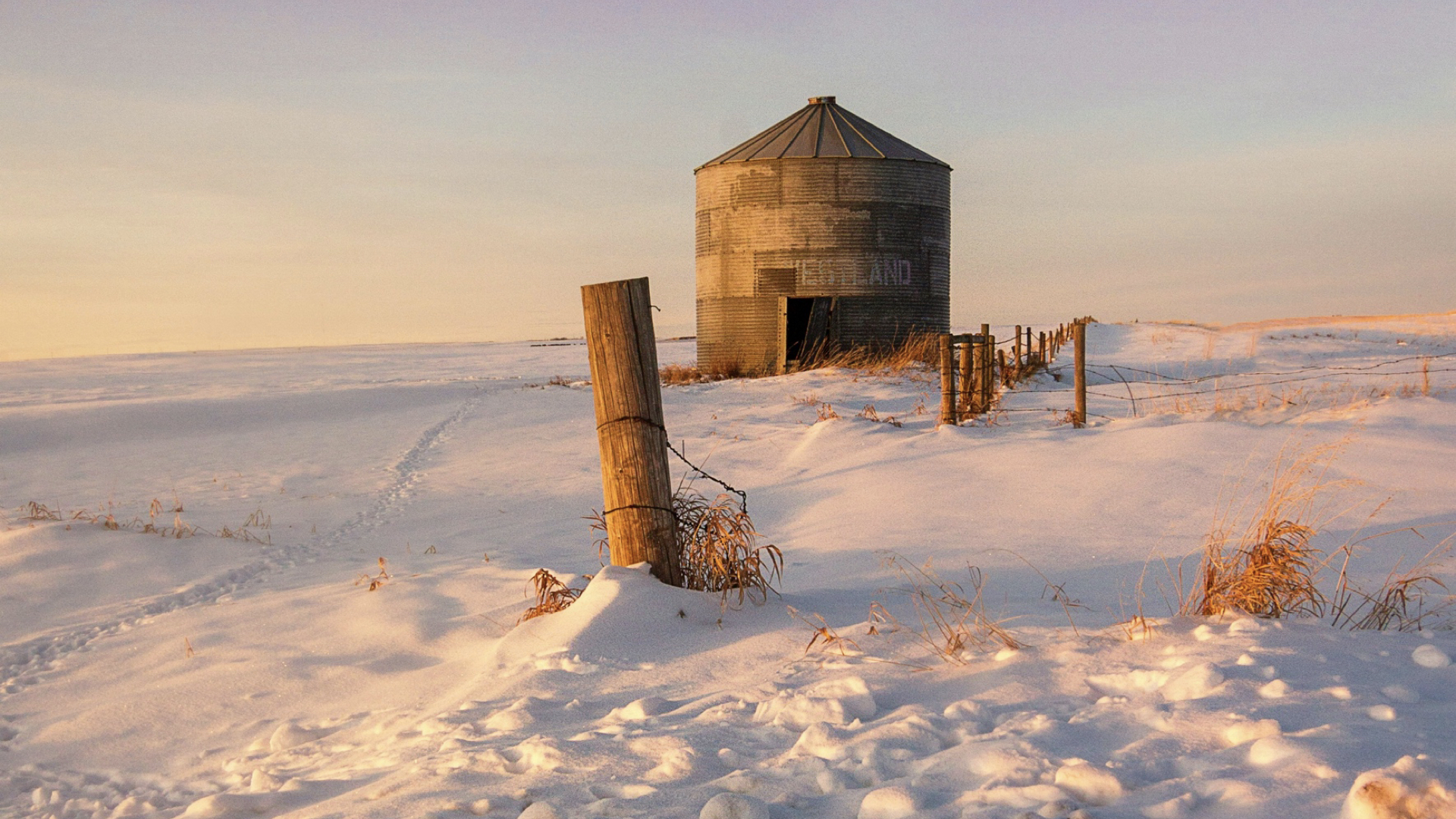
Now, sometimes when those storms happened, my parents would bundle us up in our snowsuits, and my dad would put us on a toboggan, and then he would pull us by snowmobile down to the neighbours so we could meet the school bus. I thought that was totally unnecessary, but it was fun all the same. And we would have fun in the wintertime—we’d make snowmen, we’d go tobogganing with the neighbours, we’d drive snowmobiles across the snow-covered fields. But after a while, winter started getting a little long, and we were getting tired of it, and we were hoping that spring would come soon. And so there was nothing that brought more joy to our hearts, when we were in that season, than when somebody would be wandering around in that time of year—when the weather would start to warm up and the snow would start to melt and the sloughs would start filling up with water—and they would see a crocus.
Now, crocuses are perennial plants, and throughout the winter they remain below ground, but in the spring they burst forth from a woody taproot, and they’re the first sign of spring. And so sometimes what we would do is gather up some of these crocus blossoms and put them in a shallow bowl of water on the kitchen table to remind us that spring was coming soon.
Now, there can be seasons in our life that can feel like a long, cold winter.

We are in a time when the pace of change can seem overwhelming, and with the introduction of AI a few years ago, that pace is only speeding up. Or you may be in one of those seasons of life transition, and you’re finding it difficult to change from one season of life to the next. Or maybe your winter is a spiritual one, where the once-warm joy and closeness you had in your heart toward God has cooled and dimmed, and it feels like winter has set in, and you long for a closer relationship with your Lord.
And so in those times, in those seasons, the question that can come to our mind sometimes is: when the winter in our soul feels endless, where can we find hope that will sustain us until spring comes? And to help us as we think about this question, we’re going to continue our series called Streams in the Desert, and today we’re going to look at Isaiah 35, verses 1 to 10.
In the Turmoil of Life, the Real Question Is: Who Will We Trust?
Now, you might remember from previous sermons in this series that during the time of Isaiah, there was a lot of turmoil in the lives of God’s people—both in their hearts and in the world around them. You see, what had happened is many of God’s people had turned away from God and given their deepest love to created things instead of to the Creator who made them all.
And so God allowed his people to experience the consequences of their choices—not to crush them, but to win them back, to get them to turn around and come back to him.
And some of those consequences were things like this large, warmongering superpower called Assyria that was on Judah’s doorstep and was threatening destruction. And the neighbouring nations all around Judah worshipped pagan gods, and some of them seemed to be doing quite well.
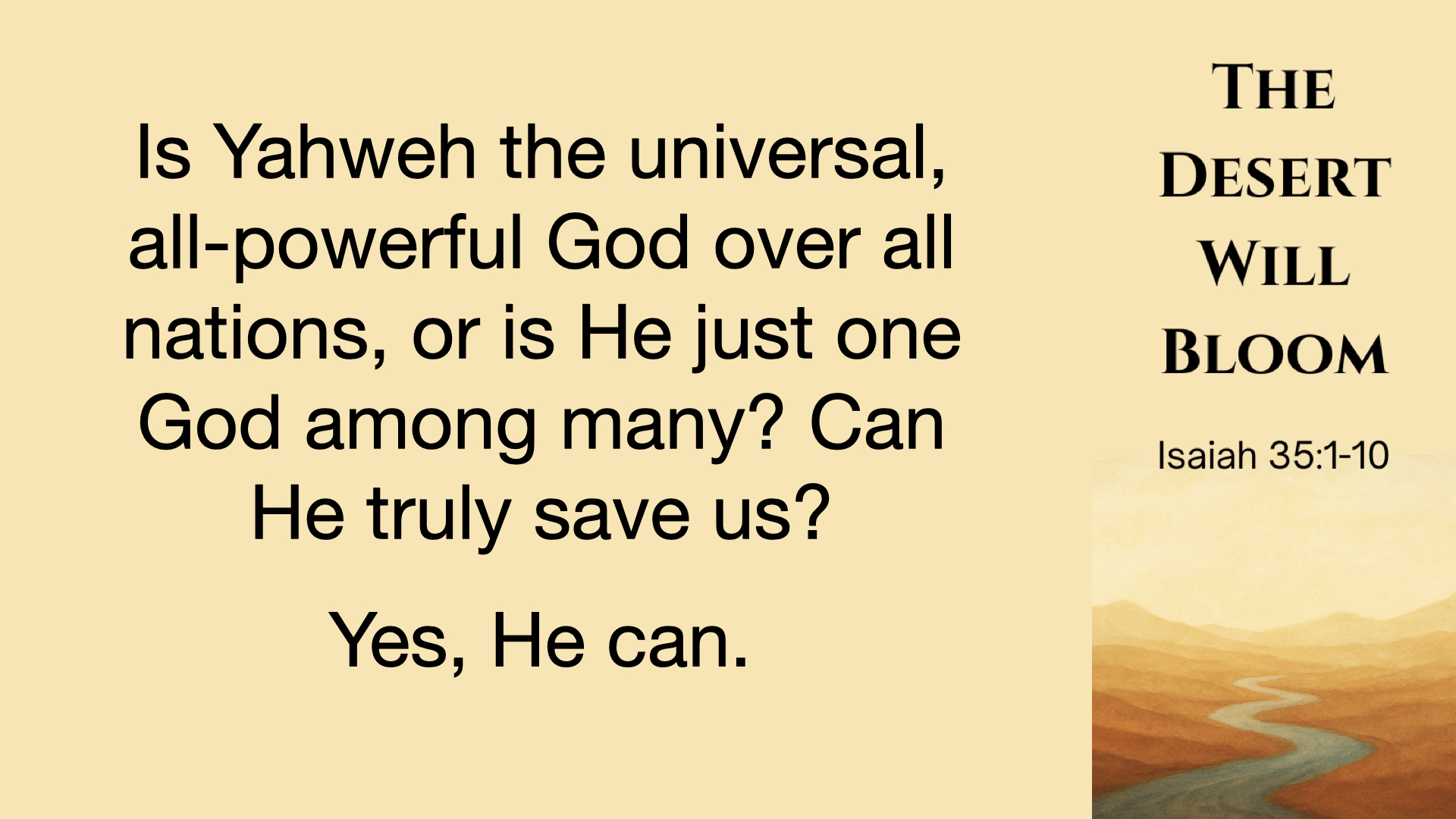
So the question that was at the heart of the matter for all of God’s people in Judah back then was this: Is Yahweh—the God of Abraham, Isaac, and Jacob—the universal, all-powerful God over all the nations, or is he just one god among many? Can he truly save us, or is he going to get gobbled up by the god of some neighbouring pagan nation?
And Isaiah answers this question in chapters 13 to 35 with a resounding yes, he can. Yes, Yahweh can save us.
And the way Isaiah does this is by showing that God is sovereign over all of the nations. They will be called to account by God, and they will face judgment for their rejection of him. And Isaiah also tells God’s people that God is the main actor and the most powerful force in all of human history. He’s the one who is directing events as they unfold. God is also wiser, and so he’s worthy of our trust.
And then in chapters 34 and 35, Isaiah paints a vivid contrast.
Chapter 34 describes a productive land that becomes a desert, while in chapter 35 a desert is transformed into a beautiful garden. And Isaiah is trying to show God’s people in his time—and us today—that the issue here is very clear.
You see, Isaiah is telling us that arrogant, self-important human beings will never be able to stand before God based on their own merits. Regardless of how rich and powerful they may be, the judgment of the nations described in chapter 34 will fall upon them, and their once-productive lives will become a barren wasteland.
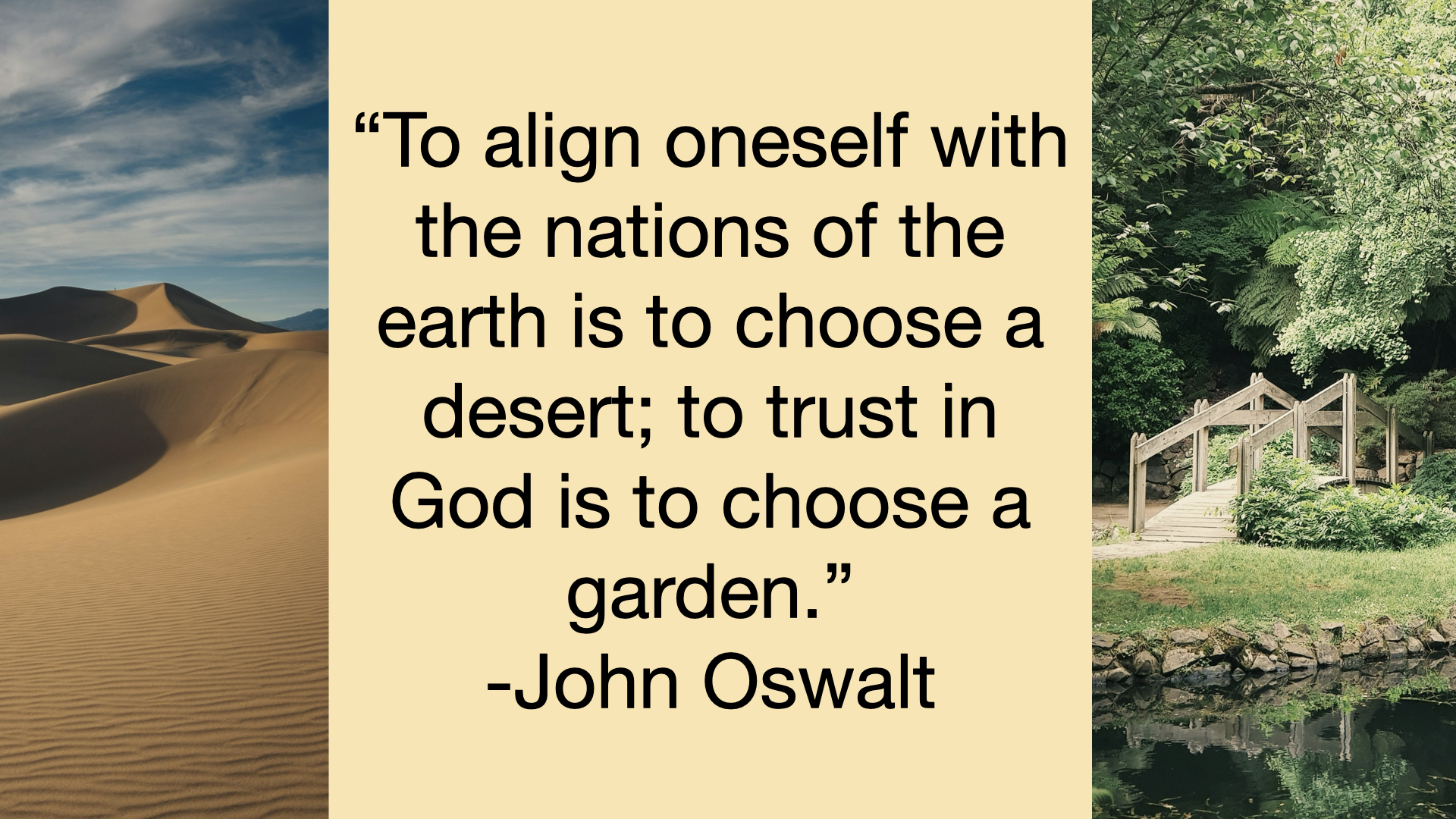
On the other hand, those who reject the enticements and temptations of the world and put themselves in the Lord’s hands and wait for him to save them—even though that may be happening in a time when they are in the middle of a desert—they will find themselves on a highway that leads to a glorious garden in which all things are healed, restored, and made new. As John Oswalt wrote in his Isaiah commentary: “To align oneself with the nations of the world is to choose a desert; to trust in God is to choose a garden.” [i]
Now, with this insight, the turmoil that swirls around us in the world and within us in our interior world becomes much more clear. For we are constantly being bombarded with rapturous delights on the one hand and soul-crushing pressures on the other. And yet, through it all, the question at the centre of our soul is this: in whom will I place my trust? Trust the world, and there will be no end to the winter that is coming for your soul. Trust in God—even in the depths of a bone-chilling deep freeze—and an eternal spring awaits you at the end of time.
God Himself Will Come and Make the Desert Bloom
And Isaiah begins his description of God’s eternal spring in this way: “The desert and the parched land will be glad; the wilderness will rejoice and blossom like the crocus. It will burst into bloom; it will rejoice greatly and shout for joy.” (Isaiah 35:1–2)
You see, God is going to come into the desert of our cold, sterile world and make it burst forth with glorious, joyful life. Isaiah describes that new world as being like Lebanon and Carmel, with their tall trees and lush vegetation. For a kid from the prairies, we could think of it as being like the Lower Mainland, with the fertile soil of the Fraser River Delta and the tall trees that cover the coastal mountains.
God’s promise to restore us and all creation in the future is the hope that will sustain us in the middle of our present deep, dark winter. Isaiah writes, “Strengthen the feeble hands, steady the knees that give way; say to those with fearful hearts, ‘Be strong, do not fear; your God will come. He will come with vengeance, with divine retribution; he will come to save you.’” (Isaiah 35:3–4)
You see, we don’t need to try to climb our way up to God, because God is going to come down to us. He’ll defeat all our enemies for us. He will overturn all the injustices we have faced, and he will make them right. He will pluck us from our sorrow and desolation and bring us into the glory of his beautiful, loving presence—a glory that he lovingly shares with us and all the rest of his people.
The physical impairments of the weak and the wounded will all be healed, and barren ground will be filled with life, for water will gush forth in the wilderness and streams in the desert. (Isaiah 35:7) God is going to make the desert of our dry and weary souls burst forth with abundant life, and we will find ourselves on a highway of holiness. Unbelievable as it may be to us, God is going to take us—broken, sin-soaked human beings—and cleanse us completely, to make us holy, so that we are fit to travel on this highway.
It’s a highway that leads to God and his glory, and though we will travel through rich landscapes filled with all kinds of animals, none of them will ever harm us. Safe and secure, we will at last be free of all the sin in our lives and the world around us. All our sorrows and griefs will be turned to joy, and we will sing songs of praise and thanksgiving to our great and wonderful God as we walk into his arms to be embraced by his glorious love forever.
Isaiah describes our journey like this: “And those the Lord has rescued will return. They will enter Zion with singing; everlasting joy will crown their heads. Gladness and joy will overtake them, and sorrow and sighing will flee away.” (Isaiah 35:10)
Jesus Is the One Who Brings God’s Spring to Us
You see, Jesus is the one who brings God’s spring to us. And so, in the midst of whatever turmoil may be swirling in or around us, in spite of the weariness in our dry and disheartened souls, we can confidently trust that better days are ahead, because God has already come to us in the person of Jesus Christ. Over 2,000 years ago, Jesus left behind the garden of heaven’s riches to come to this world and become fully human, to be our Saviour. He lived a perfect human life that counts as goodness for everyone who looks to him in faith.
And then he took the world’s sins upon himself on a cross and suffered the punishment that we deserve. And as he hung there, one of the last things Jesus said before he died was, “I thirst.” (John 19:28)
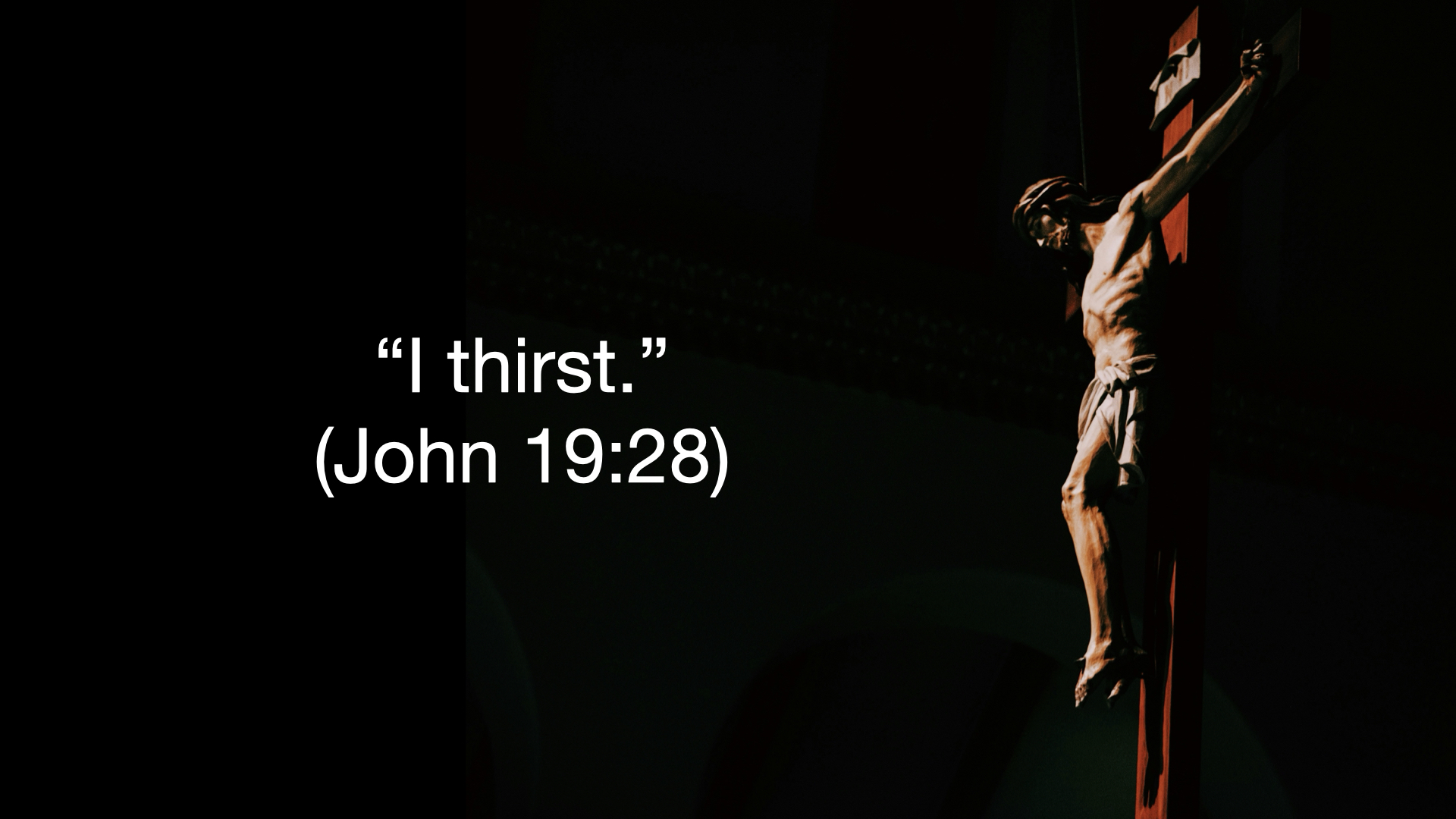
You see, Jesus came and suffered in the desert of humanity that had turned away from God, and he did that to give us the garden of a faithful Son who is living life in intimate fellowship with his heavenly Father. Jesus planted the seeds of God’s beautiful spring garden when he rose from the dead and launched a new creation that will burst forth into fullness at the end of time.
And during his ministry on this earth, when Jesus miraculously opened the eyes of the blind and the ears of the deaf, he was giving us glimpses of what life will be like when God makes all things new.
Now, we think of Jesus’ miracles as extraordinary exceptions to the natural way of things. A German theologian, Jürgen Moltmann, argues that the opposite is true. He wrote,
“When Jesus expels demons and heals the sick, he is driving out of creation the powers of destruction and is healing and restoring created beings who are hurt and sick. The lordship of God to which the healings witness restores creation to health. Jesus’ healings are not supernatural miracles in a natural world; they are the only natural thing in a world that is unnatural, demonized, and wounded.”[ii]
Jesus is going to restore all of God’s creation—including us—to the way that God originally intended it to be. And you will be included in that restoration because of Jesus’ love for you and all that he has done, all that he is doing, and all that he will do for you. In fact, Jesus has already begun his new-creation work in you by giving you new life in him. For as we read in 2 Corinthians 5:17, “Therefore, if anyone is in Christ, the new creation has come. The old has gone, the new is here.” (2 Corinthians 5:17)
Lift Your Eyes
There’s a story told about a swan and a stork. The swan was very beautiful and was swimming on a lake, and it swam close to shore where a stork was digging for snails in the mud. And the stork asked the swan, “Where are you from?” And the swan said, “I’m from heaven.”
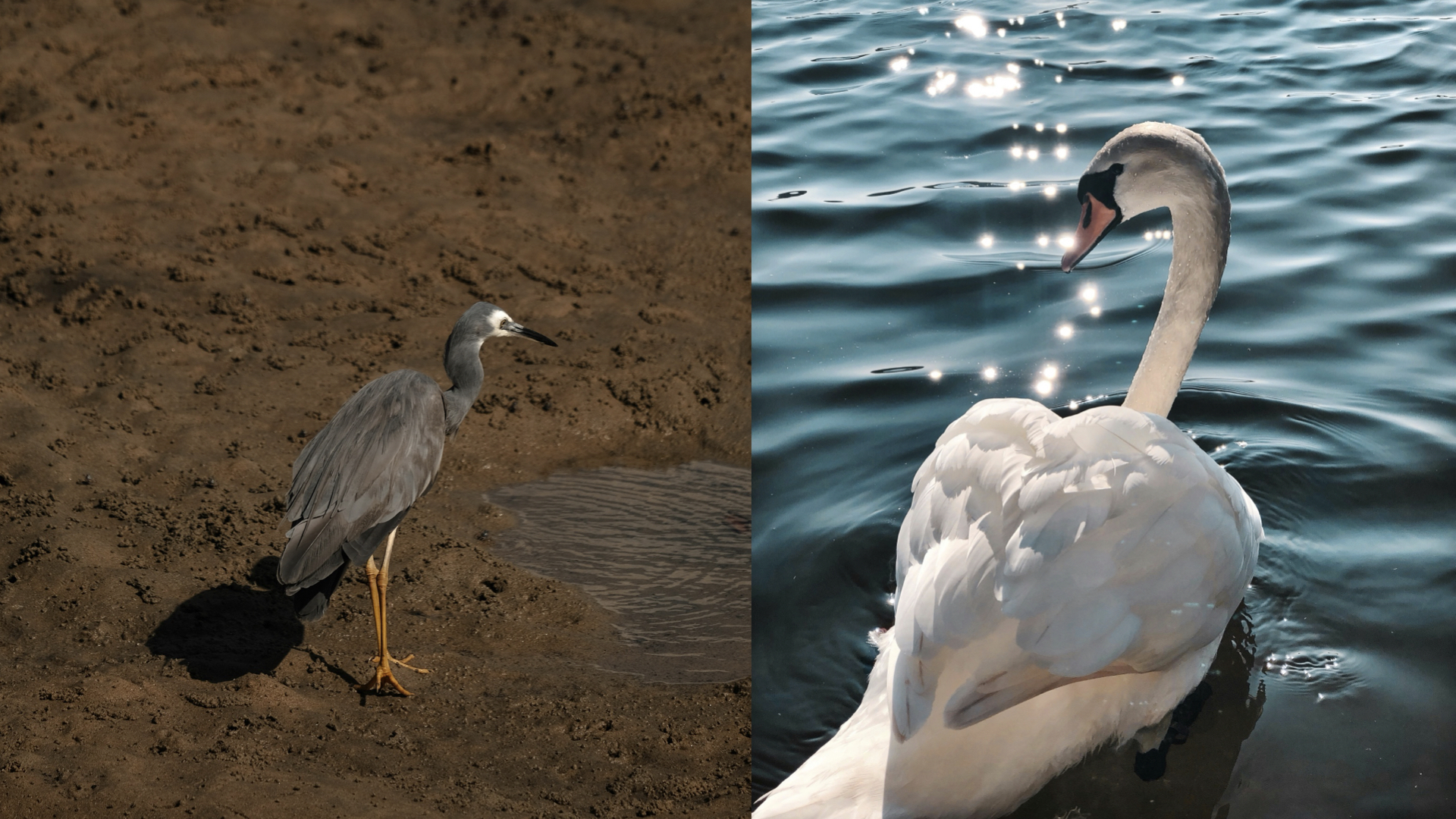
And the stork said, “What’s heaven like?”
And the swan said, “Oh, it’s very beautiful.” And then the swan began to tell the stork about all the abundance of life and all the healing and the joy and the richness that exists in heaven.
And the stork asked, “Are there any snails in heaven?”
And the swan said, “I don’t know, I haven’t seen any.”
And the stork said, “Well, if there’s no snails in heaven, I don’t want to go.”
Dear friends, the point is not about snails. It’s about where our eyes are fixed. For we can miss the glory God has prepared for us if we stay focused on the grubby little things crawling in the mud of this world.
So my encouragement to you today, dear friend, is to lift your eyes. Look up. Let your heart be captured by the glory that awaits you at the end of time. Because of Jesus, winter will not have the last word. You are going home to God. You are going to live in his eternal spring, and it’s all because of Jesus. Amen.
[i] John M.Oswalt, The Book of Isaiah: Chapters 1-39, The New International Commentary on the Old Testament series (Grand Rapids: Eerdmans, 1986), 606-7.
[ii] Jürgen Moltmann, The Way of Jesus Christ: Christology in Messianic Dimensions (Minneapolis: Fortress, 1993), 98-99; quoted in John Mark Comer, Practicing the Way: be with Jesus, become like him, do as he did (Colorado Springs: WaterBrook, 2024), 144.

 Farewell to Shadowlands