

My wife, Susan, and I have been taking our vehicles to the same mechanic for years, and every spring, something happens which I think is amazing: beautiful classic muscle cars started showing up at our mechanic’s shop. Our mechanic didn’t try to cultivate a special relationship with owners of classic cars, but somehow people started bringing their special cars tohim and he developed a reputation for doing good work and now it has become a thing. Sometimes when we take our car in for repairs, there are like three, four, or five of these amazing cars in the parking lot or in the shop. I must confess to you that there are times when I thought to myself, ‘I wonder if I could accidentally get into a blue Corvette and drive that home instead of the blue Jetta we have.’ Some scruples and alarm devices prevented me from acting on that thought, but I guess you could say I have automobile envy.

The same thing can happen with our bodies. All of us have a body and we cannot do anything in this life without our body. But we are bombarded by images of people with beautiful bodies. For example, the top 10 influencers are all very handsome and beautiful people. But most of us do not have a body that is anything like theirs. For most of us, our body is not a Lamborghini. It’s more like a Pinto. It’s not a Porsche. It’s a Fiesta. And it’s not a Ferrari. It’s a Fiesta.
And now, we are faced with a question: What are we going to do? Are we going to try to mold our body to look like the bodies we see on our screens and social media? Or should we just try to use it as best we can for the time being and then, when we die, happily discard it? How should we think about and use our bodies? That is what we are going to think about today and to help us as we do that, we are going to look at 1 Corinthians 6:12 to 20. If you have a Bible or a Bible app nearby, I invite you to turn there now. As we reflect on this question, it is important for us to remember that how we think about and use our bodies will depend greatly on what we believe about our bodies. There’s a continuum where our body is either the most important thing in the world to us or just trash that we should gladly get rid of at the end of life. So, where should we be on that continuum? That’s what we’re going to think about.
As we do that, there are a few things about this passage that you need to be aware of. First of all, Paul is writing to the Christian church in Corinth to in part to address some of the problems that were happening there. Like many other places and times, the surrounding culture had influenced the thinking and behavior of the Christians in Corinth. In ancient Corinth, people believed that the human body was a prison house for the soul. The soul was considered to be the only essential part of a human and death was viewed as positive because it meant release for the soul.
Because the body was seen as insignificant, the prevailing thought was that our physical appetites, including both food and sex, should be satisfied without restraint. At the time when Paul wrote this letter, prostitution was condoned and it was deemed acceptable for a married man to have an affair with a single woman. As a result, one of the problems that Paul was addressing with his letter was that a man openly involved in a sexual relationship with his stepmother.
Another important aspect to note, which may vary depending on your translation, is that Paul uses certain key words in unique ways. These key words are “flesh” and “body.” When Paul uses the term “flesh,” he uses it to refer to that part of ourselves and all of humanity that is opposed to God. It is shorthand for referring to our sinful human nature. On the other hand, Paul tends to use the term “body” to refer to the entire person. As a side note, in today’s message, when I mention the word “body,” I’ll be specifically referring to the physical aspect of our lives.
Furthermore, it’s important to understand that in this passage, Paul addresses the underlying beliefs that drive our thinking and subsequently, our actions. He directs his words towards common beliefs in Corinth, which are encapsulated in certain sayings. His goal is to counter these sayings. It’s crucial to recognize this, as we might read a saying and assume that if it’s in the Bible, it must be true and therefore should be followed. However, what Paul is doing is holding these sayings up and then refuting them. Both of the sayings that Paul challenges contain a kernel of truth, but there’s a problem with them when viewed in their entirety. And we can tell when Paul is quoting a common saying that he is going to refute because he always introduces it with the words “You say”.
The first common saying that Paul refutes is, “I have the right to do anything.’
Now, this could easily be taken from our culture today. Another way someone might express this is, ‘You’re not the boss of me.’ Or, ‘It’s my body. It’s my choice.’
And there’s a grain of truth here. It is true that God has given each and every human being the freedom to make decisions. And for those who follow Jesus, the freedom we have in Jesus Christ has been multiplied exponentially with the forgiveness of sins He has granted us, along with the new life in Him and the indwelling of the Holy Spirit that Jesus has provided. We have incredible freedom. We live and function within the realm of God as followers of Jesus Christ. It’s almost mind-boggling how much freedom God has bestowed upon us.
So, it’s true that we do possess immense freedom. However, as Paul mentions, not everything we can do is beneficial. There are actions we can take with our freedom that could harm ourselves or others. These actions would not be acts of love, so we choose to refrain from them. But Paul also points out that some of the things we might do could lead to bondage. You have the freedom to take your paycheck and head to a nearby casino, gambling it all away. You have that freedom. You’re also free to go into a dark alley and inject drugs purchased off the street into your veins. You have that freedom. You’re free to go home after a difficult day of school or work, attempting to numb boredom or pain with alcohol, food, or some other substance or activity of your choice. You have that freedom. However, if you continue engaging in those behaviors, they will eventually undermine away your freedom. They’ll become addictions that control your life, much like a marionette master controls a stringed puppet, and you will lose your freedom. So yes, we do possess great freedom. But we voluntarily limit our freedom to ensure that our lives can be a blessing, not only to ourselves, but also to the people around us.
Then Paul addresses a second common saying: “Food for the stomach and the stomach for food, but God will destroy them both.” Again, there’s a grain of truth in this statement because food satisfies the hunger of the stomach and the stomach is designed to digest the food we eat. Furthermore, a day will come when each of us will die and, given enough time, our bodies will eventually turn to dust. However, the end of our life in this world does not mean the end of our bodies.
In verse 14 of our passage, we read: ‘By His power, God raised the Lord from the dead, and He will raise us also.’ The resurrection experienced by Jesus and the one we will receive is a physical resurrection. You see, when human beings were initially created by God, he made us as enfleshed souls. The most significant aspect of our existence isn’t just our body nor our soul; it’s the unity of body and soul that makes us fully human.
Due to the sin of our first parents, not only was our soul corrupted by sin, our bodies were also. Consequently, both our soul and body need to be redeemed by God for us to have life with Him. This is why Jesus came into the world with a physical human body. He was both fully God and fully human. He was like us in every way except that he did not sin.
When the time was just right, Jesus willingly and lovingly went to the cross for you and me. It was through the suffering he endured in his body that he was able to redeem your body. Jesus has reclaimed your body from sin, corruption, and a destiny of destruction. Sin no longer defines the identity of your body. In God’s perspective, your body is holy and perfect in Jesus Christ. Although some of us may look in the mirror and, based on what we see with our eyes, doubt God’s perspective, we can affirm what God sees by faith. And a day will come when we will see the perfection of our body with our own eyes. That will happen when Jesus returns to this earth in a visible way and raises us from the dead. Then we will be fully alive, fully human, and truly free and we will dwell with Jesus eternally in the new heaven and earth.
Jesus’ death and resurrection for us also has an immense impact on our lives right now. In verse 13 we read, and this is a bit of a paraphrase, ‘Our body is meant for the Lord, and our Lord is meant for our body.’ Looking at the first and second parts of this sentence separately, here is what they mean. The first part of the sentence, ‘Our body is meant for the Lord,’ tells us four things. First, though we may not understand how it has happened, Jesus has made a connection with our body. He represented our body with his as he lived a perfect human life and as he died on the cross for all our sins. Our body is now interconnected with Jesus and it belongs to him. Second, the focus of our body has shifted. The main orientation of our body in the past was on ourselves. Now our body is focused on Jesus. Third, our body has a new purpose. Prior to Jesus coming into our lives, our body was focused on fulfilling our desires, all of which were tainted by sin. Now our body is focused on worshipping Jesus and fulfilling his purposes for us and for the world. Finally, because Jesus has made us a beloved, forgiven child of God and he now lives within us, we are his representatives in the world. We are the hands and feet of Jesus. Together with all our sisters and brothers in Christ, we are the hands and feet of Jesus. That means that everything Jesus does in this world in a physical sense, he does through us and all his other followers in the world.

The second part of this sentence says ‘the Lord is meant for our body.’ What does this mean? It means that Jesus preserves, protects and provides for our body. We do not need to be anxious about these things because Jesus is taking care of them for us. Even when we die, Jesus keeps his eyes on our dusty, dead body because it will be the seed from which He will resurrect our new, glorified body. While our old and new bodies may not be the same kind of body, there is a one-to-one identification between them.
That means that even now, as our body grows old and declines in ability, we look forward with great anticipation to the day when Jesus will resurrection us from the dead.
Let’s also remember God’s perspective of our bodies. While we might think that the value of our body is based on how it looks, this isn’t God’s viewpoint. In God’s eyes, our bodies are invaluable, integral, and beautiful facets of the people he calls his “Beloved”. It’s God’s love that renders our bodies precious, invaluable, and sacred. Jesus has connected us to him and made us part of his body in the world.
Through Jesus, we’ve been united with Him, becoming part of His body in this world. The Holy Spirit now resides within us, making our bodies, just as they are right now, his sacred temple – his dwelling place—for he lives within us.
This means that what we do with our bodies is very important. Our bodies have been redeemed by Jesus and given a new purpose and future. Therefore, in response to God’s love, we use our bodies to glorify Him – aligning our thoughts, words, and deeds with God—while refraining from combining our bodies with sin.
Taking a body – a body which Jesus has redeemed and declared holy – and then combining it with sin is a problem, especially in the case of sexual sin, but it is not confined to that type of sin. Here is what that is like. Imagine taking a beautiful, delicious carrot cake and then mashing it together with manure and serving it to an honored guest. Why would anyone do such a thing? Why would you combine something that is holy with something that is unholy? From God’s perspective, that is what it is like when we combine our body with sin.
However, it is crucial for us to remember that when we stumble and combine our bodies with sin, either intentionally or unintentionally, the waay out is not to try harder next time. The way out is to admit our sin to ourselves and to God, and then receive the free and full forgiveness that he gives us through his Son, Jesus Christ. Then we ask the Holy Spirit to guide us in a new and better direction. The forgiveness given to us by God through Jesus forms the foundation of every aspect of our lives.
One of the most compelling descriptions of the physical transformation we will experience when Jesus resurrects us comes from the imagination of C.S. Lewis in his book The Great Divorce. The story he tells us a work of fiction, yet it tells us important truths about heaven and hell.
In a particular passage from the book, Lewis describes a procession held in honor of a beautiful lady. After she passes him by, he writes these words:
“I cannot now remember whether she was naked or clothed. If she were naked, then it must have been the almost visible penumbra of her courtesy and joy which produces in my memory the illusion of a great and shining train that followed her across the happy grass. If she were clothed, then the illusion of nakedness is doubtless due to the clarity with which her inmost spirit shone through the clothes. For clothes in that country are not a disguise: the spiritual body lives along each thread and turns them into living organs. A robe or a crown is there as much one of the wearer’s features as a lip or an eye. But I have forgotten. And only partly do I remember the unbearable beauty of her face.”
(Source: e-book, C. S. Lewis, C. S. Lewis Christian Collection, (Timeless Wisdom Collection, 2016) 214.)
This woman’s beauty was so incredible that when the narrator, Lewis, first sees her, he wonders whether she is Mary, the mother of God. However, that was not the case. But she wasn’t. She was an ordinary woman, living what the world would call an insignificant life in an obscure part of London. But all the things that she did—whether it was feeding her cats or interacting with those around her – she did with great love.
Lewis goes on to write:
“Every beast and bird that came near her had its place in her love. In her they became themselves. And now the abundance of life she has in Christ from the Father flows over into them.” (Lewis, 214)
Not only will our bodies be miraculously transformed in the future, but Jesus is also doing the miraculous work of transforming the lives of others, as his love fills and overflows our bodies just as they are right now. Your body is having an impact on the people around you as Jesus lives in it and shines his love and his light through you. That’s impacting people, forever around you.
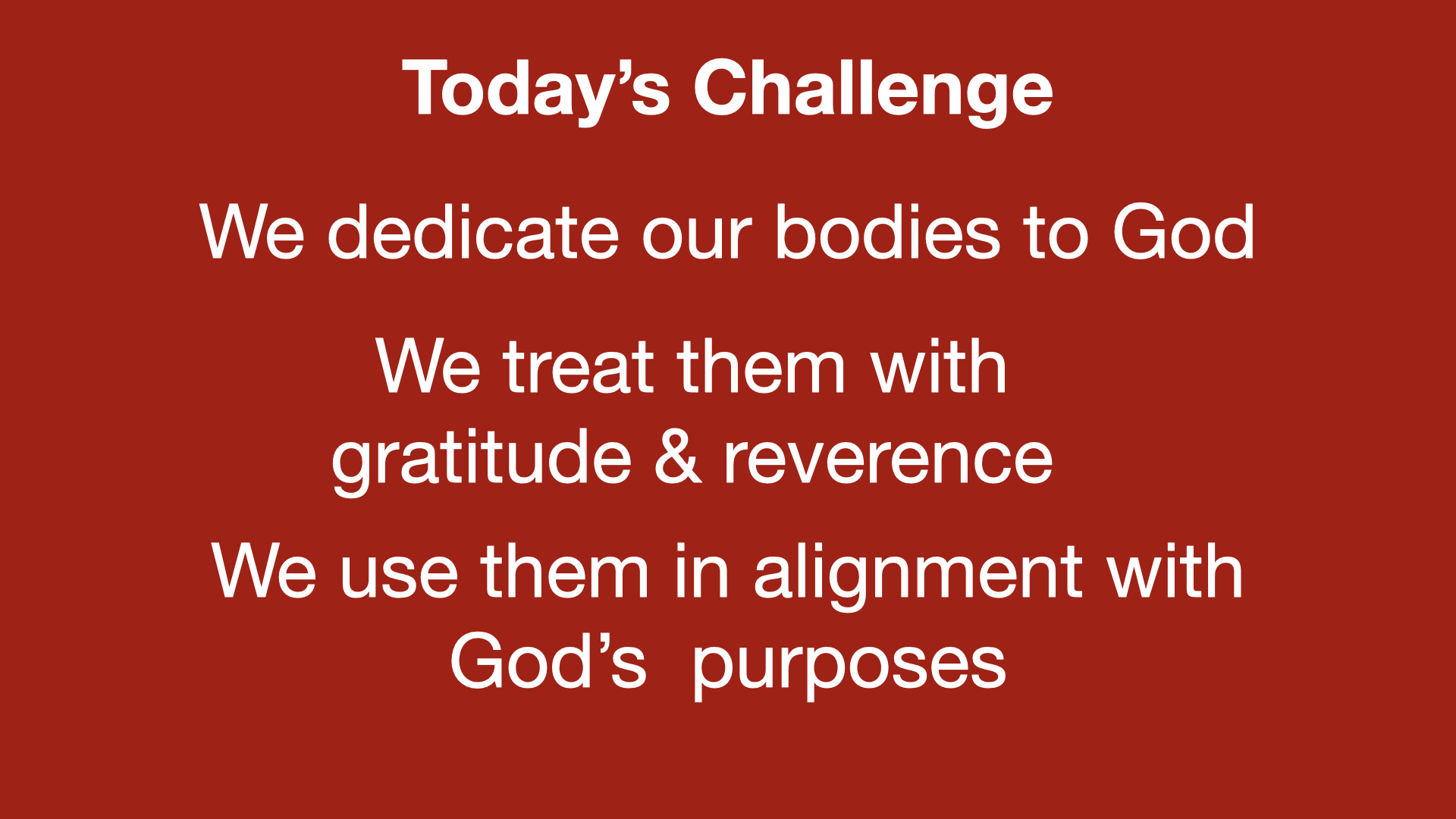
So how should we answer our original question: “How should we think about and use our bodies?” In response to all that God has done for us—forgiving us all our sin, bringing us into life with him, redeeming our bodies, and filling them with the Holy Spirit—the answer would be: We dedicate our bodies to God and we treat them with the gratitude and reverence that is due to them because of what God has done for our bodies. He’s redeemed them and he’s declared them to be holy in Christ. Therefore, we use our bodies in alignment with God’s purposes. Amen.
(This message was shared at Walnut Grove Lutheran Church in Langley BC on August 27, 2023. For more info, please go to wgcl.org.)

 Farewell to Shadowlands