

So let’s start with some questions. Do you have any problems? Do the people around you have any problems? Yes, of course, everyone has problems, right? There are different kinds of problems people could have. Some may have financial problems. Maybe the expenses are more than your income, or maybe the rise in interest rates has impacted you and squeezed your financial situation. One could have relational problems. Maybe you have a relationship or two that isn’t quite the way you would like it to be, but you don’t know how to get it back on track. Or maybe it’s just that the tasks of life are overwhelming to you, whether that’s at school, at home, or at work. There are all kinds of problems and everybody has problems.

And we can also say that, in a general sense, there are two kinds of problems that we face in life. There are those problems which we can resolve, and then there is a second category of problems, which we either cannot resolve because maybe we can’t do anything about it, or maybe we’ve tried in the past, and we’ve just found it really difficult, and for reasons that are unknown to us, we can’t resolve a particular problem. So the two kinds of problems we face in life are the problems we can resolve and the problems we either can’t or have difficulty resolving.
And the main way we humans deal with our problems is this: First, we weigh out what is the pain of addressing the problem, because there’s always pain in addressing the problem. In fact, we humans tend to not address a problem unless the pain of the problem becomes greater than the pain of addressing the problem.
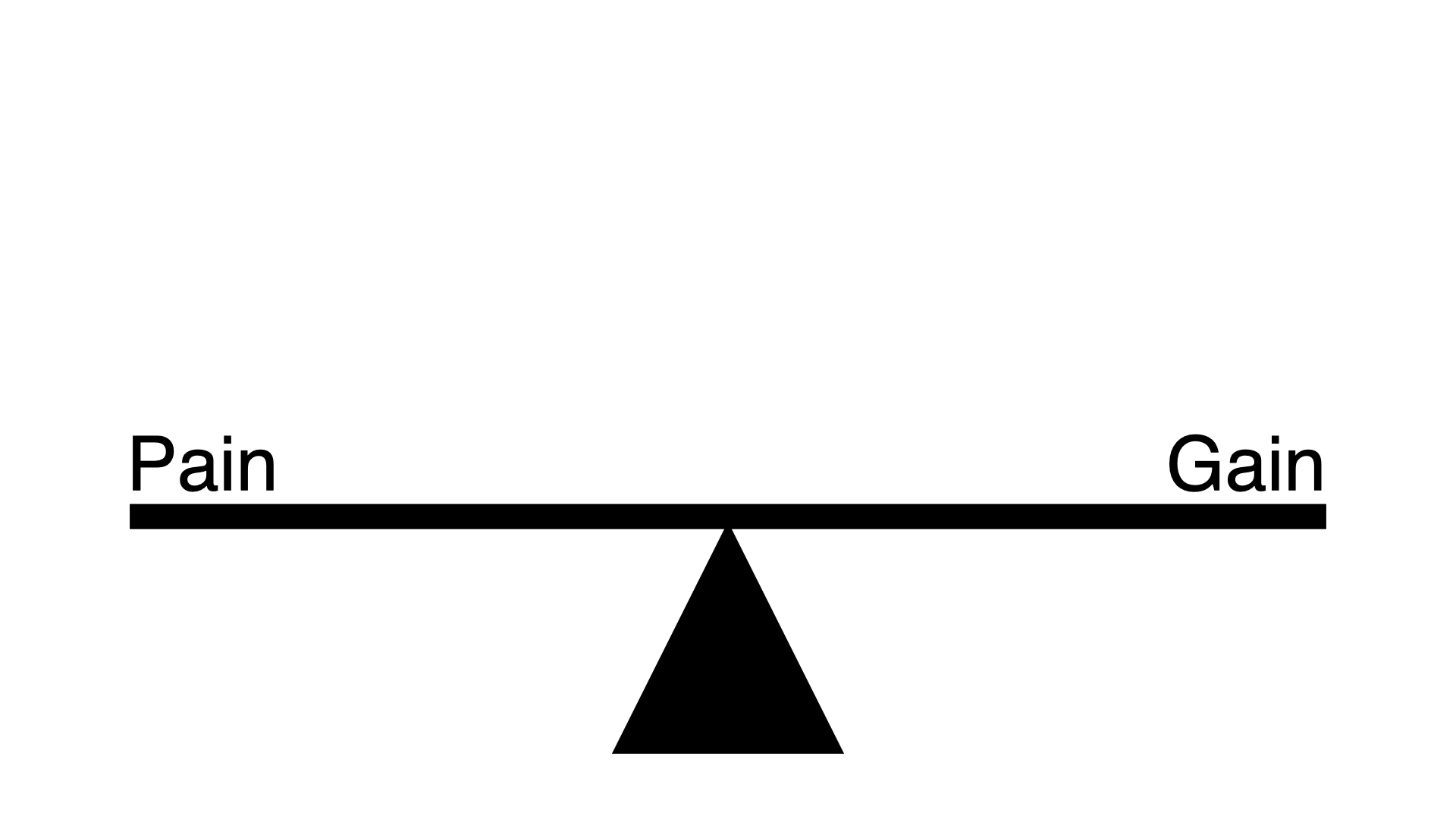
So we figure out what the pain is of addressing the problem—what it is going to cost us—and then we ask ourselves, what’s the gain of resolving that issue, whatever it may be? And if the gain is greater than the pain, then we willingly move ahead and address the issue. We willingly take on the pain required to address the problem.
Now, this method of dealing with problems works alright for that category of problems that we can resolve. But it doesn’t work very well for those problems which we cannot resolve. Because sometimes we don’t know if there’s going to be any gain, and sometimes we don’t know how much pain it’s going to cost us to move forward in that situation. And in those moments, it can be tempting for us to try to exit the situation and maybe start over somewhere else. Now, please don’t misunderstand me. There are times when the best thing to do is to exit a situation and start over somewhere else. But I know that sometimes I want to do that more than I really should. There are times when I want to exit a situation when I really should stay and keep moving forward.
So here’s the question I’m asking you to consider with me: when we’re facing really tough problems, how can we make decisions that lead to better outcomes? And to help us as we reflect on that question, we’re going to be looking at 2 Corinthians 5:6-21. If you have a Bible or Bible app nearby, I invite you to open it up to that passage.
But first, let’s take a step back for a moment and reflect on how God makes decisions. Just as we face dilemmas from time to time in our lives, God also faced a great dilemma. He created this world and all that exists, and it was very good. But then sin entered the world, and his once good creation became corrupted, and death became part of life in this world, which is not part of God’s plan for us or for his creation. Then everything we do is tainted to one degree or another by sin. And so God had a dilemma. What was he going to do?
Let’s imagine that he used our way of dealing with problems. As he looked at his broken creation, he weighed a couple of considerations. First of all, what would be the pain that God would have to endure to restore his broken creation? And then what would be the gain of doing that? But right at this point, we need to add a third consideration because there’s another factor that’s important for God and for us when we make decisions. And that is, what is the worth, or value, of what is at stake here?

For example, if you have a car and it’s worth $2,000, but it will cost you $5,000 to put it back on the road, should you fix it? No, you should not fix that car, because the cost of fixing it is more than the car’s worth. But imagine for a moment, that you find a Porsche GT in a barn north of Eyebrow, Saskatchewan. If you had the money, you would pay a lot of money to fix that car because it’s worth a lot of money.
It’s the same thing with God, because he wasn’t just considering the pain and the gain. He was considering the worth of his creation when he was deciding what to do. And for him, the worth of his creation, the worth of each and every part of his creation, the worth of each and every human being he created, has infinite value. We know that because the price God was willing to pay to restore His creation was the infinite worth of the life of God the Son, Jesus Christ. And that’s how you can know what you are worth. Because your worth isn’t based on what you do, what you know, what you have, or how you look. Your worth is based on what God says you’re worth. In God’s eyes, you have infinite worth, and if you’re wondering what you are really worth, all you need to do is look at the cross. The cross is what tells us that each and every human being has infinite worth in the eyes of God because that’s the price that God is willing to pay to restore you and all creation.

So, in April 2019, there was a fire in Notre-Dame Cathedral in Paris. The roof of the Cathedral was destroyed, along with the spire that was in the middle of the roof and the rest of the building sustained significant damage. Because of the worth of the Cathedral to the people of Paris and France, the decision was made to restore it. So the first thing they did was clear out all of the debris from the fire. The second thing they started doing is cleaning up those items in the cathedral which were not damaged beyond repair, for example, the stained glass windows. Third, they decided to rebuild what had been destroyed. But they decided to rebuild the roof and the spire using exactly the same techniques that were used to build it in the first place. This means that they are doing all of the rebuilding work by hand with hand tools because they want the restored Cathedral to be authentic to the original design.

In a way, God has done something very similar to restore us. By going to the cross and suffering and dying there, Jesus has done is he has cleared away all of the damaged debris that was separating us from God. He has reconciled us to God and there is no barrier between us and God anymore. He’s brought us and God together, but that isn’t all that he did. Jesus has cleaned the remaining portions of our life with his forgiveness, his goodness, and his holiness. The theological word for this is “justified”. Jesus has justified us, and here is an easy way to remember what that means for us. With the forgiveness that Jesus has given to us, he has justified us and it is “just as if I had not sinned”. That’s what Jesus has done for you. Before God, it’s just as if you had never sinned.
Not only that, Jesus, by his resurrection, started a New Creation within the old creation. Within the brokenness of this world, Jesus has begun something new. And with his resurrection, the risen Jesus is the first fully completed New Creation human being. But everyone who trusts in Jesus is also a New Creation. It’s just that the process hasn’t been completed yet.
And so Paul, in his letter to the Corinthians, says these words: “Therefore, if anyone is in Christ, the new creation has come: The old has gone, the new is here!” (2 Corinthians 5:17) And this new creation person is categorically different from the old person because this new person is God-centered, God-dependent, and God-directed in life. All they want to do is to love God and love His creation, including the people He has created.
However, we also need to remember that this new creation, even though it exists within you and everyone else who believes in Jesus, is invisible to everyone except God. So we cannot tell by looking at a person whether they are a new creation person or not. But that does not mean that we treat other people like the world does. Paul also writes these words; he says, “So from now on we regard no one from a worldly point of view. Though we once regarded Christ in this way, we do so no longer.” (2 Corinthians 5:16) Every person that you look at is a person for whom Jesus Christ has died. And every person that you encounter in your everyday life is either a new creation person or someone who could be a new creation person. They are someone whom God created and whom God loves, and for whom God sent His Son into the world to restore them completely.

So what does all of this mean for us? Well, it means that the challenges we face in life are never really a threat to us. They cannot hurt us and they cannot harm the new creation person within us. They are merely stepping stones on our journey of life with God. And they can actually strengthen our heart’s ability to love and to trust. Just as trees need wind to strengthen their roots so that they can stand, and just as a nugget of ore plucked from the ground needs heat in order to burn off the impurities and allow the gold that is within to be revealed, so also you and I need trials and tribulations in order to strengthen our faith. and so the impurities in our life can start to be drained away so that more of that pure heart, which Jesus has placed within us, can shine through.
So the two questions we can ask ourselves when we are facing challenges—even when there are challenges which we cannot solve and they’re very painful for us—are: Am I going to trust Jesus in this? And second, am I going to love others, including myself, like Jesus did, in this?

You see, to make decisions when we’re facing tough times, we need more than the calculation of pain and gain. What we actually need is faith and love. Those two things are dependent on the condition of our heart and, without Jesus, that’s a problem because a heart without Jesus is sick with sin. In Jeremiah 17:9, we read, “The heart is deceitful above all things and beyond cure; who can understand it.”
But the good news is that Jesus has given us a new heart, a new heart that loves as he loves us, a new heart that trusts that Jesus is who he says he is and that he does what he said he will do.
Now, we also need to remember that, even with our new heart from Jesus, it will always costs us to love well. True love is always sacrificial love. Paul, in his letter to the Corinthians, addresses this. He writes, “For Christ’s love compels us, because we are convinced that one died for all, and therefore all died. And he died for all, that those who live should no longer live for themselves but for him who died for them and was raised again….We are therefore Christ’s ambassadors, as though God were making his appeal through us. We implore you on Christ’s behalf: Be reconciled to God. God made him who had no sin to be sin for us, so that in him we might become the righteousness of God. (2 Corinthians 5:14-15, 20-21)
Nick Vujicic was born without arms or legs, and he was well aware of that fact growing up and didn’t actually have a problem with it until he went to school, where his schoolmates teased him mercilessly and said that he was an alien. That began a deep, dark depression for him at the age of eight, which continued until he was 13. He was in so much despair that he tried to drown himself in the bathtub.

When he was 13, he hurt his little foot which he uses to walk. Then he not only had no arms and no legs, he couldn’t walk either. He decided that he would be thankful for the things that he had rather than be sad over the things he did not have.
When he was 15, he read about a blind man in John, chapter 9. sentence in John Doe’s story of a blind man. In the story, people were wondering why this man was born blind. And Jesus said it’s so that the works of God can be displayed in him. And Nick thought to himself, ‘Well, if God can have a plan for a blind man, then he can have a plan for me.’
In high school, he once spoke to his classmates as the vice-president of his class, and the janitor of the school heard him speak. The janitor said to Nick, ‘You’re going to be a speaker who goes around the world and talks to people,” and Nick asked, ‘What do you mean? Like, what would I say to them?’ The janitor replied, ‘You are going to tell them your story.’ So the janitor helped Nick prepare a talk, which he shared a couple of months later. Since then, he’s talked to about 10 million people in person and almost 3 billion on TV, and over a million people have given their lives to Jesus Christ as a result of the message he has shared.

Nick wanted, hoped for and prayed for a miracle: that God would give him legs. He even has a pair of shoes in this closet, just in case that miracle happen. But in the video Nick filmed for “I am Second,” he says that the greatest miracle God gave him was his salvation, everything else was just a bonus. But God has given him several bonuses. He has given him a beautiful life, and together they have four lovely children. Nick says that he doesn’t represent people without arms and legs. He represents healed, broken-hearted people, so he can let other broken-hearted people know that they also can be healed and that they can be a miracle too. He says, “If God can use a man without arms and legs to be His hands and feet, then He can use any willing heart.”

So going back to that question we were looking at earlier, when we are facing really tough problems, how can we make decisions that will lead to better outcomes? The answer is the challenge I am setting before you: When you are facing tough times, trust that God loves you and is with you. Trust that he is working to bring about good things for you and for others. And remember what he’s given you: a new life to live, a new heart to love, and a new story to share with other people so that they can be reconciled to God too. Amen.
(This message, or something like it, was shared at Walnut Grove Lutheran Church on September 17, 2023. For more info, please go to wglc.org.)

 Farewell to Shadowlands
I am in an interesting life transition right now and this is exactly what I needed to read. I thank God for your encouragement at just the right time! Thank you for following your calling.
LikeLike