

When we moved here seventeen years ago, we were not able sell our acreage in Saskatchewan before we left so we had to arrange financing for both our property back there and the house we bought here in Langley at the same time. As part of those financial arrangements, the bank insisted that we borrow some of the money we needed from family. We mentioned our predicament to Susan’s Mom, and she quickly came through for us. I did the same with my Dad and he said, “Let’s talk about when you get here.” Susan and I and our children were planning to travel to Alberta and stay at my Mom and Dad’s cabin, Mom and Dad were going to visit us while we there, so I felt like a plan was in place.

The day came when Mom and Dad visited us at their cabin and they started getting ready to leave before we had any conversation about the money. I did not want to have to ask for the money, I wanted them to offer to give it to me. But I soon realized that if I didn’t ask, it may not happen. So, I decided that, if I wasn’t going to ask for myself, I would ask for the sake of my family. So, I stepped forward and asked my Dad for the money. He said ‘yes’ and Mom wrote us out a cheque for the money we needed.
As I think back on that event, I have sometimes wondered why my Dad didn’t simply give me what he knew I needed. But I think that he wanted me to ask him that money in person so I could learn some things. I learned that I have a lot of pride in my heart that was getting in the way of asking for what I needed. And I learned that my Dad and Mom really loved me and would come through for me and my family when I really needed them. All I had to do was ask.
I tell that story because it illustrates the complicated relationship we humans sometimes have with prayer. Several times in the Bible God calls us to pray to him. But he already knows what we need, so why doesn’t he simply give us what we need without us asking us for it? And sometimes we ask God for something over and over again and he doesn’t give it to us. Why is that? If you are like me, you need some help in the area of prayer. So, let’s turn to Jesus like his disciples did long ago and say, “Lord, teach us to pray.” To hear his response, we will eventually end up in Luke 11:1-13, but before we get there, we will look at the passages in Luke leading up to it as we continue our series on Luke and Acts called, “Setting the Prisoners Free.”
Jesus’ Ministry in Galilee
When we began digging into Luke two weeks ago, we saw that Luke’s purpose in writing his Gospel was to give the Christian Church a tool to use to reach and teach God-fearing and pagan Gentiles and bring them into God’s family of faith. We also saw that there are three reoccurring themes in Luke. We see continual reminders of the Journey Jesus takes from heaven to earth and back to heaven again. We see the pattern of the Prophet in Jesus’ ministry as he teaches and does miracles to great acclaim, but then he faces rejection. And as Jesus shares meals with unlikely people, like tax collectors and prostitutes, we see the acceptance and reconciliation he brings through God’s Presence at Shared Meals.
When we step back and look at Luke’s Gospel in its entirety, we can see that it has four parts: First, there’s Jesus’ Birth & Preparation for Ministry (chapters 1 to 4), then Jesus’ Ministry in Galilee (chapters 4 to 9), followed by Jesus’ Journey to Jerusalem (chapters 10 to 19), and finally we have Jesus’ Ministry in Jerusalem (chapters 19 to 24). We covered the first section two weeks ago and we started the second—Jesus’ Ministry in Galilee—when we saw how Jesus stood up in the synagogue in his hometown of Nazareth and declared in the words of the prophet Isaiah that he had come to fulfill Scripture by releasing creation from its bondage to sin and brokenness and restoring it to its rightful state of harmony with its Creator. The people of Nazareth rejected Jesus that day, but he was miraculously rescued from their intentions to murder him to continue his ministry and his journey to a cross.
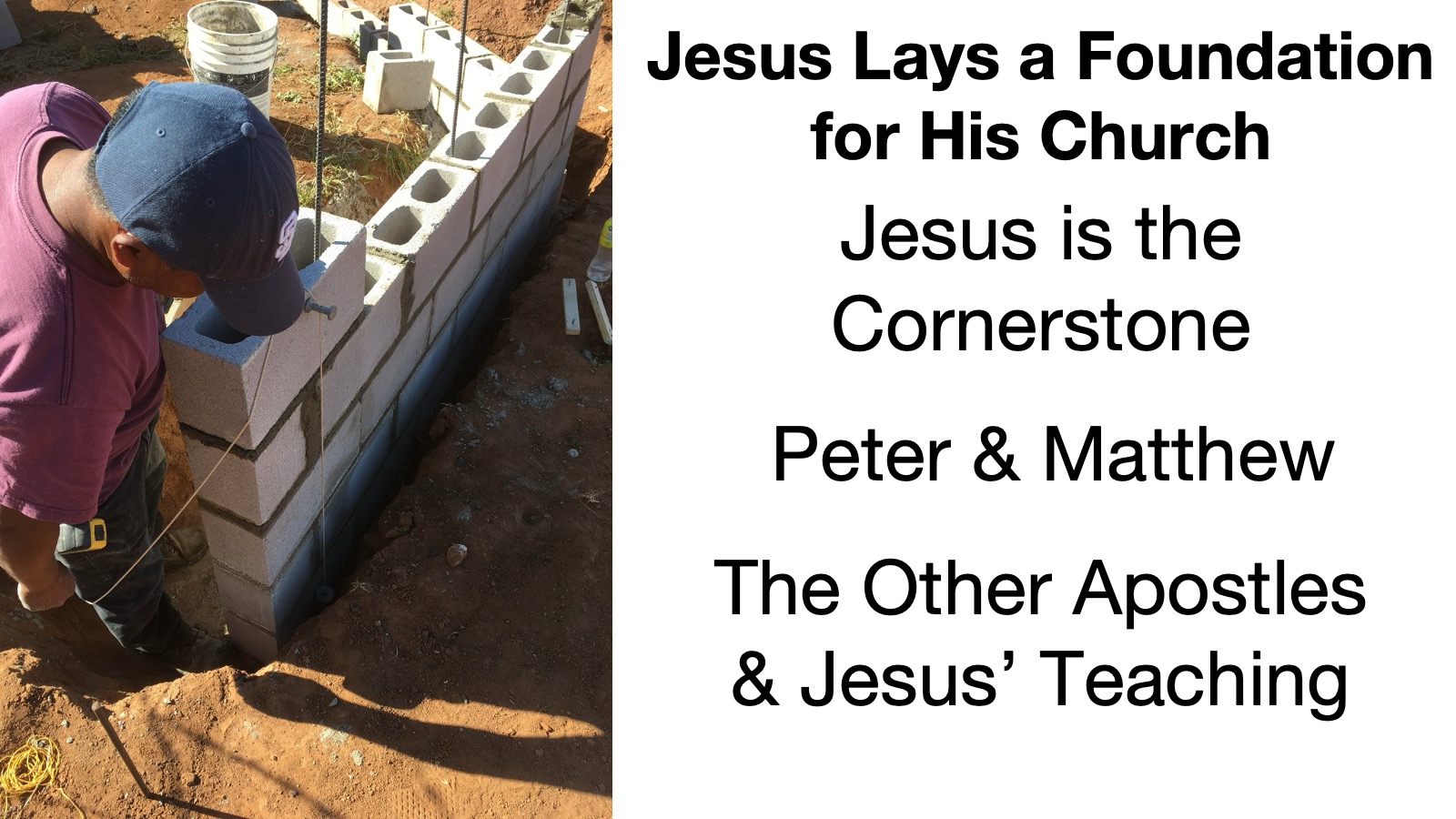
Jesus’ Ministry in Galilee has two sections to it. First, Jesus lays a foundation for his Church with himself as the Cornerstone. When laying a stone foundation, the cornerstone is the first stone that is laid, and it aligns all the other foundation stones. This Jesus does through his proclamation in the synagogue at Nazareth and his teaching and healing in Capernaum. For the next part of the church’s foundation, Jesus calls Peter, as the first of the Twelve Apostles, and Matthew, as the first of the Gospel Writers. These are the second and third stones which are set in place and they set the direction of the rest of the stones. The final part of the church’s foundation comes with the call of the rest of the twelve apostles, and Jesus’ teaching, at the Sermon on the Plain, of the two ways people can follow, the way of life or the way of death.
The second section of Jesus’ Galilean Ministry focuses on his teaching, healing and miracles, and it too has three parts. First, Jesus heals, teaches and forgives several people. He heals a centurion’s servant, raises a widow’s son from the dead, eats with a Pharisee and forgives a sinful woman. Then Jesus teaches about the Parable of the Sower and the Mysteries of God’s Kingdom. In this part, Jesus also calms a storm, frees a man from demonic possession, raises Jairus’s daughter from the dead and heals a woman with a hemorrhage. Finally, we have the climax of Jesus’ Galilean Ministry, which includes the feeding of the Five Thousand, Peter’s Confession that Jesus is the Messiah, Jesus’ Transfiguration, and his predictions that he will suffer, die and be raised again.
Then we get to the turning point in Jesus’ ministry where we read: 51 As the time approached for him to be taken up to heaven, Jesus resolutely set out for Jerusalem. (Luke 9:51) With that, Jesus’ journey to Jerusalem begins.Along the way, Jesus experiences rejection in Samaria, sends out the seventy-two on a short-term mission trip, and he teaches the parable of the Good Samaritan.
Jesus’ Teaching on Prayer
Then comes an event for which we will slow down and consider more fully because it is a worthy introduction to the topic of prayer. Jesus dines at the home of two of his closest friends, Mary and Martha. Martha was busy with preparations for the meal and she was upset that her sister, Mary, was sitting at Jesus’ feet and listening to him instead of helping her. So she asked Jesus to tell Mary to help her. 41 “Martha, Martha,” the Lord answered, “you are worried and upset about many things, 42 but few things are needed—or indeed only one.[f] Mary has chosen what is better, and it will not be taken away from her.” (Luke 10:41-42)
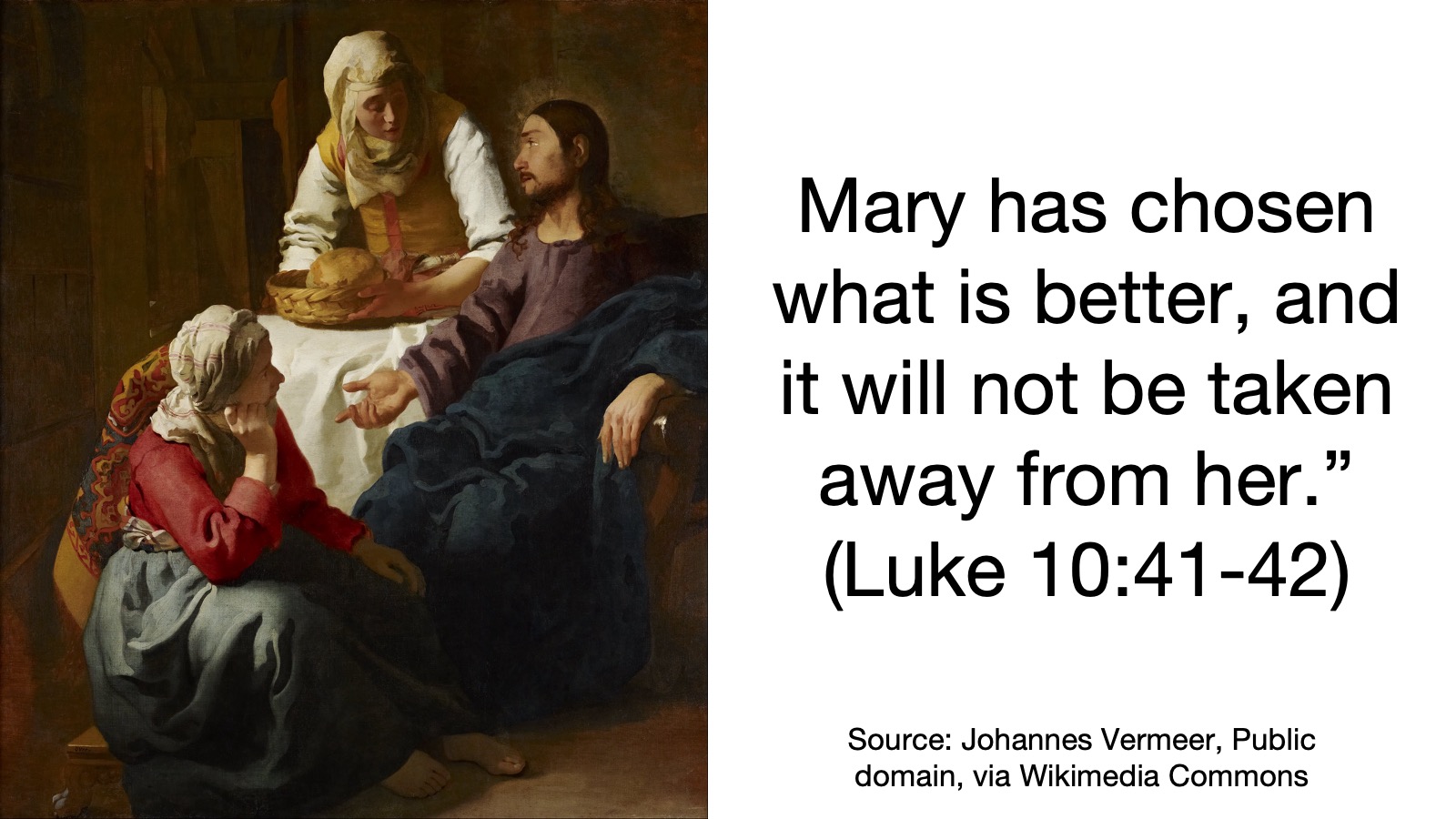
I’m guessing that many of us tend to be like Martha and focus on what we are doing with our efforts and energy. I know that I do that. But Jesus shows us that everything we do—our prayer, our worship, and even ordinary, everyday things like preparing a meal—are best begun by sitting at Jesus feet and receiving from him.
For when we look at what Jesus taught his disciples about prayer in Luke 11, we see that prayer is all about relationship, the relationship between us and God. That relationship is a gift given to us by Jesus. For he is God the Son who became fully human, lived a perfect human life for us, suffered and died on a cross for all our sins, and then rose from the dead on the third day that followed to make each and every one of you a beloved, forgiven child of God. Because of Jesus, we can approach God like a little child comes to their earthly father and say, “Dad, I’m in big trouble. I need you and I need your help. Please come and help me.” And before we even ask, we can know with certainty that our heavenly Father will do all that he can to help us because he loves us and wants to give his children good gifts.
God wants us to ask him for the things we need, and in the asking we learn that the gifts he gives us are greater than the earthly needs which prompt us to pray. We pray for bread for our hungry bellies, and God gives us that and more. He also gives us Jesus, the bread of life from heaven who nourishes our soul in this life and forever. We long for a portion of God’s holiness to be present among us, and God gives that and more. With the faith that the Holy Spirit has poured into our lives, God declares us to be completely holy in his sight as his Son, Jesus, who lives in us, and we live in him. We beg for deliverance from the various temptations that assault us, and God does do that and more. deliver us from evil. But it is more than a momentary rescue. For Jesus has made us new people with a new identity that is firmly anchored in him, not us. Jesus knows that we struggle with temptation and often succumb to sin, but when that happens it does not change how he sees us in any way, shape or form. And when we, by faith in him, begin to see ourselves as Jesus sees us, temptation loses its power to hook and hold us. After all, why would we settle for the false promise of temporary pleasure or power when the great gift of life in God’s kingdom is already ours?
What does all this mean for us?
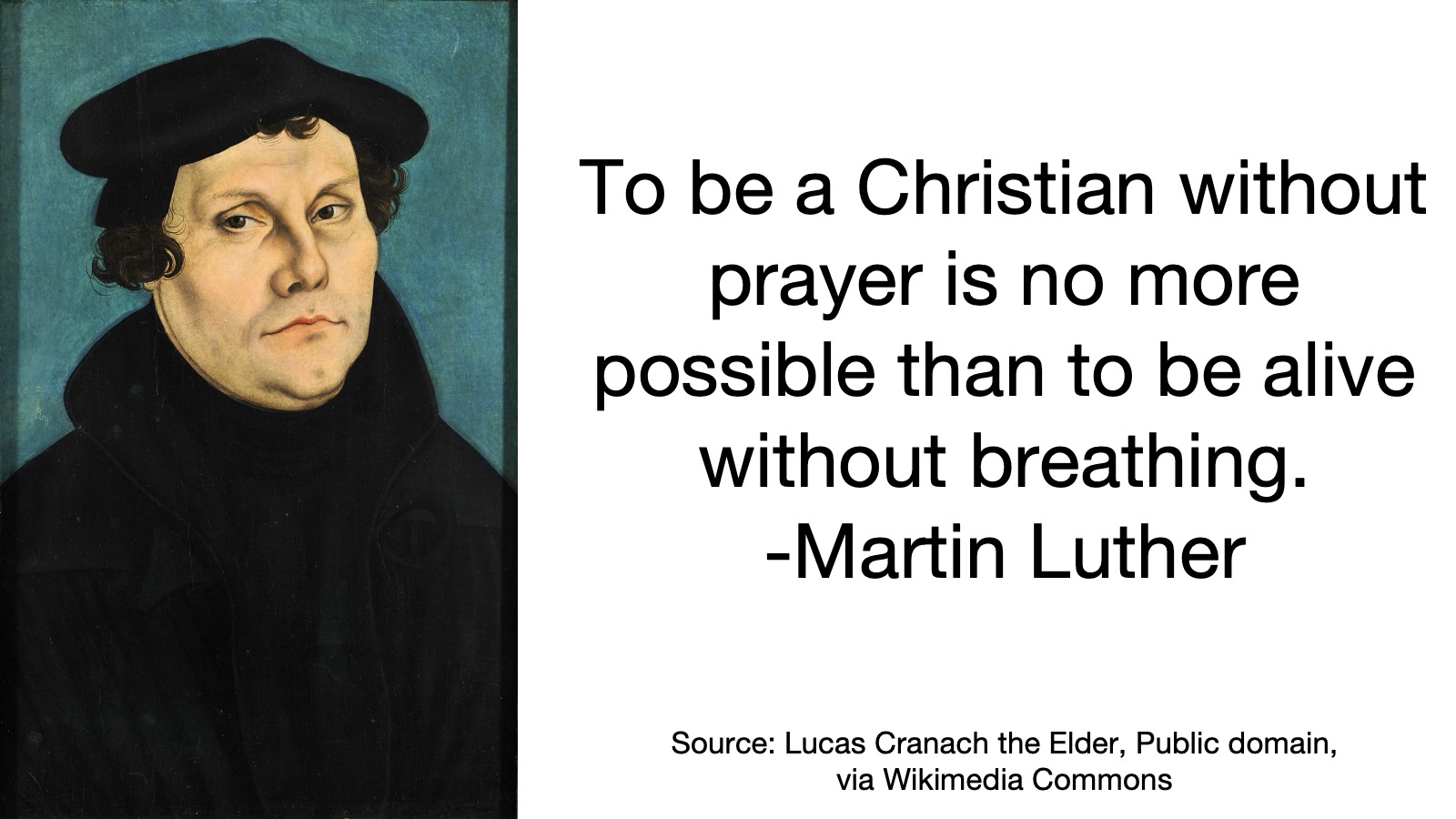
To counter our innate tendency to try to live our life in our own power, we need going, interactive conversation with God to guide, encourage and empower us in the life we have as his child. I think that is why Martin Luther said, “To be a Christian without prayer is no more possible than to be alive without breathing.” It is through prayer that we learn again and again, that we have a gracious and loving Father who loves to generously give his children good gifts, like the gift of Jesus, the gift of the Holy Spirit, and the gift of life in God’s kingdom as his beloved, forgiven child. It is through prayer that we see that, through Jesus, God’s kingdom has already come to us and the life we are living right now is being lived before our Father in heaven, even as we live that same life before humanity on earth.
God has breathed the breath of heaven into the clay of our human existence and that changed everything for us. God is our loving Father, we are his beloved children, we are journeying toward the release and restoration of all creation that Jesus is bringing to this world, and prayer is the conversation we have with God along the way.
We Tend to Pray the Lord’s Prayer Backwards
In an issue of CT Magazine, Pastor Andrew Wilson described his reflections on prayer after he and his wife were on a flight that was caught in severe turbulence on final approach to land. People began crying out to God and Pastor Wilson was fascinated by the content of those prayers. After the plane landed safely, he realized that we humans tend to pray the Lord’s Prayer backwards. The most common petitions he heard were variations of “Deliver us from evil.” People were exclaiming, “Help!”, “Save us!” and “Please don’t let me die!” Less frequently, he heard people cry some form of “Forgives us our sins” as people said, “I’m sorry” and “God, please forgive me.” Then came prayers like, “Please, keep my children safe”, or “Please, provide for my family.”
Pastor Wilson wrote,
“Left to our own devices, we pray the Lord’s Prayer backwards. Without being taught, we say help, then sorry, then please do X for me, and then please do Y for others. And then we begin to appreciate more fully the One to whom we are praying—not just as the One who dispenses safety, redemption, and material goods, but for his own sake.
Yet Jesus taught us to pray it forwards. The topsy-turvy order of the Lord’s Prayer is one reason it is so remarkable. Jesus wanted to make sure (the disciples) never forgot that prayer is not intended to move from action to relationship. Instead, it is intended to move from relationship to action.”[i]
Today’s Challenge
Remember, when Jesus taught his followers how to pray, he said that they should begin by addressing God as Father.
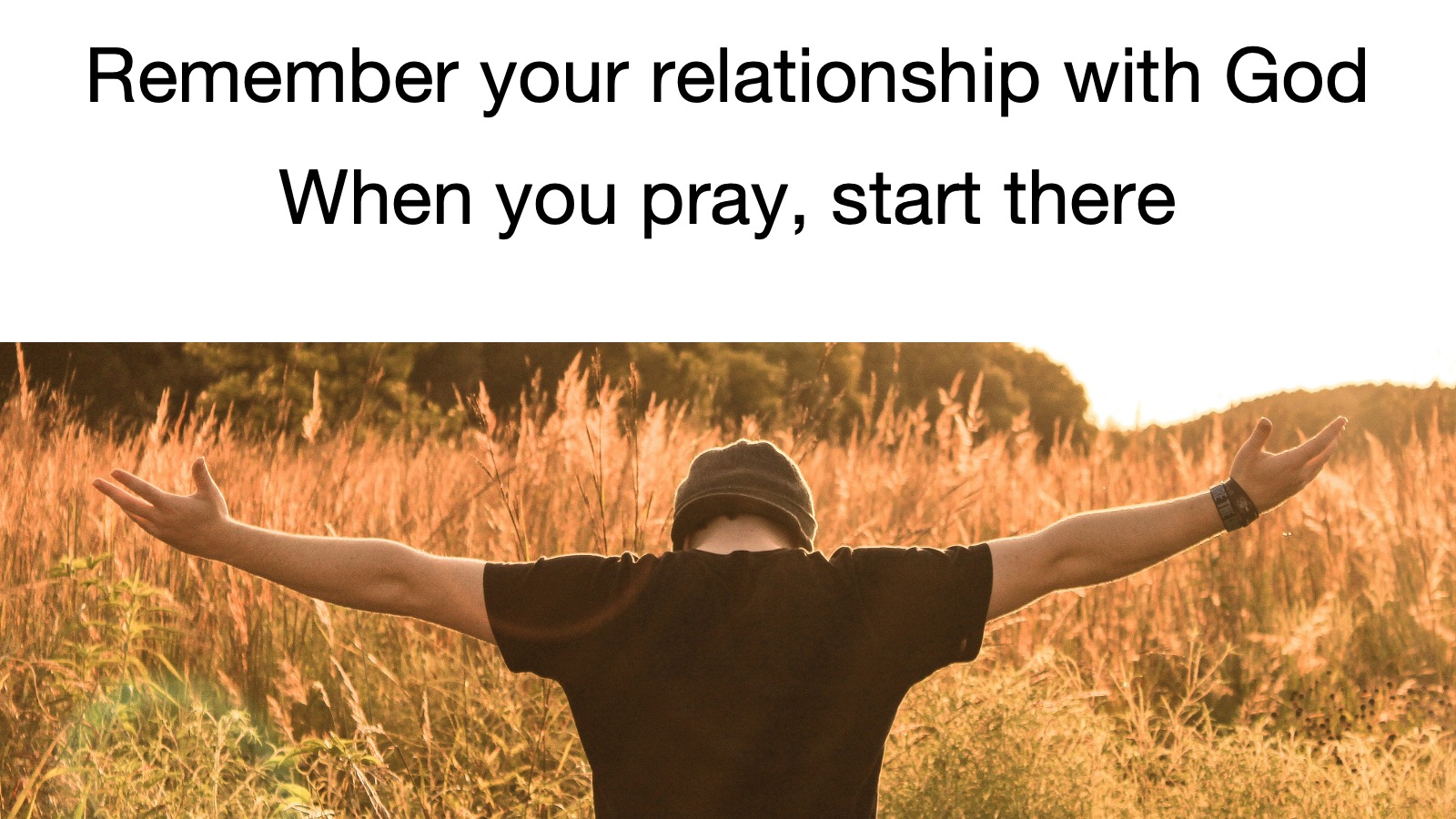
Therefore, here is the challenge I am setting before you today: Forget any flowery formulas you may have for prayer. Instead, remember your relationship with God. Because of Jesus, he is your Father and you are his child. When you pray, start there and the rest will naturally flow from there. For when our prayers are focused on the relationship with God we have through Jesus, it transforms how we see God and how we see ourselves. Amen.
[i] Andrew Wilson, “Backwards Prayers,” Preaching Today (Internet; available at: https://www.preachingtoday.com/illustrations/2022/october/backwards-prayers.html; accessed July 26, 2025).

 Farewell to Shadowlands