

One of the most challenging things in business is to navigate an intergenerational transfer in a family business. And I’ve had some experience with this, being part of a family business, and I know this from others who’ve gone through similar kinds of things. So it’s always interesting to me when I see a business that has done it successfully. And so my interest is piqued when I was online one day and I saw an infographic from Forbes magazine that talked about five businesses that had successfully made transitions like this. I was especially excited to see that one of them was a Canadian company, Canada Goose clothing company, which was started in 1957 by Sam Tick in Toronto. He was making clothing for other companies who would then put their labels on it. In 1972, his son-in-law David Reiss came into the business and David invented a machine that stuffed down into clothing in large quantities, so he mechanized that process. In 1982, he became the CEO of the company, and then his son Dani entered the company in 1997 in the sales division. In the year 2000, he was the one who encouraged the name change to Canada Goose. And then in 2001, he became the CEO of the company. Now, Canada Goose has a net income of $70 million in 2021, on revenues of over $900 million. The three keys to their transition were, first, don’t take over the family business unless it’s who you truly are. Second, previous ownership must let the next generation run the business in their own way. And third, the pre-planned handover doesn’t work. It’s better to let things happen naturally.[i]
And if you think about it, this almost sounds like a spiritual process. If we were to use “church language” to describe those three keys we might say something like, ‘Use the gifts the Spirit has given you; train up your child in the way they should go, and then when they’re older, they can run the company; and follow the Spirit as He unfolds events in the day-to-day of our lives.’
The issue of transitions is a big one because all of us have to somehow figure out how to make a transition from being overwhelmed by the many big challenges that confront us to handling them with confidence. For some of us our challenge may be how to transfer the business over to the next generation in the family, but there are many other big problems in the world today. There are many people who have been negatively impacted by the rise of interest rates, and they cannot afford the mortgages on their houses anymore. There are people whose jobs have been severely impacted by the COVID-19 pandemic, and things have not returned to normal, whatever normal is. There are people facing all kinds of challenges today. But the question is, how do we do that?
We have clue in the Bible from the lives of the first disciples of Jesus. They faced extremely difficult challenges, but what may be confounding for us is that even though they were with Jesus for about three years, they were hesitant and uncertain in their faith during that time. The divine Son of God is with them, teaching them, loving them, and showing them all kinds of miraculous things, and yet they don’t fully get it. But then, later on, they had this confident, bold, powerful faith, and Jesus wasn’t around when they had it. How does that happen? Well, that’s what we can ask for ourselves. How do we transition from being hesitant and uncertain in our faith to being bold, confident, and powerful in our faith? And to help us think about that question, we’re going to be looking at John chapters 13 and 14. If you have a Bible or a Bible app, I invite you to turn there now.
This whole section of chapters is set in the night when Jesus was betrayed. These moments that Jesus has with his followers are so very precious because they are the last moments he’s going to have before he goes to the cross and there’s a lot of weight to the words Jesus shares. During this time, as he and his followers are gathered in the upper room, where they’re celebrating the Passover for the last time, there are some events that are going to change the trajectory of the history of creation forever. First, Jesus does this amazing thing. He washes the dirty, stinky feet of his sandal-wearing followers, a job that was reserved for the lowest household servants. After he washed everybody’s feet, he says, “I have given you an example to follow. Do as I have done to you. I tell you the truth, slaves are not greater than their master, nor is the messenger more important than the one who sends the message. Now that you know these things, God will bless you for doing them.” (John 13:14-17) Jesus is modeling servant leadership for his followers back then and for all of his followers down through the ages. He shows us how to lead by serving.
Then Jesus does something quite shocking. He says, “I tell you the truth, one of you will betray me.” (John 13:21) This is a close-knit band of followers, and Jesus is saying that one of them is going to turn Jesus over to his enemies. We know that the betrayer is Judas and shortly after Jesus said this, Judas left the meal. The other disciples didn’t know Judas was the betrayer and they thought he was going to do something related to the finances because he was the treasurer of the group. He held the moneybag for the group and he was helping himself to it. The real reason Judas left the meal was to finalize the plan to place Jesus into the hands of his enemies.
With this moment, Jesus is being propelled toward the cross. Within hours, he would be arrested, beaten, falsely accused, flogged, unjustly condemned, and nailed to a cross to suffer and die for the sins of the whole world. In doing so, Jesus was making a way where there was no way. He made a way for all of humanity to have a living relationship with the God who loves them. And we know that’s the case because on the third day that followed, Jesus rose from the dead. He’s alive and that means that the penalty for sin has been paid in full.
On top showing his followers how to lead and telling them that one of them would betray him, he also told them that he was going to die. He said, “You children, I will be with you only a little longer. As I told the Jewish leaders, you will search for me, but you can’t come where I’m going.” (John 13:33)
There are numerous tumultuous events in the future for his followers, but they’re going to have to face those things without the physical presence of Jesus. Can you imagine the fear that they felt in that moment? In a way, we face the same dilemma as those first disciples. We get to know about Jesus through the stories we read in the Bible, where he did things as a physical being, a being that people could see and touch.
But then, how do we transition from knowing about Jesus to knowing him personally and having a personal relationship with Him when we can’t see him with our eyes? There’s a gap that we need to get over, and Paul describes that gap in this way in First Corinthians as he’s writing to the church there. He says, “Brothers and sisters, I couldn’t address you as people who live by the Spirit but as people who are still worldly, mere infants in Christ.” (1 Cor. 3:1) How do we transition from being worldly followers of Jesus to being people who live by the Spirit? How do we transition from having a tentative, insecure faith to having a bold and vibrant faith, even in the face of persecution, even in the face of the threat of death? How does that happen?
It happens through the promises that Jesus gives to us. When Jesus said that He was the way, Philip then asked for some extra assurance. He said, “Just show us the Father, and that’ll be enough for us.” And Jesus says this, “Don’t you believe that I am in the Father and the Father is in me? The words I speak are not my own, but my Father who lives in me does his work through me. Just believe that I am in the Father and the Father is in Me, or at least believe because of the work that you have seen me do.” (John 14:10-11)
So what is Jesus saying? He is saying that the foundation of the comfort that he gives is the triune nature of God. We believe based on what we read in the Bible that God is one God, so there’s unity, but he exists in three persons: Father, Son, and Holy Spirit. That’s how the word Trinity was developed. Now, the word “Trinity” is not in the Bible, but the God that’s described in the Bible is a Trinity, Father, Son, and Holy Spirit. Today is Holy Trinity Sunday, and often in some churches, the Athanasian Creed is recited. I would like to share with you just an excerpt from it because this is a statement about what we believe about the Trinity. Just a note, whenever you see the word “catholic” spelled with a lower case “c”, that mean “universal”.

And the catholic [or universal] faith is this, that we worship one God in Trinity and Trinity in Unity, neither confusing the persons nor dividing the substance.
For the Father is one person, the Son is another, and the Holy Spirit is another.
But the Godhead of the Father and the Son and of the Holy Spirit is one, the glory equal, the majesty co-eternal.
What is this creed of the Christian church saying? It’s saying that God is one in substance and yet exists as three different persons: Father, Son, and Holy Spirit. And why is that a source of comfort for us? It’s a source of comfort for us because when we have Jesus, we have all of God, including the Father.
Jesus not only tells us how we can be sure of the promises he makes to us, he also goes on to say something which, if you think about it, is quite astounding. He says, “I tell you the truth, anyone who believes in me will do the same work I have done and even greater works, because I am going to be with the Father. You can ask for anything in my name, and I will do it so that the Son can bring glory to the Father. Yes, ask me for anything in my name and I will do it.” (John 14:12-14)
So what is Jesus saying here? Remember, Jesus has already told us that when we have him, we have all of God, including the Father. But now Jesus is also saying that after his ascension, he is our Advocate with the Father. He is at the right hand of the Father, which is a position of power, authority, and honor. Back in that time and culture, the honored guest would be seated at the right hand of the host. Jesus is in that position of honor, power, and authority, at the right hand of the Father, and he is serving there as our advocate. As he’s with the Father, he’s speaking to the Father on our behalf, and Jesus promises us that He will do whatever we ask him in his name that glorifies the Father.
Not only that, Jesus also promises to send a second Advocate to be with us. Now some Bible translations use the word “Advocate,” others use “Helper”, or “Encourager”, and some use the term “Paraclete,” which harkens back to the Greek term meaning someone who comes alongside and calls out to you, supporting you like a friend who walks with you in a time of great trouble. This is the picture that Jesus has given to us. “And I will ask the Father, and He will give you another Advocate, [Jesus is the first advocate, and the Holy Spirit is the second one] who will never leave you. The Holy Spirit leads you into all truth. The world cannot receive Him because it isn’t looking for him and doesn’t recognize him. But you know him because he lives with you now, and later will be in you.” (John 14:15-17)
What is Jesus saying to us here? He’s saying that the Holy Spirit is the one who connects us, through faith, to Him. And not only that, but it is also through the Holy Spirit that we get to know Jesus personally. We all need the Holy Spirit in our lives. And Jesus’ promise to us is that we have the Holy Spirit. The Holy Spirit comes alongside us and speaks Jesus’ words of comfort, encouragement, forgiveness, and life to us. The Holy Spirit helps us to transition from living as worldly Christians to living by the Spirit.
Now, let us remember that coming into the fullness of life with God is totally God’s work and is entirely a gift. The Father creates, nurtures, and provides for us. The Son, Jesus Christ, went to the cross to pay the debt of forgiveness for all our sins so that anyone can walk through the doorway of life with God. He has opened that door for us.
But let us not forget the work of the Holy Spirit. He breathes life into our dead, God-denying soul and brings us into a free and full relationship with the three-in-one God. The Holy Spirit points us to Jesus, teaches us all truth, gives us faith, and then grows that faith to maturity. The Holy Spirit helps us to turn away from our old life and leave it behind. And the Holy Spirit is the one who helps us to do the great things that will glorify God.
Now, whenever people talk about the Holy Spirit, the concept of power comes up. And it’s good and proper that it does because Jesus said, “You will have power when the Holy Spirit comes upon you.” Now, in recent years, and even longer ago than that, there have been problems with the way power has been handled in the Christian church. We know this from stories of pastors who have fallen, like Bill Hybels and Ravi Zacharias. If any of you watched the Secrets of Hillsong series, you know that it touches on how power was abused. In Canada, we also have our own history with the residential school system, which involved the abuse of power among other sins. So we have to wrestle with the idea of how power should be used and what is the right way to use it.
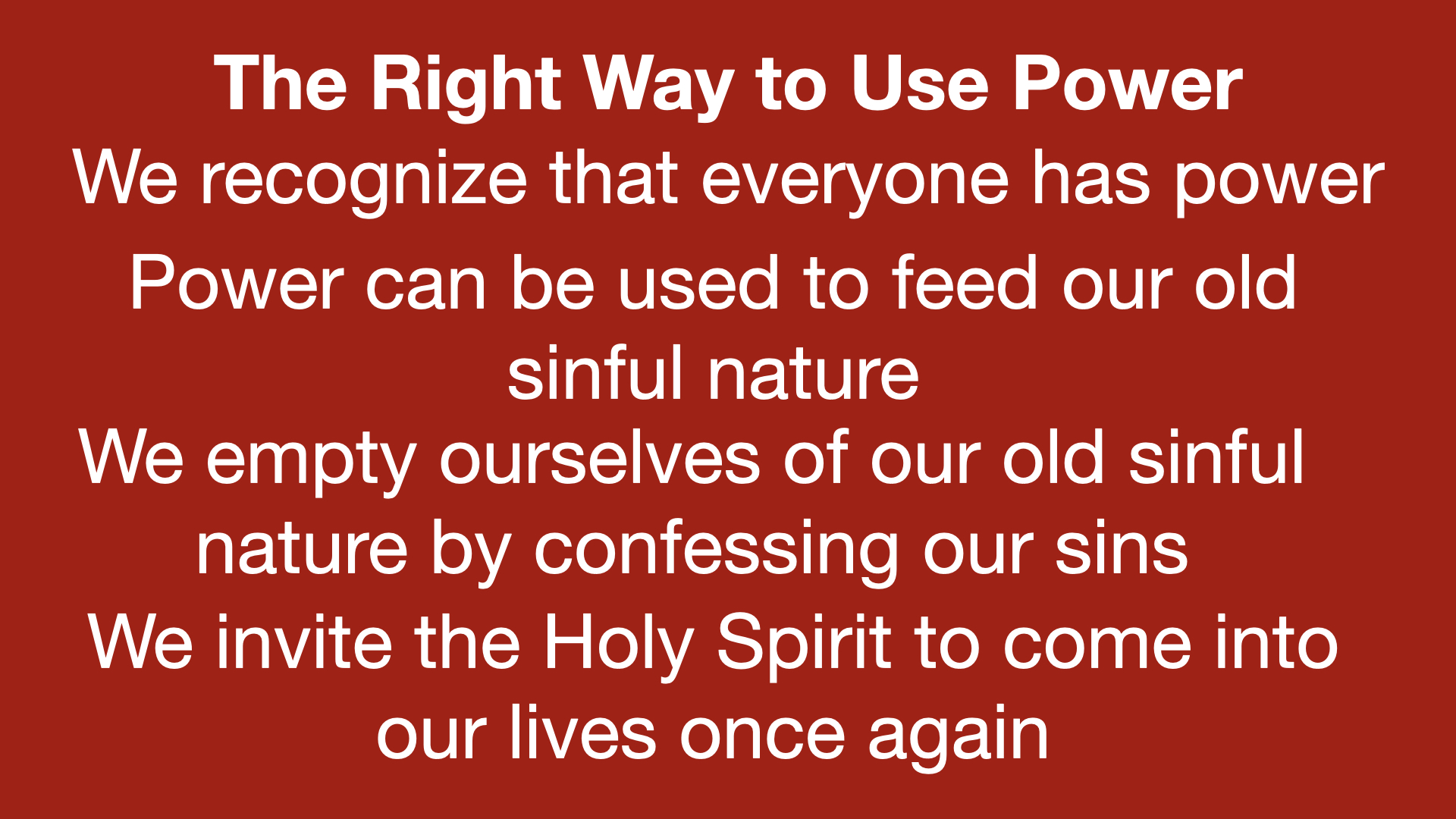
The right way to use power starts by recognizing that everyone has power. We often think of power belonging only to those in positions of authority or those with abundant resources. But everyone, even if you are living in the Downtown Eastside, has power given to them by God. And God gives us the freedom to choose how to use it. So first, we must recognize that everyone has power.
The second important thing is to acknowledge that power can be used to feed our old sinful nature. This can happen very easily, and I think in many cases this is what is going on behind the scenes when power is abused in the church. A discerning question for us to ask ourselves is this: Am I using my power to feed my ego, or am I using my power to serve others? God gives us power so we can serve others, but how do we turn things around when the only patterns we are familiar with are ones where power is abused? How do we break away from those patterns we’ve seen, perhaps in our own lives, relationships, workplaces, or even in the church?
There is a passage in Philippians 2 that where Jesus shows us how to do that: “Have this mind among yourselves, which is yours in Christ Jesus, who, though he was in the form of God, did not count equality with God a thing to be grasped, but emptied himself, by taking the form of a servant, being born in the likeness of men.” (Philippians 2:5-7) Jesus emptied Himself and set aside the use of divine power so that He could come and be one of us and bring us into life with God.
In a similar way, the next step for us in the right use of power is to empty ourselves of our old sinful nature by confessing our sins, allowing Jesus to forgive us and make us more like Him. Then, the fourth step is to invite the Holy Spirit to come into our lives once again and fill us. For some people, it’s a one-and-done experience, but for many of us, it’s something we need to do each day – to invite the Holy Spirit to come into our lives once again.
Imagine that I have a glove. If I set it on a table beside a Bible and I say to the glove, “Pick up that Bible,” nothing happens.
Maybe the glove needs some encouragement. If I speak to the it and say to it,” I know that you are a good glove. I’ve seen you work well in other situations. I know you can do this, just go ahead and pick up the Bible. You can do it!” But nothing happens.
If I put other gloves around the glove so that it has some fellowship, and then I tell the glove to pick up the Bible, still nothing happens.
And it’s the same with us. We cannot do the work that God calls us to do, and we cannot live the fullness of the rich, full, abundant life that Jesus wants to give us until we are filled by the Holy Spirit, which is the Spirit of Jesus Christ.[ii]
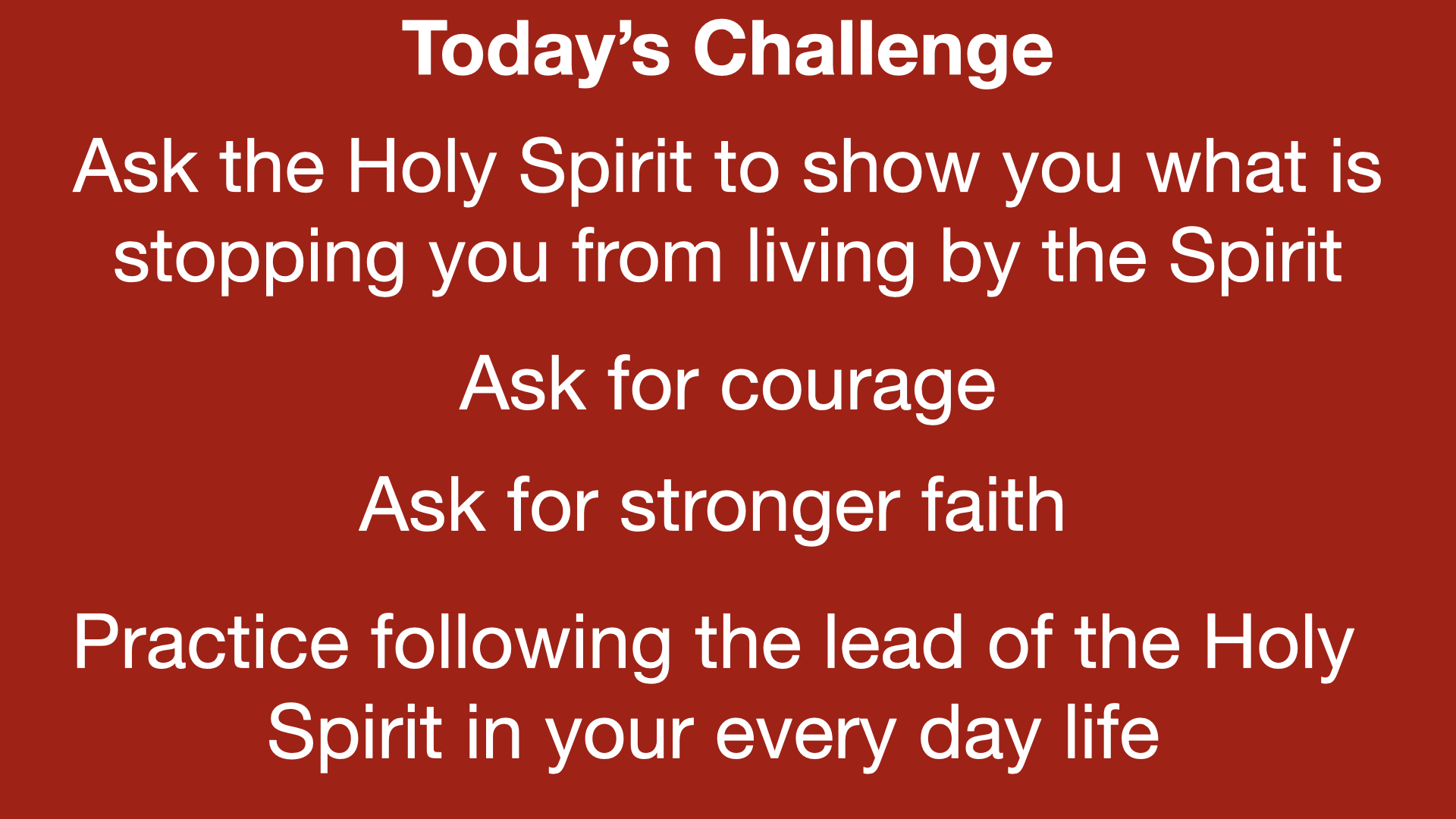
So the challenge that I want to leave you with today is this: ask the Holy Spirit to show you what may be stopping or impeding you from living by the Spirit. Then ask for the courage you need to turn away from those things, whatever they may be. Also, ask for stronger faith, bold faith, and confident faith. Then, practice following the lead of the Holy Spirit in your everyday life. Start with the little things that you sense the Spirit is directing you in, and over time, grow in following His lead in bigger things. That’s what walking with the Spirit truly means. Amen.
[i] “5 Successful Business Transitions: And What Made Them Work,” Forbes (Internet; available at: https://www.forbes.com/sites/suntrust/2018/08/27/5-successful-business-transitions-and-what-made-them-work-infographic/?sh=6f65c938cc99; accessed on May 24, 2023), and “Canada Goose (clothing),” Wikipedia: The Free Encyclopedia (Internet; available at: https://en.wikipedia.org/wiki/Canada_Goose_(clothing); accessed on May 24, 2023).
[ii] “’The Glove’ Illustration from Pastor Bryan’s Sermon on June 7, 2015.” Grace Chapel. June 9, 2015. Video, https://www.youtube.com/watch?v=i5k1741uj2c.


1 Comment