

I think that we live in a very strange time. Recently, significant social movements like Me Too, Black Lives Matter, and Every Child Matters began to try to address and remedy issues like sexual violence, racism, and the inter-generational devastation caused by Canada’s residential school system. At the same time, we have the rise of Cancel Culture where people are shamed and ostracized because they have offended somebody. And with the proliferation of social media, now anyone anywhere can be the judge, jury, and executioner for someone’s reputation and career. Now, let me be clear, I think that it is a good thing for past wrongs to be brought to light so that they can be properly addressed and healed. Isn’t that something that we as Christians believe in? We call it Confession and Forgiveness. And I also think that it is a good thing for individuals to have a voice on social media where they can raise concerns and cast light on harm that is being done.

But there are also great problems with the changes that are happening in our society. For example, there is a chilling effect on public discourse. People are afraid of offending someone and getting canceled, so they don’t share their personal thoughts and feelings about important issues. Also, there is no due process that protects the reputations and careers of innocent people. But, I think that the biggest problem with these changes in our culture is that there is no pathway of restoration for those who have done something wrong. It seems like the Western world has switched from being a guilt culture to a shame culture within a generation, and we are having trouble adapting to that new reality.
These external factors in the culture around us have an impact on our inner world, and that is worthy of our attention because the state of our internal world determines how well we function in life. Guilt in our inner world tells us that we have done something wrong, but we also know that our path back to wholeness requires that we pay the penalty for our misdemeanours. But shame says that there is something wrong with me, and that can be devastating in a person’s inner world, especially in a culture that does not offer any pathway of recovery. How can we have any hope of restoration when we find ourselves in a pit of shame? That’s what I am inviting you to reflect on with me. To help us as we do that, we are going to be digging in a particular passage from the Bible: John 21:15-25. If you have a Bible or a Bible app nearby, I invite you to turn there now.
Peter’s Denial of Jesus
However, before we get to John 21, we are going to look at some other passages to give you important background information that you will need to know. On the night before Jesus was crucified, he told his followers that he would be leaving them soon. In chapter 13 of John’s Gospel, we read:

Simon Peter asked him, “Lord, where are you going?”
Jesus replied, “Where I am going, you cannot follow now, but you will follow later.”
Peter asked, “Lord, why can’t I follow you now? I will lay down my life for you.”
Then Jesus answered, “Will you really lay down your life for me? Very truly I tell you, before the rooster crows, you will disown me three times! (John 13:36-38)
Within hours, Jesus was arrested in the Garden of Gethsemane and taken to the home of the High Priest for questioning. As Peter warmed himself by a fire in the courtyard of the High Priest, he was twice accused of being an associate of Jesus and twice he denied even knowing him. Turning to Luke 22, we find out what happened next:
About an hour later another asserted, “Certainly this fellow was with him, for he is a Galilean.”

Peter replied, “Man, I don’t know what you’re talking about!” Just as he was speaking, the rooster crowed. The Lord turned and looked straight at Peter. Then Peter remembered the word the Lord had spoken to him: “Before the rooster crows today, you will disown me three times.” And he went outside and wept bitterly. (Luke 22:59-62)
Can you imagine the shame Peter must have felt in the depths of his soul? He wanted to stand with Jesus, but his fear of being harmed was greater than his love for Jesus, and Peter denied knowing Jesus, not once, not twice, but three times. Then, in the very next moment, he looked into the eyes of the One he denied, a rooster crowed, Peter realized what he had done.
Jesus Restores Peter
Fast forward to several days later, a time after the horror of Jesus’ crucifixion and death and the glory of his resurrection. Peter and six other disciples of Jesus have gone fishing on the Sea of Galilee. They fished all night but caught nothing. Early the next morning, a stranger on the shore told them to cast their net on the right side of the boat, which they did. Their net was soon filled with so many fish that they were unable to pull the net into their boat. John immediately realized that the stranger on the beach was Jesus, and he called out, “It is the Lord!” Hearing this, Peter jumped in the water and headed toward Jesus. The other disciples followed in the boat, towing the net behind them. When they all got to shore, there was Jesus, cooking a breakfast of fish and bread for them.

Turning again to John’s record of events, we read:
When they had finished eating, Jesus said to Simon Peter, “Simon son of John, do you love me more than these?”
“Yes, Lord,” he said, “you know that I love you.”
Jesus said, “Feed my lambs.”
Again Jesus said, “Simon son of John, do you love me?”
He answered, “Yes, Lord, you know that I love you.”
Jesus said, “Take care of my sheep.”
The third time he said to him, “Simon son of John, do you love me?”
Peter was hurt because Jesus asked him the third time, “Do you love me?” He said, “Lord, you know all things; you know that I love you.”
Jesus said, “Feed my sheep. Very truly I tell you, when you were younger you dressed yourself and went where you wanted; but when you are old you will stretch out your hands, and someone else will dress you and lead you where you do not want to go.” Jesus said this to indicate the kind of death by which Peter would glorify God. Then he said to him, “Follow me!” (John 21:15-19)
Key Takeaways That We Can Apply to Our Lives
So what are some things we can take from this passage and apply to our lives? First of all, no matter what we have done, regardless of how shameful it may be, Jesus will restore us. In many ways, we are like Peter, full of good intentions, making good commitments, and then spectacularly failing to follow through. Could there be a more shameful thing than to deny that you know Jesus and then look into his eyes? Yet Jesus loved, forgave, and restored Peter, and he will love, forgive, and restore you too!
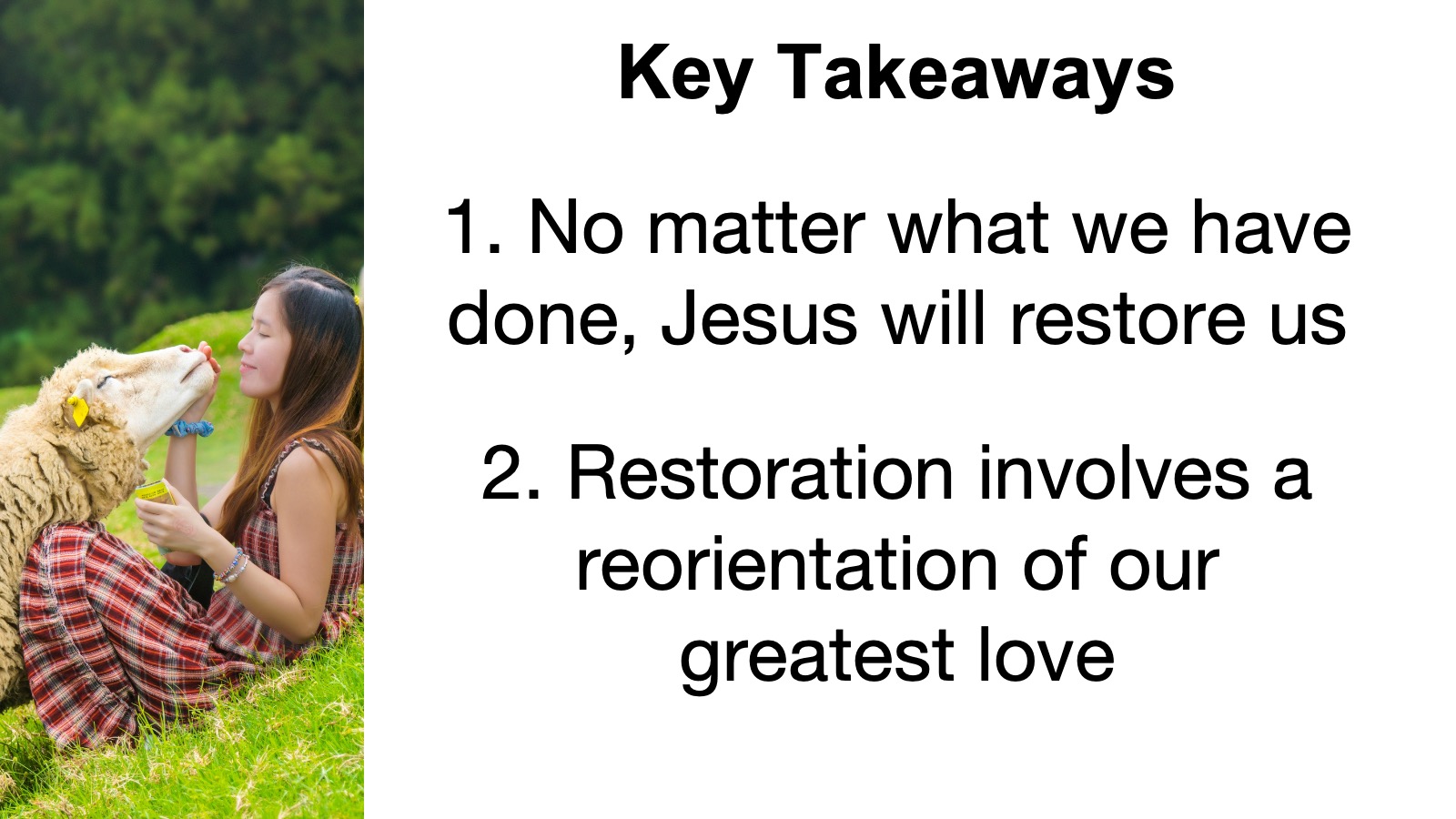
Second, restoration involves a reorientation of our greatest love. When Jesus asked Peter, “Do you love me more than these?” the question could have meant several different things. Peter and his friends were fishing, and Jesus might have been asking Peter if he loved him more than the boats and gear Peter used for fishing. Or Jesus could have been asking Peter if he loved him more than he loved his friends, the other disciples. Another possibility goes back to Peter’s earlier claim that he would follow Jesus even if everyone else abandoned him. Maybe Jesus was asking Peter if he really loved him more than the other disciples did, which is what he had claimed earlier. A fourth possibility connects to Jesus’ statement to Peter, “When you are old you will stretch out your hands.” This was a phrase that the people of that time clearly understood as referring to crucifixion. Maybe Jesus referring to life in general when he said the word “these” and was thereby asking Peter if he loved him more than he loved his own life?
We have no clear answer, but it could be that Jesus was deliberately being vague to include anything that we might possibly love more than him. You see, when Jesus restores us, he doesn’t want to simply take us back to where we were before. He wants to use the shameful experience we went through to bring us to a better state where we are built up and strengthened in faith, hope and love. That’s why, before we go ahead with Jesus, we need to go back with Jesus, back to the root cause of our shameful derailment, which is always loving something else more than Jesus. And, as Jesus restores us, he gently recalibrates and reorientates our love so that our heart is once again focused on him as our greatest love. Then as Jesus’ love for us has its way in our heart, we are drawn deeper and into the rich, full, abundant life that he wants to give to us.
Third, relying on Jesus and on his knowledge will carry us through our darkest valleys of fear and doubt. When Jesus asks Peter three times if he loves him, that must have been hard for Peter. It would have taken him back to that moment in the courtyard of the high priest’s home when he denied Jesus, and all those emotions he felt then must surely have come flooding back. But Peter was changed by that experience. In the Upper Room, Peter’s reliance was on himself and on his own power, wisdom, and strength. We see that in his words when he said, “I will lay down my life for you.” Now he said, “Lord, you know all things. You know that I love you.”
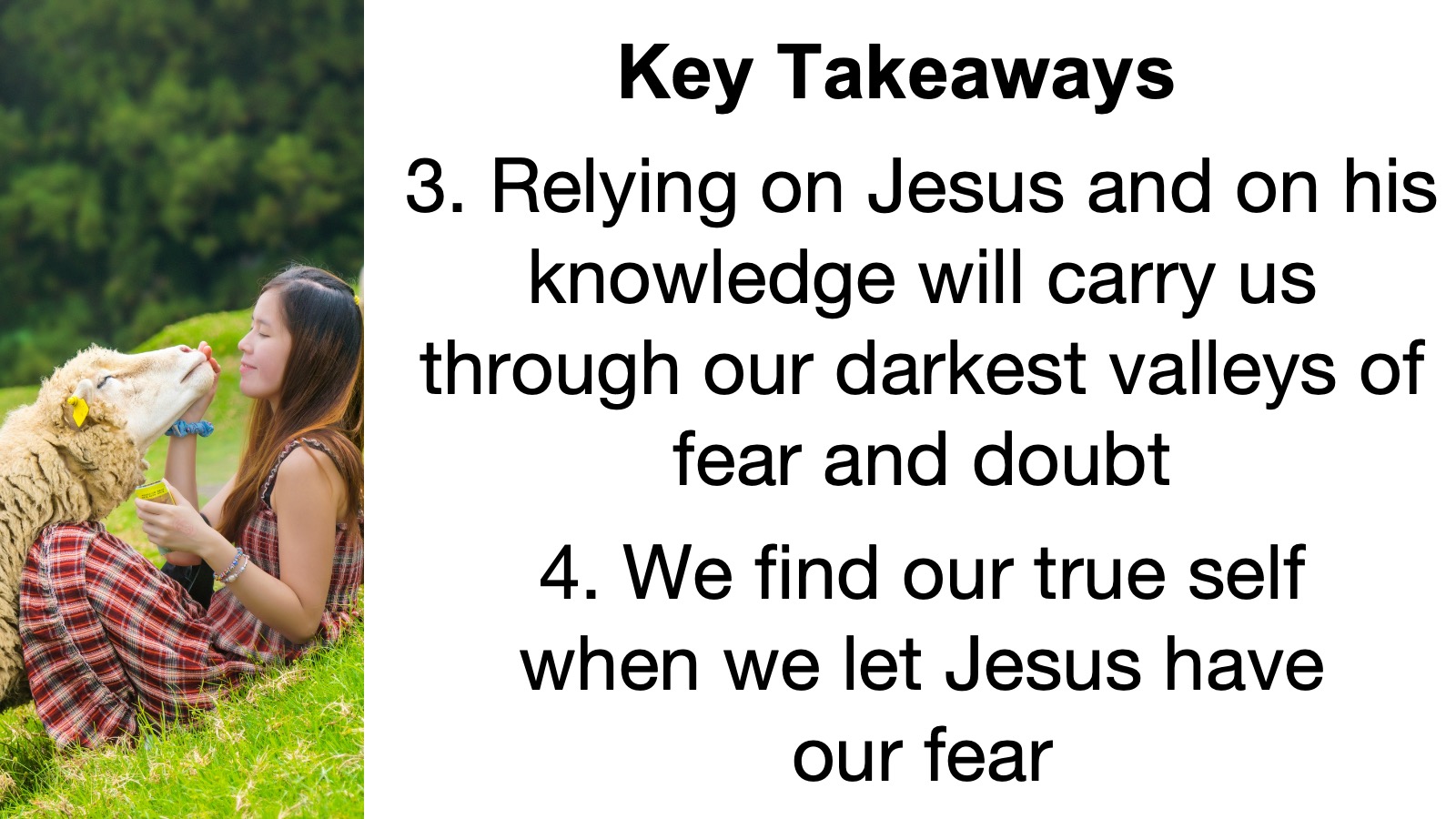
One of my seminary professors used to say, “We need to pay attention to who is driving the verbs.” Prior to his failure, it was Peter that was driving the verbs of his life. But after all that Peter went through, he knew that the true power, hope, healing, and restoration that he needed lay, not within himself, but in Jesus. And in Peter’s life, Jesus was now driving the verbs. Realizing the futility of relying on his own knowledge and strength, Peter came to a place of fully relying on Jesus and his knowledge and strength. That reliance on Jesus would carry Peter through all the highs and lows of the remainder of his life, and it will carry you too!
Fourth, we find our true self when we let Jesus have our fear. Peter wanted to be the kind of person who would lay down his life for Jesus, but his fear derailed him into a path of shame. I think that seeing the resurrected Jesus was what took away Peter’s fear. What was there left to be afraid of when Jesus had defeated humanity’s greatest enemy, death?
Always Remember that You are Lovable & Loved
Shame researcher and author, Brené Brown, has said “Shame is basically the fear of being unlovable.”[i]

Dear friends, always remember that you are lovable and loved. Jesus has proven that by dying on the cross and rising again so that he could live with you and you could live with him forever. Whenever an external or internal voice speaks a word of shame to you, give that word to Jesus. And continually fill your heart and mind with his words of unconditional love and acceptance for you. Then you will be equipped to serve others with his love as he has loved and served you. Amen.
[i] Elizabeth Whitworth, “16 Brené Brown Shame Quotes + Context and Explanation,” Shortform (Internet; available at: https://www.shortform.com/blog/brene-brown-shame-quotes/#:~:text=%E2%80%9CShame%20is%20the%20intensely%20painful,the%20fear%20of%20being%20unlovable.%E2%80%9D; accessed August 24, 2024).
This message was shared at Walnut Grove Lutheran Church in Langley and St. Luke Lutheran Church in Surrey on September 1, 2024. For more info about Walnut Grove or St. Luke, please go to wglc.org or sllc.ca.

 Farewell to Shadowlands