

On Sundays, I wear contacts, but I usually wear glasses the rest of the week. A few weeks ago, while I was at the church someone saw me wearing my glasses and asked if they were new. Then they said, “When I saw you with your glasses on, I thought of John.” John is my son and I have had people tell me before that one of my kids looks like me, or that I look like one of them, and each time it is a surprise to me. But it shouldn’t be because in my family we have something called the “Paulgaard head,” which is a family trait that gets passed down through the generations. I have it, my dad had it, and my sons have it.
We all have physical characteristics that are passed down through the generations in our families, and that happens through our genetics, but the environment also plays a role. And I have seen situations where someone is adopted into a family, yet they talk and behave just like everybody else in the family, even though they’re not related by blood. From our parents, we get patterns of thinking and ways of being which are planted deep within us, and then we act based on those things as we go through life. This is especially the case when we are stressed for that is when we really dig deep and draw from the parentage we have.
Have you ever been in an argument with someone you love and they say to you, “You sound just like your dad!” (or your mom) and they don’t mean it as a compliment? You are in a moment of stress and you are drawing on the parentage that you have been given. So we can see that Conduct is the clue to paternity. How we behave tells people who our parents are.

There world is in a lot of turmoil right now with wars in several places and authoritarianism on the rise. High interest rates are taking a larger share out of household finances, as are rents, and many people are really hurting. All of this can be overwhelming for us, and we may wonder, “How can I do anything about it?”
We can’t do anything about those things that happen out in the world, but we can do something about how we respond to them. In those moments when we are challenged, each of us has a choice regarding how we are going to respond. Are we going to respond with hatred, anger, frustration, or disgust, or are we going to be a person of peace who responds with love, grace, understanding and compassion?
And each one of us can make a difference in the world. As one person is a person of peace towards the people around them, the people in that first group can then share that peace with the people in their own groups, and it can spread from person to person and from group to group, until it goes all the way around the world. That’s how you can play a role in bringing peace into this troubled world.
However, in order to do that, we need to reflect on what sort of parentage we are drawing on, especially when we’re stressed. That’s why I am inviting you to think about this question: How does the parentage within you need to change so that you can be a catalyst for peace in this world? And to help us as we think about this question, we’re going to be reflecting on 1 John 3:11-24. If you have a Bible or a Bible app nearby, consider opening up to that passage.
There we find a letter written, many scholars agree, by the apostle John. When he was younger, John and his brother, James, were known as the sons of thunder because of their impulsive behavior and their temper, which would go from zero to 100 in amoment. And yet, as he wrote his gospel account decades later, when he was about 90 years old, John only refers to himself as “the disciple whom Jesus loved.” And as he wrote his series of three letters to people who are undergoing persecution, John emphasized love so much that some refer to him as the apostle of love.
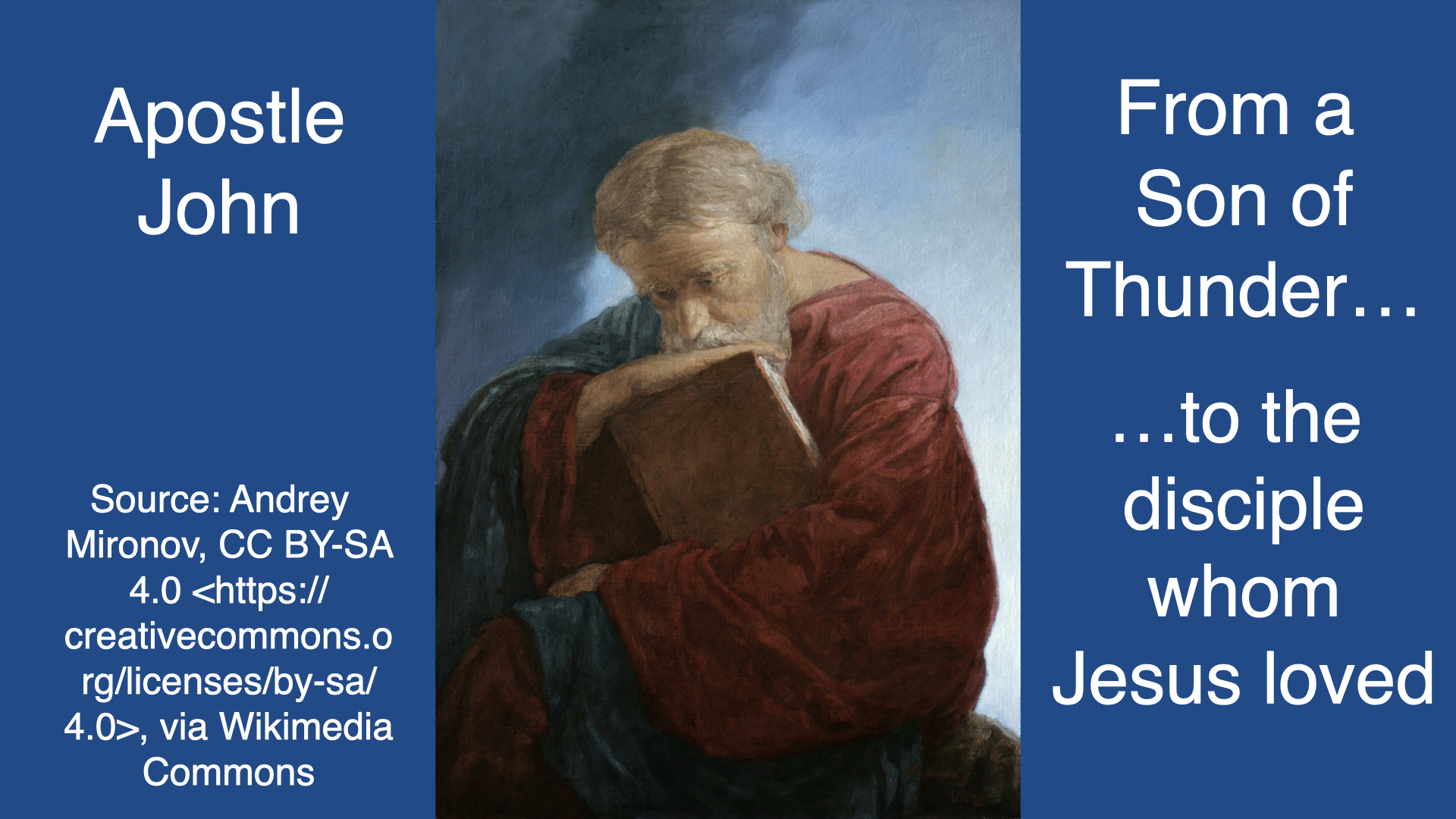
So how does that happen? How do you go from being a “son of thunder” to being “the disciple whom Jesus loved”? The answer is love. The transformation of John the Apostle happened through the love of Jesus Christ for him. You see, Jesus’ love can change the parentage we draw from in the deepest part of our being because he has given us a new Father.
John writes, “See what great love the Father has lavished on us, that we should be called children of God! And that is what we are! The reason the world does not know us is that it did not know him.” (1 John 3:1) In the person of Jesus of Nazareth, God the Son came into this world and became fully human. It was love that motivated him to leave behind everything, all of the riches and glory that he had in Heaven, to become a helpless baby in a manger. And then, in human weakness, he lived a perfect life for you and for me. And when the time was just right, he willingly, lovingly went to the cross, to give his life for your life, so you could have his life in the family of God. Because he loves you, Jesus has made you a member of God’s family, you are a beloved, forgiven child of God, and that means that God the Father is your Father. That’s the new parentage that Jesus has given you.
As we learn to live our lives with the knowledge and awareness that God is indeed our Father–that he indeed loves us, that he is providing for us, protecting us, preserving and guiding us, and that he only wants what is best for us–that’s the parentage we can draw on that will help us to be people of peace.
So Jesus gives us a new parentage and then our new parentage directs our behavior. As we live as the new person that Jesus has made us to be, of course, we are going to act and think and be different. John tells us, “This is how we know who the children of God are and who the children of the devil are: Anyone who does not do what is right is not God’s child, nor is anyone who does not love their brother and sister.” (1 John 3:10) John is reminding us of the truth that our conduct reveals our parentage. We can tell the children of God and the children of the devil apart by their actions because their actions flow from their being. Jesus has brought to life within us a new person and given us a new way to be. Our actions flow from our being, so we naturally want to obey God and love the people around us. Those who belong to the evil one do not.

This also means that we can draw on God’s love and our identity as his children whenever we face challenges. So let me give you an earthly example. Some years ago in the previous parish where I served, I was facing a situation unlike anything I had never encountered before in my life. There was some conflict that was going on, I was part of it, and I was totally overwhelmed. I was going into a situation where I knew I would have to face the person with whom I was in conflict and I did not know what to do.
But I remembered how my dad would face situations like the one I was in. You could say that my dad had a type A personality, but he also had an ability to see a way forward through a very difficult situation and stick to it, even when it looked like there was no hope of things ever working out in the way that he hoped. But things did work out the way that he hoped because he would stick to his principles and his values, and he would keep moving forward.
So I thought to myself, that tenacity was in him, and he’s my dad, so some of that tenacity must also be in me. And then I did what he did. I stuck to my principles and my values, and I kept moving forward. And by God’s grace, He made things work out in a way which was better than I had ever thought possible.
All of us can do the same thing with our heavenly Father. Every time we come up against a situation where we feel overwhelmed and inadequate, we can remember that God is our Father. We can recall how he has saved his people in the past, how he was with them in times of struggle–like when they were wandering in the desert for 40 years–how he encouraged them, built them up in faith, hope, and love, and provided his Son as our Savior. And he has also given us his Holy Spirit to live within us. So we remember those strengths that we see in our Heavenly Father, then we trust that because he is our heavenly Father, those strengths are somehow also in us. We have inherited them from him because we are his children and he is our Father.
There are three keys for being a person of peace. The first key is: Remember what Jesus did for you, how much he loved you, how he gave himself for you. As he walked around on this earth, Jesus not only saved us, he also showed us what true love is really like. Love is the essential ingredient for having peace in our hearts, in our lives, in our relationships, in the world. Jesus showed us that the love that changes the world is agape love, sacrificial self-giving love. That kind of love is what moves us to take the lower place so the other person can have the higher place. That’s the love that moves us to want what is best for the other person, even if it costs us to make that happen. It’s that kind of love that moves us to give up the grasping for power that we all tend to have so the other person can blossom and grow into the person that God wants them to be.
Love is a necessity for peace. John tells us, “This is how we know what love is: Jesus Christ laid down his life for us. And we ought to lay down our lives for our brothers and sisters.” (1 John 3:16)
Please note that the second sentence in this verse describes our response to Jesus’ love for us. When we lay down our lives for others, it does not save us. Jesus has already done that for us. In response to what he has done for us we lay down our lives for the people around us.
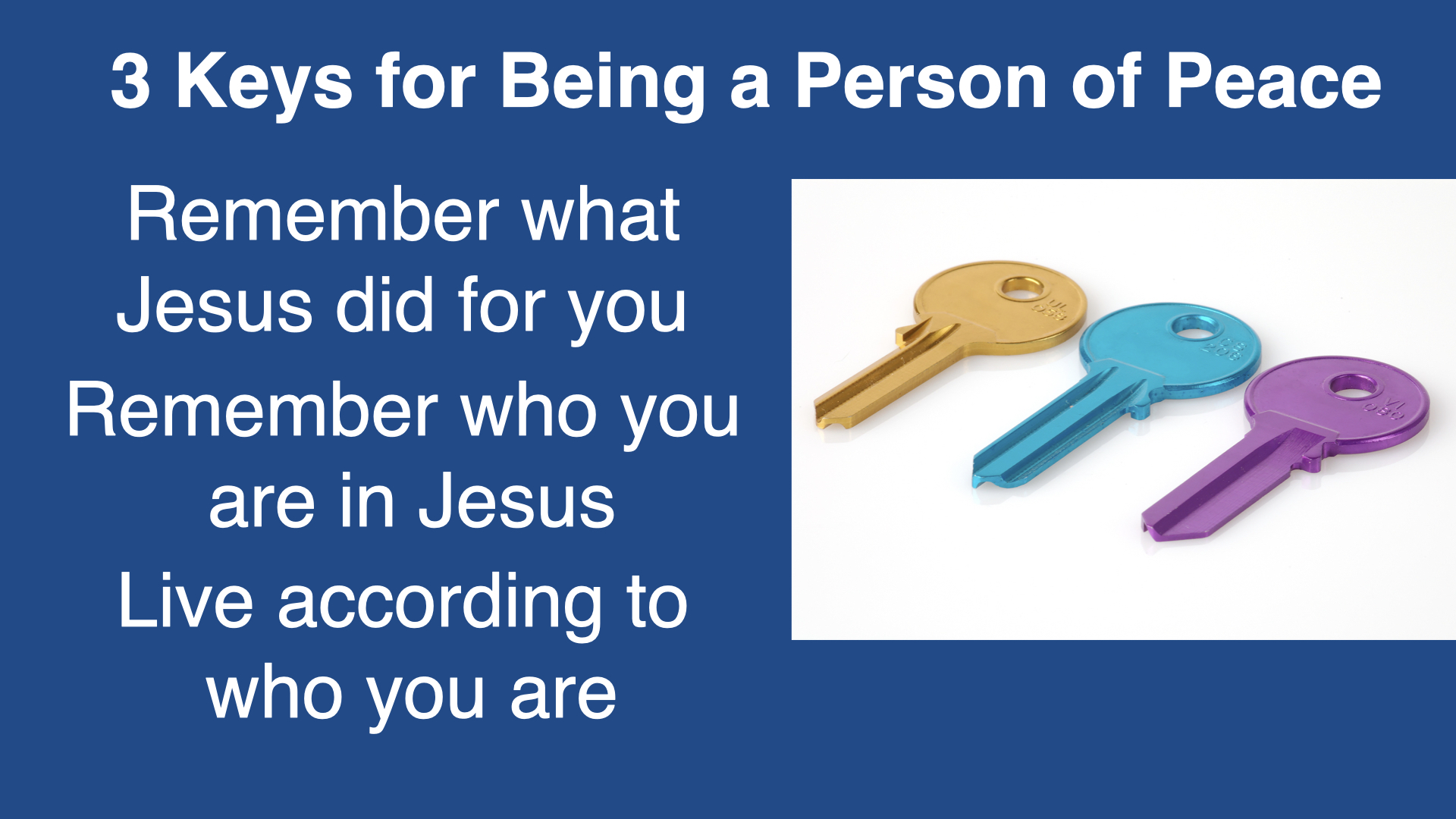
The second key to being a person of peace is: remember who you are in Jesus. You are a child of God, forgiven, beloved, unconditionally accepted without any reservation at all. And you have the same kind of intimate relationship with God the Father that Jesus has because he has given that to you. You can call on God at any time, about anything, anywhere, and know that he’s with you and he loves you. He will walk with you toward what he knows is the best outcome for you and all others. John points this out to us: “Dear friends, now we are children of God, and what we will be has not yet been made known. [We know who we are, but the world around us doesn’t.] But we know that when Christ appears [when he comes back and raises us from the dead and makes us and all things right again], we shall be like him, for we shall see him as he is.” (1 John 3:2)
The third key to being a person of peace is: live according to who you are in Jesus. John reminds us, “Dear children, let us not love with words or speech but with actions and in truth.” (1 John 3:18) Good words are good, but good words without action sometimes don’t mean much to the people around us. But when loving actions flow from our being toward them, then they are more likely to know that we really do love them.
And so, what does all of this mean for us? Our moments of greatest weakness can be our times of greatest strength. An overwhelming challenge forces us to abandon our own strength and then cling to God and his strength, because, to be honest, we have no other choice. Our resources and our strength will not get us through what’s before us. So, we fall into the arms of God and trust Him to carry us through whatever it is that we’re facing. And then we realize that that turning away from our own strength and resources and trusting in God to carry us is actually the best way to live all the time, on a moment-by-moment basis.
So, how can we cultivate that kind of reliance, that kind of trust in God on a daily basis? Well, Advent can be a time of spiritual housecleaning. We tend to think that Advent is all about the lead up to Christmas, but it is more like the season of Lent, a time of preparation. We’re preparing not only to celebrate when Jesus came again, we’re also preparing our hearts for when he’s going to come again. And so, just like we clean up our houses and rearrange things and get rid of stuff that we realize we don’t need anymore, we can do the same things in our lives.
We can ask ourselves three questions: First, what are the things—and by things, I mean the patterns of behavior, the ways of thinking, the heart longings, the beliefs, and the values—that are holding you back from deeper reliance on God? And once we identify what those things are, we get rid of them. The second question we can ask ourselves is: Which are the things that are neutral when it comes to our relationship with God? They have no beneficial effect that we can see, and they have no detrimental effect either. Those things we need to hold loosely for now, because there may come a time when we have to get rid of them, or we may realize later on that we actually need them. The third question that we can ask ourselves is: What are the things that help you grow in relying on God more?
Those are the things that we need to add more of into our lives. Because our goal is to live in such a way that we decrease and God increases within our lives.

D.L. Moody, in one of his sermons, told a story about a man who, with his wife and son, lived on the East Coast of America but went to the West Coast to make his fortune in the gold rush that was happening there. It took him some time for him to make enough money to support himself and his family, but when he had done so, he sent for his wife and son to join him. They booked passage on a ship and headed out. Not too long after they left port, a fire broke out on the ship. The ship was carrying gunpowder, and the captain knew that everybody had to get off the ship as soon as they could. When the fire reached the cache of gunpowder, it was going to blow up, and everybody on board at that time would be killed. All the passengers headed for the lifeboats, but there wasn’t enough room for everyone in those lifeboats. And when the mother and her son got to the lifeboats, there was only one left and it was nearly full. There was only room for one person. So the mother kissed her son and said to him, “If you live to see your father, tell him that I died in your place.” Then she placed him in the lifeboat and she stayed on the ship.
Dear friend, in a much, much, much greater way, Jesus has died in your place so that you can live in him. And the challenge that I am setting before is this: First, trust in Jesus. Trust in who he is and trust in his love. Second, draw on the divine parentage of love that Jesus has given. And then finally, love one another. Amen.
(This message was shared at Walnut Grove Lutheran Church in Langley BC on December 10, 2023. For more info, please go to wglc.org.)


