

One of the challenges of life as a human being is learning how to deal with fear. Fear is not a bad thing, it’s something God has put in us to help us to deal with threats, to take action when a threat comes near. But the problem with fear sometimes is our feelings of fear do not match with the reality of the danger. For example, we can be terrified about things that are very unlikely to happen, like a plane crash or a freak accident, while at the same time we can be very blasé about things that are truly dangerous, like texting while driving or climbing a ladder without paying attention.
So, it’s important for our fears to match reality, but even this doesn’t help us all the time—especially in the case of what is humanity’s greatest fear: the fear of death. Because a brief statistical analysis will tell us that the chance of us dying, the chance of anyone dying, is 100%.

And yet, if we let ourselves feel the weight of that reality, it will crush us. It will impair our ability to live life to the fullest, and so we’re caught in a dilemma.
We can’t deny death, but we can’t live in constant fear of it either. There has to be a better way to live—a way in which we are honest about our mortality, but we’re not enslaved to it.
So, how do we deal with the fear of death? That’s what we’re going to be thinking about today. And to answer that question, we are going to continue the series that we are on, called Psalms for Grounded Living, and today we’re going to dig into Psalm 16.
God Is My Refuge, My Portion, and My Guide in This Life
As we open this psalm, we see that the author, David, is facing a dire situation of some kind, but we don’t know what it is. And we quickly see that he’s being very realistic about this danger, for he begins not with self-confidence but with a cry. He cries out, “Keep me safe, my God, for in you I take refuge” (Psalm 16:1).
Now that’s the honest prayer of someone who knows his fears, who feels his vulnerability, and runs straight to the only one who can hold him steady.
David isn’t pretending to be strong—he’s actually admitting that he isn’t strong. And that’s where grounded living begins: not with self-assurance, but with surrender.
David looks around at his life, and he sees some things that we may often miss. He sees that God has already surrounded him with signs of His goodness. He sees the people of God, the holy people who are in the land, and he declares, “They are the noble ones in whom is all my delight” (Psalm 16:3).
One of the ways God steadies us in this life is by giving us a community of faith—a people who remind us of who God is when our hearts forget. And this is something that God has even brought home in a deeper way to me recently, as I’ve realized that I am more loved and accepted, and there’s more warmth for me in the people around me than I realized before.
We were never meant to face our fears alone.
And then David goes deeper. He cries out, “Lord, you alone are my portion and my cup; you make my lot secure” (Psalm 16:5).
In the ancient world, your portion was your inheritance—and that meant it was your security, your future, your identity all wrapped together.
David is saying here: My security isn’t in my circumstances. My future is not in my achievements. My identity is not in what I can hold—it’s in the God who holds me.
And because God is David’s inheritance, David can then say, “The boundary lines for me have fallen in pleasant places” (Psalm 16:6).
He’s saying God has made his circumstances work out for good. That’s not naïve optimism—that’s faith. Faith learning to see the goodness of God even in an imperfect world. It’s the quiet confidence that whatever God has given, wherever God has placed you, He is present there, and His presence is enough.
And then finally David says, “I will praise the Lord, who counsels me; even at night my heart instructs me” (Psalm 16:7).
God doesn’t just protect us and provide for us—He guides us. He speaks into our confusion. He steadies our steps. He shapes our heartfelt desires. Even in the dark, when our fears are loudest, God’s voice is louder still.
In the first eight verses of this psalm, God is trying to tell us through David that when we look at our lives through the eyes of faith, we discover that God has already given us everything we need to live a grounded life: His people, His presence, and His guidance.
You see, God is a good and loving Father, and He loves each and every one of you, for He created you, and you are fearfully and wonderfully made.
Notice that before David ever talks about death, he talks about life. Before he faces the grave, he names the goodness of God that surrounds him right now. And that goodness becomes the foundation for the confidence he will express in the rest of the psalm.
God Holds My Future, Even in Death
For after David names all the ways that God steadies him in this life—His people, His presence, His guidance—he turns then to the fear that haunts every human heart: What happens when my life ends?
And it’s here that Psalm 16 becomes one of the most hope-filled passages in all of Scripture.
David says, “Therefore my heart is glad and my tongue rejoices; my body also will rest secure” (Psalm 16:9).
Notice the shift. He’s not talking here just about emotional peace or spiritual comfort. He’s talking about his body—the part of him most vulnerable to death, decay, and the limits of this world.
David believes that even his physical life is held by God forever.
And why?
Because he trusts the character of the God who has carried him this far. Because the God who has been faithful to him in life will not abandon him in death. Because the God who has been his portion, his inheritance in this life, will be his portion, his inheritance in eternity.
And then David makes a stunning claim:
“You will not abandon me to the realm of the dead, nor will you let your faithful one see decay” (Psalm 16:10).
On David’s lips, this is a declaration of deep trust. But when it’s applied to Jesus—as Peter does in Acts 2:25–32 and Paul does in Acts 13:35–37—these words become a prophecy fulfilled.
David died. David was buried. David did see decay.
But Jesus didn’t.
Jesus is the faithful one—the ultimate faithful one—who entered death and came out the other side, breaking its power from the inside. And because Jesus did not see decay, because He rose in victory, because death could not hold Him, that means that death cannot hold all the people who belong to Him either. And that includes all of you.
The promise of Psalm 16 that meets and overcomes our fear of death is this: The God who steadies us in this life is the God who secures us in the life to come.
Our future is not fragile. Our hope is not theoretical. Our destiny is not uncertain.
David ends the psalm with a vision so beautiful it almost takes our breath away. He says, “You make known to me the path of life; you will fill me with joy in your presence, with eternal pleasures at your right hand” (Psalm 16:11).
This is not wishful thinking. This is resurrection reality.
Because Jesus lives, we also will live. Because Jesus Christ is at the right hand of the Father, we will be with Him. Because Jesus walked the path of life through death, He will now lead us to our eternal home on the other side of death.
So when we face our mortality—when the fear of death whispers at the edge of our minds—we don’t have to deny it or minimize it or pretend it isn’t there. We can look death in the eye and say: You are not the end of my story.
Because of Jesus, the God who holds your life now will hold your life forever.
Living Grounded in the God Who Holds Us
So what does all of this mean for us?
The solution to our fears—especially our fear of death—is living grounded in the God who holds us. Or that’s another way of saying: living by faith in the God who saves.
Because Psalm 16 is true—because God really is our refuge in life and our security in death—it reshapes how we live right now.
David isn’t giving us abstract theology. He’s giving us a way of life. A grounded life. A steady life. A life that refuses to be ruled by fear because it is held by a faithful God.

Here’s how we respond to the assurance of resurrection life that we have in Jesus Christ:
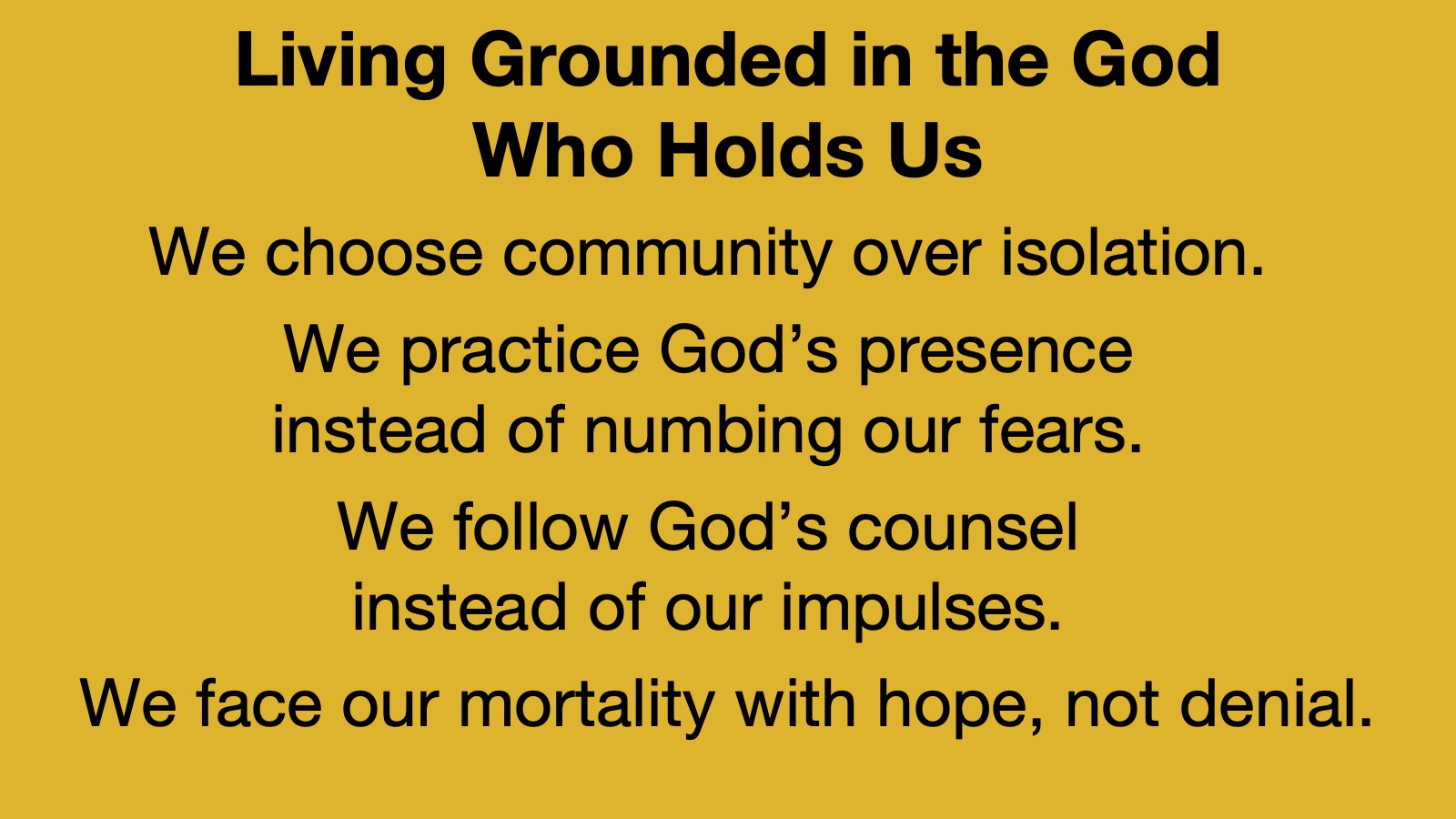
1. Choose Community Over Isolation
David delights in the saints in the land—God’s people around him. He sees God’s goodness in those people.
Fear isolates. Fear whispers, “You’re on your own.”
But grounded living means intentionally drawing near to the people God has placed in our lives—those people of faith who remind us of truth when our fears get loud.
This might mean joining a small group, reaching out to someone you’ve drifted from, or worshiping regularly with God’s people on Sundays.
God steadies us through His people. We need each other.
2. Practice God’s Presence Instead of Numbing Your Fears
David says, “I keep my eyes always on the Lord” (Psalm 16:8).
When fear rises, our instinct is to distract ourselves—scrolling, binge-watching, overworking, overplanning. At least I see all of those things in my life. Maybe you see them in yours too.
But grounded living means turning our attention away from those things and toward God.
This could look like carrying a Bible verse with you this week—something you can whisper when fear arises. Maybe something like “Do not let your hearts be troubled. You believe in God; believe also in me” (John 14:1).
Or it could be taking five quiet minutes in the morning to center yourself in Jesus before the noise begins.
3. Follow God’s Counsel Instead of Your Impulses
David praises the Lord who counsels him—even at night. For some of us, we might say especially at night.
Fear often pushes us toward reactive decisions—grabbing control, rushing ahead, or shutting down.
But grounded living means slowing down enough to ask: Lord, what are You saying? Where are You leading?
This might mean pausing before sending that email, praying before making that decision, or seeking wisdom from a mature Christian friend instead of acting alone.
4. Face Your Mortality With Hope, Not Denial
Because Jesus rose from the dead, David’s words become our reality: “My body also will rest secure” (Psalm 16:9).
We don’t have to pretend death isn’t real. We don’t have to fear it. We don’t have to let it steal the joy of the life we’ve been given.
Grounded living means remembering that our future is not fragile. Our story does not end in the grave. The God who holds our life now will hold our life forever.
Putting it all together, the essence of living a life grounded in Christ is this: We live differently today because we know who holds our tomorrow.
Fear doesn’t get the final word.
Death doesn’t either
Jesus does.
Lift Your Eyes
When David looks at his life, he doesn’t deny his fears. He doesn’t pretend he’s invincible. He doesn’t try to talk himself into courage.
Instead, he lifts his eyes to the God who has been faithful in every season.
And as he does that, something remarkable happens: Fear begins to loosen its grip. Joy begins to rise.
That’s what happens when we see God as He truly is— the God who has surrounded us with His people, the God who has walked with us through every valley, the God who has whispered wisdom into our confusion, the God who has steadied us when it felt like we were falling.
You and I have never lived a day in our lives when we were not held by our gracious and loving heavenly Father.
And then as we look at Jesus—the one Psalm 16 ultimately points toward—the one who entered death and came out the other side, the one whose body did not see decay, the one who shattered the grave and now stands alive forever, suddenly the fear of death, which once felt so heavy, begins to lose its weight.
Because Jesus has defeated death. Death is no longer a wall. It’s no longer a dead end. It’s a doorway.
And because Jesus has gone through death to resurrection life ahead of us, the path of life is not a mystery—it’s a promise.
Because Jesus is alive, your future is not fragile. It is 100% secure in Him.
This is the hope that steadies us. This is the joy that fills us. This is the confidence that carries us.
You are held by a God who has not failed you in this life and will not—will not—abandon you in death.
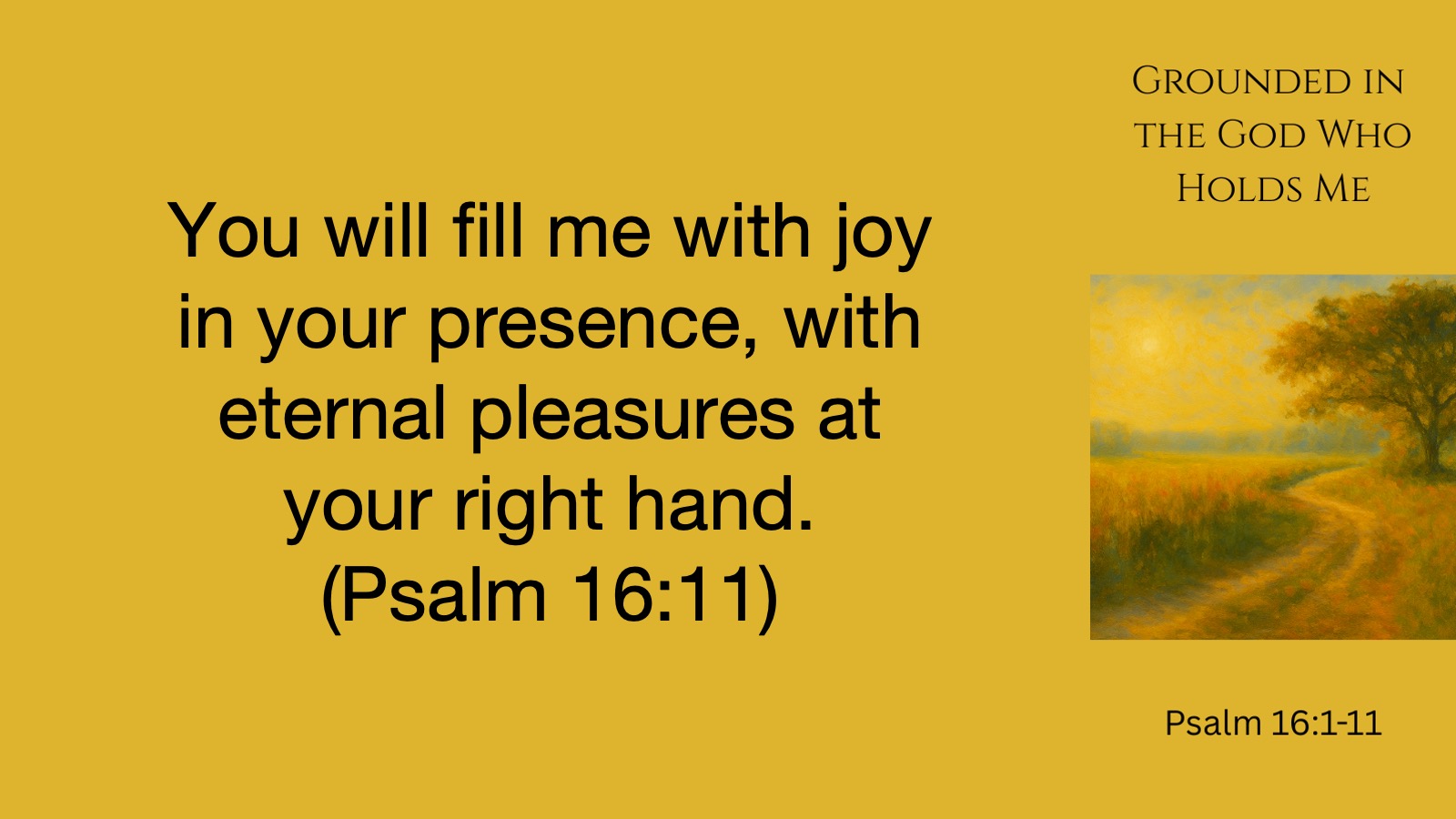
David ends Psalm 16 with a vision of where all this is heading: “You will fill me with joy in your presence, with eternal pleasures at your right hand” (Psalm 16:11).
That’s your future. That’s your destination. That’s the home Jesus has prepared for you and is leading you toward even right now.
So I want to encourage you to lift your eyes, lift your hearts, lift your hope—for the God who holds your life now will hold your life forever.
Here’s a step I’m inviting you to take this week—just one step:
Name one fear and place it in God’s hands.
Not all your fears. Not the whole tangled web of anxieties. Just one.
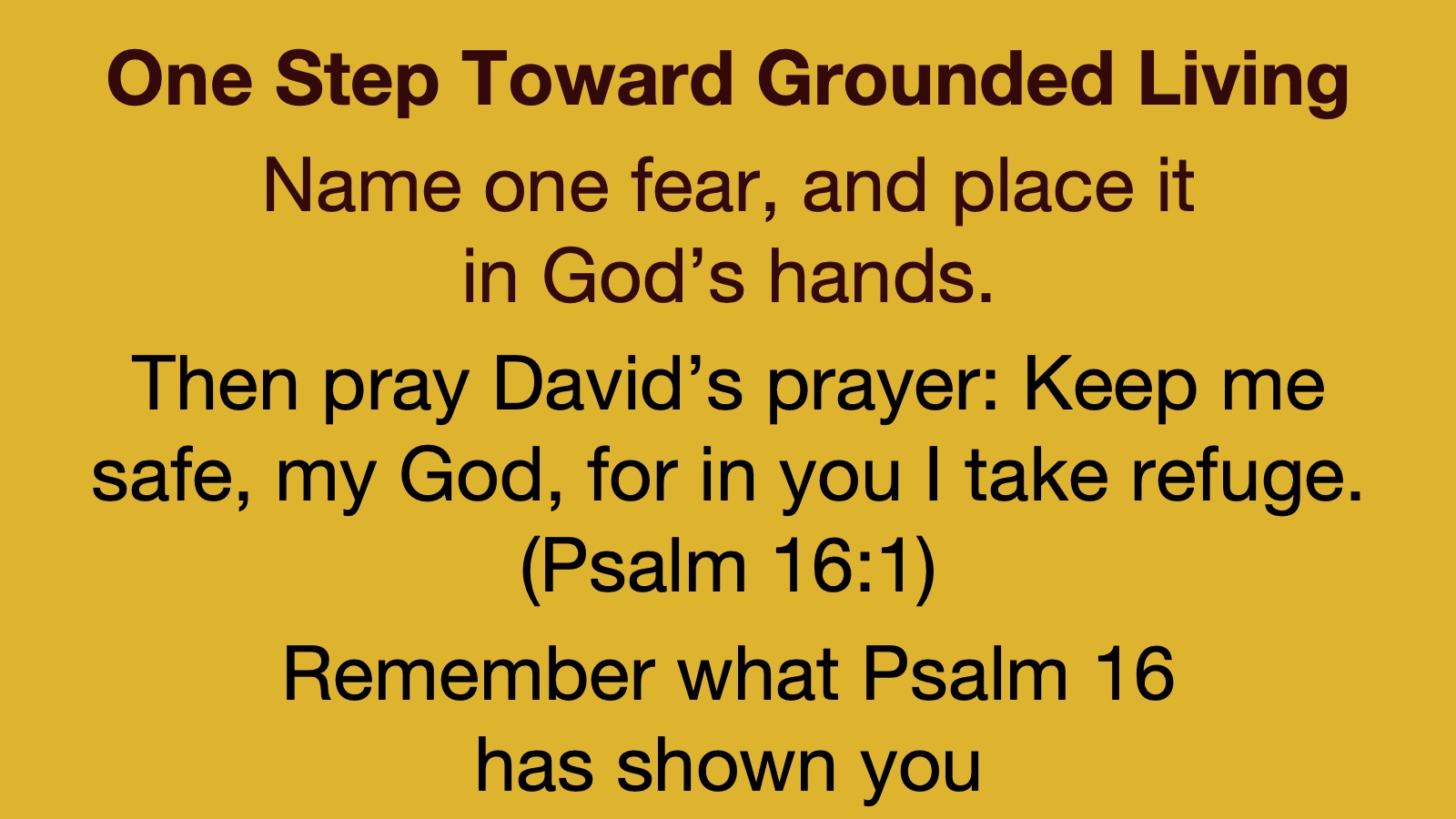
Take one fear that has been humming in the background of your life—maybe a fear about your health, your children, your future, your finances, your relationships, your aging, or your mortality—and bring that fear into the light of God’s presence.
And after you’ve named that fear, then pray.
You could pray a prayer like David did: “Keep me safe, my God, for in you I take refuge” (Psalm 16:1). Or you could pray a prayer of your own making.
But whatever that prayer is, say it slowly. Say it honestly. Say it as many times as you need to for your heart to become calm.
And as you pray, remember what Psalm 16 has shown you: You are not handing your fear into a void. You are placing it into the hands of the God who has held you every day of your life and will hold you every day of your eternity.
This is how grounded living begins—not by eliminating fear, but by entrusting it to the God who is your refuge, your inheritance, your God, and your future.
Amen.


