

Growing up on a farm, fall was one of my favourite seasons. It was the moment when months of planning, preparation, and hard work finally met those vast fields of golden grain waiting to be harvested. For weeks we would get the equipment ready, chomping at the bit for the day when our combines would begin licking up the swaths laid out in long, parallel lines.
But when that day finally came, there was still one crucial step before we could settle into the rhythm of harvest. I can still see my dad climbing up onto the combine, making those first adjustments, then working his way around the machine as chaff and dust swirled around him. He would grab handfuls of chaff as it flowed over the sieves and blow on it to see if any wheat was going out the back. He would dig through the straw left behind to make sure no kernels were being lost on the ground. Then he’d check a sample from the grain hopper to see if any chaff or straw had ended up where only wheat belonged.
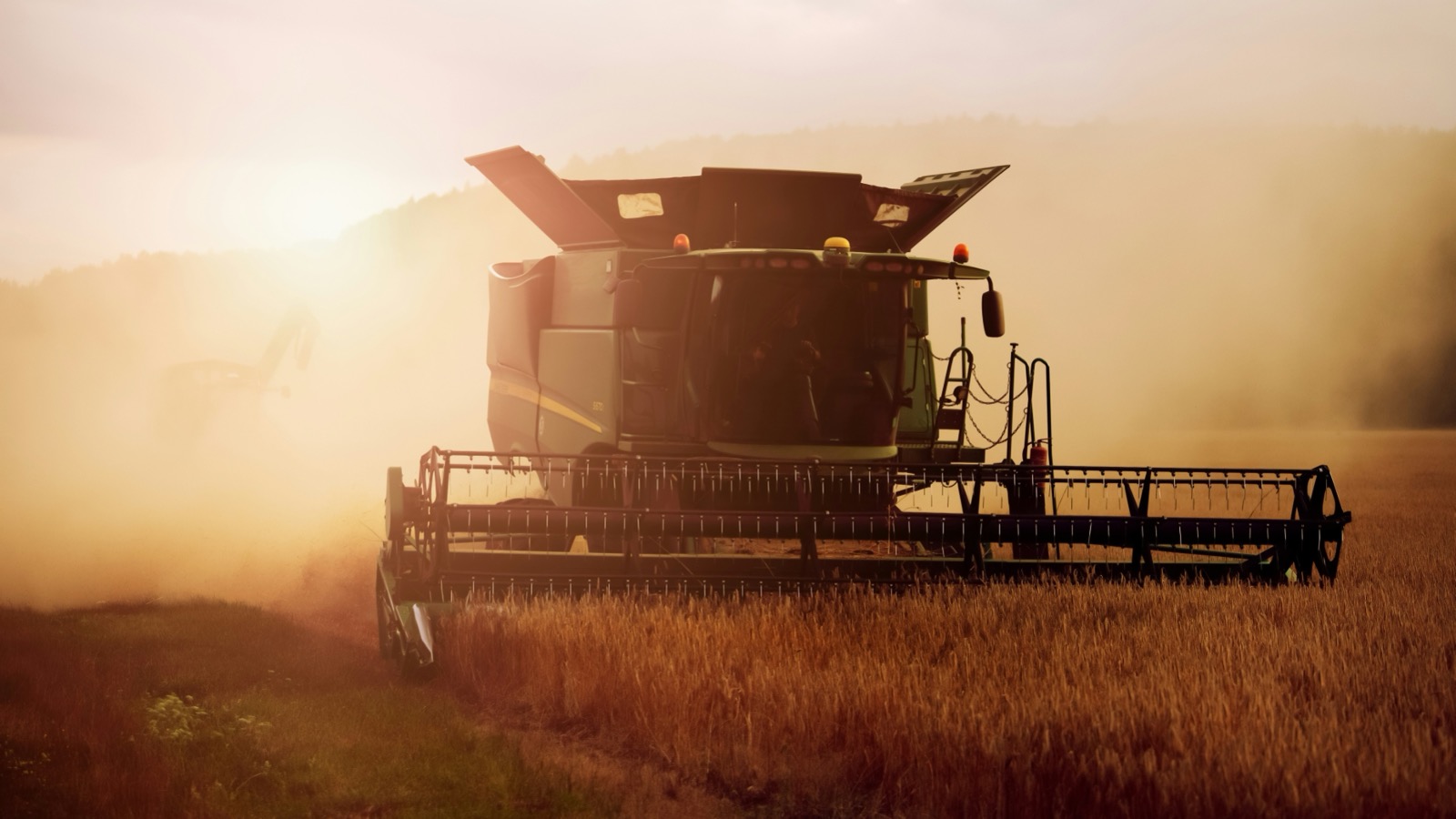
All of it was for one purpose: Was the combine separating the wheat from the chaff the way it should? Because inside that machine, everything that enters goes through a sorting process. The wheat — the part with weight, substance, and value — is gathered into the hopper. The chaff and straw — the parts without weight — get blown out the back and left behind on the field.
Even as a kid, I understood the basic idea: Some things are kept. Some things are discarded. And the difference between the two isn’t luck. It’s nature. Wheat has weight. Chaff does not.
Psalm 1 says something similar about human life. There are only 2 ways to live Two kinds of people we can become. Two paths we can walk. One path leads to rootedness, stability and fruitfulness — a life with weight and substance. The other leads to drift, emptiness, and impermanence — a life that blows away like chaff.
Everything gets sorted. Some things are gathered. Some things are left behind.
Psalm 1 presses this question into our souls: What kind of a person are we becoming? A person whose life has weight and value and is meant to be kept… or a person whose life is light, empty and meant to be discarded?
That leads us to the question this Psalm wants us to wrestle with: How do we become the kind of people who walk the path that leads to security, stability, and salvation — the blessed life?
To answer that question, let’s begin our four-part series on the Psalms called “Psalms for the Journey.” Across this series, we’ll walk through seasons when life feels steady, seasons when everything falls apart, and seasons when God brings surprising renewal. The Psalms give us language for every part of that journey, from confident trust to raw lament to joyful praise. Ultimately, they lead us to the God who meets us in every season and draws us into a deeper, more resilient faith. As we follow this path together, we’ll discover that the Psalms don’t just describe life with God — they shape it.
For the first part of this series, over the next four weeks, we will attend to those seasons in life When Life Feels Steady and focus on Psalms for Grounded Living. We begin today with Psalm 1.
The Blessed Life Begins with What We Turn Away From
The Psalms are like the hymn book for God’s people from ancient times right down to, and including, today. Psalm 1 not only introduces and sets the stage for the entire collection of 150 Psalms — It also identifies what we could call the central theme of the Bible: There are two ways that a person can live their life. But only one of those ways leads to the blessed life.
And as it describes the blessed life, Psalm 1 begins in a surprising place. Before it ever tells us what the blessed person does, it tells us what the blessed person does not do: Blessed is the one who does not walk in step with the wicked or stand in the way that sinners take or sit in the company of mockers, (Psalm 1:1)
This Psalm starts with a refusal — a deliberate turning away. Because the blessed life isn’t first about adding something to your life; It’s about subtracting the things that slowly hollow you out. Just like wheat and chaff look similar until the combine shakes them apart, the Psalm says there are patterns, voices, and influences that may look harmless on the surface but ultimately leave us weightless. They shape us without our noticing. They form us into people who drift rather than people who are rooted.
Psalm 1 names three kinds of movements — walking, standing, and sitting — that indicate a slow slide from casual influence to settled identity. It’s the picture of a life that gradually aligns itself with the wrong voices, the wrong loves, and the wrong centre of gravity. This Psalm is saying to us: If you want a life with weight, you have to pay attention to what is shaping you.
Everyone is being shaped by something. The only question is: who or what is shaping you?
The blessed life begins with a kind of holy resistance — a refusal to let your life be formed by whatever is loudest, easiest, or most convenient. It begins with the courage to say: I won’t walk in that direction. I won’t stand in that place. I won’t sit in that story. Not because we are better than anyone else, but because we know how easily our hearts drift. At least, I know how easily my heart drifts. I know how quickly thing, however well-intentioned I may be, can turn into chaff when I have my hands on them instead of the Lord’s.
Before we can be rooted, we must stop drifting. Before we can be planted, we must stop being blown around.
Psalm 1 invites us to ask: What voices, habits, or patterns are quietly shaping me into someone I never intended to become? What do I need to turn away from so I can turn toward the life God wants to grow in me?
This is where the blessed life begins.
The Blessed Life Grows as We Delight in God and Bear Fruit That Lasts
If the blessed life begins with what we turn away from, it continues with what we turn toward. Psalm 1 moves from resistance to rootedness, from subtraction to nourishment, telling us that the blessed ones are those: “…whose delight is in the law of the Lord, and who meditates on his law day and night.” (Psalm 1:2)
The Psalmist is making a profound claim: You become what you delight in. Your life takes the shape of whatever captures your imagination, your affection, your attention.
This is why Psalm 1 doesn’t say, “Blessed is the one who obeys the law of the Lord.” It says, “Blessed is the one who delights in it.” Because God isn’t after reluctant rule keeping. He’s after a heart that finds joy, stability, and life in His voice.
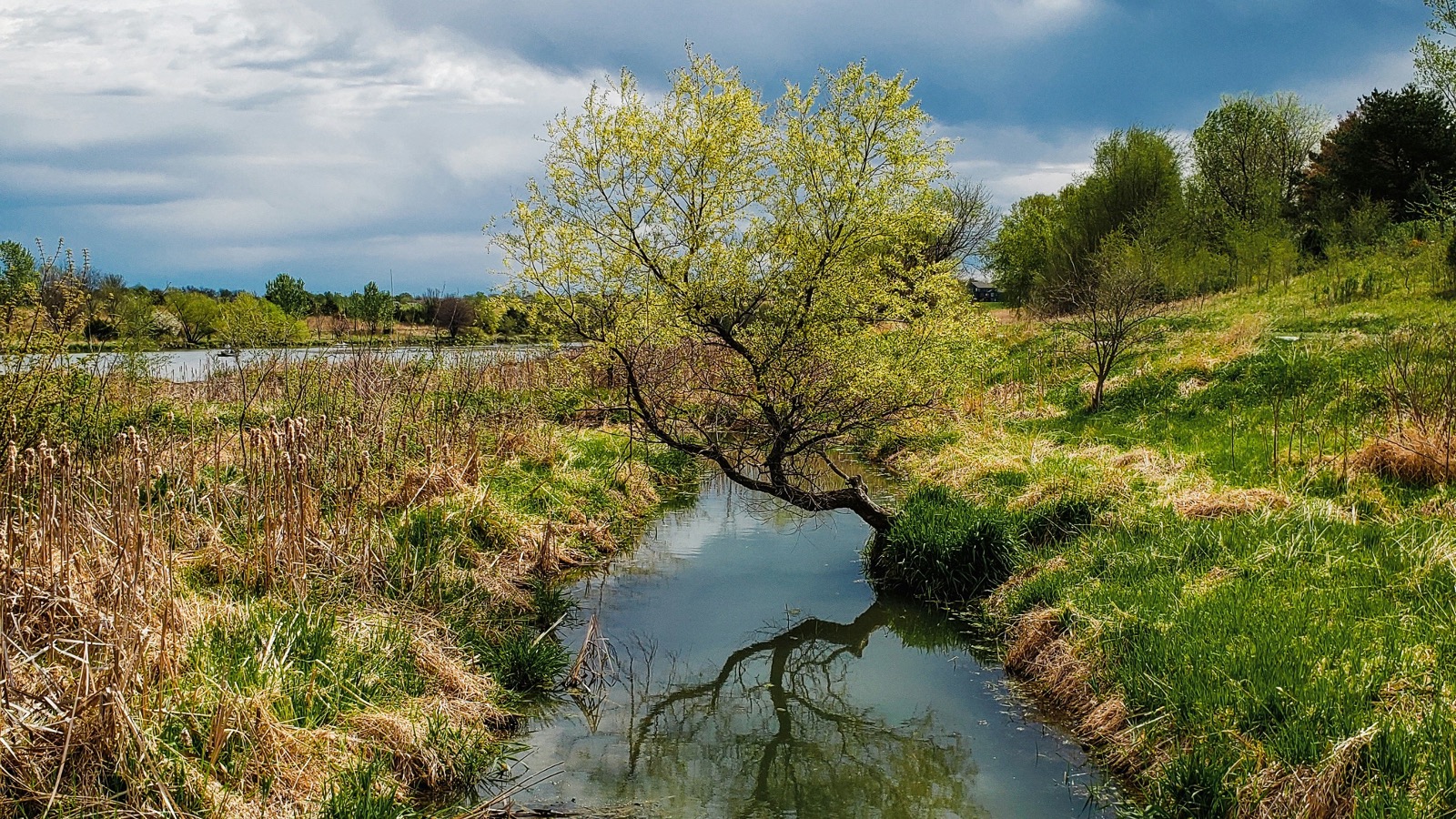
And when God’s Word becomes our delight — when His voice becomes the stream we return to again and again — something begins to happen inside us: “That person is like a tree planted by streams of water, which yields its fruit in season and whose leaf does not wither” (Psalm 1:3)
A tree doesn’t grow by trying harder. A tree grows because it is planted in the right place.
The blessed person is not a wild tree that happened to grow near water. They are a tree intentionally planted by a gardener who knows exactly where life will flourish. And when we are planted beside the right stream: Our roots go deep. Our fruit becomes visible. Our resilience increases. Our lives gain weight and substance.
Fruitfulness is not something we manufacture. It is something God grows in us as we stay rooted in Him.
And here is the good news that Psalm 1 whispers and the New Testament shouts: Jesus Christ is the true stream of living water. He is the Word made flesh. He is the One whose life flows into ours. He is the source of the fruit we bear.
To delight in the law of the Lord is ultimately to delight in Him — to let His words, His ways, His presence, His Spirit become the steady stream that nourishes our souls. And when Christ becomes our delight, we become the kind of people who bear fruit “in season” — fruit that lasts, fruit that blesses others, fruit that reflects the life of the One who planted us.
Psalm 1 invites us to ask: What stream am I planted beside? What am I delighting in? What fruit is growing in my life because of where my roots are?
The blessed life is not achieved. It is received.
It grows in us as we root ourselves in the One who is the Living Water.
Application — Becoming People with Weight in a World of Drift
Psalm 1 invites us to take an honest look at how our lives are being shaped. Not in a guilt‑driven way, but in a grace‑filled, Spirit‑led way. Because every one of us is being formed by something. Every one of us is planted beside some stream. Every one of us is becoming either wheat or chaff — a person with weight, or a person who drifts.
So the question is not, “Am I being shaped?” The question is, “What is shaping me?”
Psalm 1 gives us two invitations: to pay attention to the voices forming us, and to plant ourselves beside the stream that gives life.
And before I try to paint a picture of what this can look like, hear this clearly: Becoming a person with weight in a world of drift is not about trying harder — it’s about being attentive to God and his plan to redeem you and the world and aligning your life with God and his plan.
This is the inner work. The reflective work. The heart‑level work.
The Blessed Life Is Already Growing in You Because Christ Is with You
The foundation and the power to live a blessed life is not based on what we do, it is based on what is already true. The hope of Psalm 1 is not that we would somehow become perfect trees — always rooted, always fruitful, always steady. The hope of Psalm 1 is that God Himself has planted us, and He has planted us beside a stream that never runs dry.
The blessed life is not something we achieve. It is something God is already growing in us.
Because the One who is the Living Water has come near. Jesus Christ — the Word made flesh, the true Tree of Life, the One whose roots go down into eternity — has stepped into our world of drift and weightlessness. He has taken on our chaff-like tendencies, our wandering hearts, our shallow roots. And in His death and resurrection, He has given us His life, His strength, His rootedness.
He is the One who says: “Let anyone who is thirsty come to me and drink.” (John 7:37); “I am the vine; you are the branches. If you remain in me and I in you, you will bear much fruit;” (John 15:5)
In Him, you are not a tree struggling to survive in a dry land. In Jesus, you are a tree planted, nourished, strengthened, and kept. Even when you feel ordinary. Even when life feels steady and uneventful. Even when your growth feels slow.
God is at work beneath the surface. Your roots are going deeper than you realize. Your fruit is forming even when you cannot see it. Your resilience is growing in ways you won’t notice until the drought comes. Your life is gaining weight and substance because Christ is your stream.
Psalm 1 is not a picture of what you must become on your own. It is a picture of what God is making you into through Jesus.
And the promise at the end of the Psalm is breathtaking: For the Lord watches over the way of the righteous, (Psalm 1:6)
Not from a distance. Not with crossed arms. Not waiting for you to fail.
He watches over you like a gardener watches over a beloved tree — tending, pruning, nourishing, protecting, rejoicing.
The blessed life is not a reward for the strong. It is a gift for the rooted.
And in Christ, you are rooted more deeply than you know.
Three Small Ways to Send Your Roots Deeper into Living Water
Because Christ is already growing His life in you, here are three simple, practical steps to help you stay rooted in Him this week. The blessed life doesn’t grow from big spiritual heroics. It grows from small, steady choices that keep our roots near the water.
1. Choose one voice to turn down
This week, gently turn down one influence: a social media feed a news cycle a podcast a habit of scrolling a cynical or negative voice
Not forever — just long enough to create space for God’s voice.
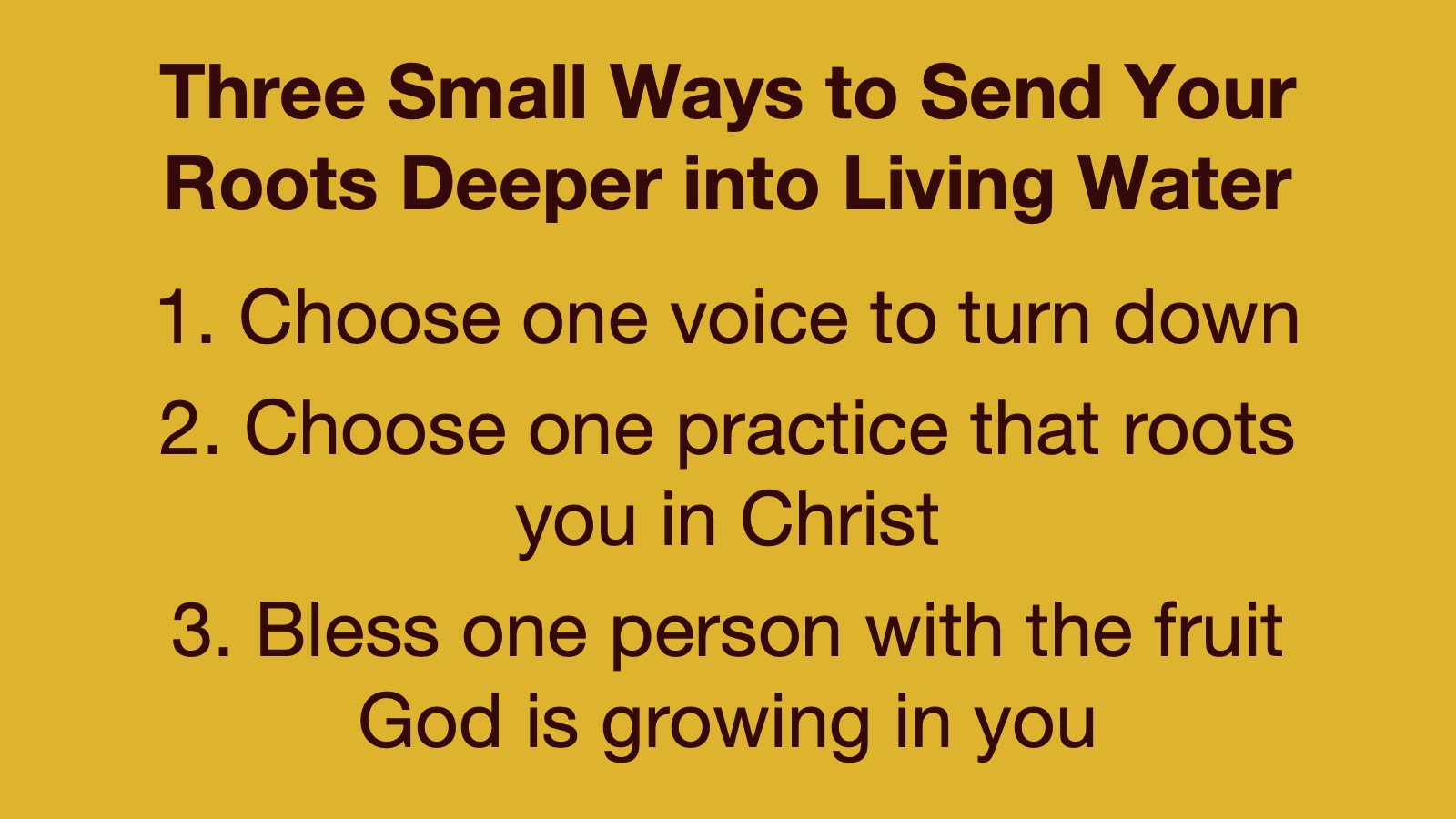
2. Choose one practice that roots you in Christ
Pick one small rhythm that keeps your roots near the stream: read a short Psalm each morning, pray a simple prayer in rhythm with your breath, take 60 seconds of silence to be with God before bed, or write down one thing each day for which you are grateful.
Small practices, done steadily, grow deep roots.
3. Bless one person with the fruit God is growing in you
Fruit is never for the tree. Fruit is always for someone else.
Ask the Spirit to show you one person you can bless this week — with a word, a meal, a prayer, or a simple act of kindness.
I leave you with this encouragement: Nourish yourself with living water from the stream God has planted you beside — and let Christ grow the blessed life in you. Amen.


Wonderful! Your three small ways are so good, thank you!
LikeLike