

A note before you read: This message includes a personal story about one of my children struggling with thoughts of suicide. If this is a painful subject for you, please take care as you read, and feel free to set it aside for another time.
If you are thinking about suicide, or you are worried about someone else, please reach out right now. You are not alone, and help is available 24 hours a day.
- In Canada: call or text 9-8-8 to reach the 9-8-8: Suicide Crisis Helpline.
- Kids, teens and young adults: Kids Help Phone, call 1-800-668-6868 or text CONNECT to 686868.
- Indigenous Peoples: the Hope for Wellness Help Line, call 1-855-242-3310.
- In the United States: call or text 988 to reach the 988 Suicide & Crisis Lifeline.
- If you or someone else is in immediate danger, call 9-1-1.
Years ago, when we were still living in Saskatchewan, Susan and I realized that one of our children was struggling with thoughts of suicide. They had a plan for carrying it out, and the means to do it were readily available on our acreage. I had been taught in seminary that when someone has those three things together—suicidal thoughts, a plan, and the means to carry it out—you don’t leave them alone. You get them help as quickly as you can.
So we did. We got our child to our family doctor and they were admitted to the psychiatric ward of our local hospital. And all of this happened the week before Easter.
On Easter Sunday, I visited my child in the hospital in between the worship services I led that day. On a day when churches are filled with Easter decorations, and the great hope of the Christian faith, “Christ is risen,” is declared, I sat in the sparse surroundings of that hospital room with my child and felt like I had nothing.
And it wasn’t as though I was on completely foreign ground. I had served as a student chaplain in a psychiatric hospital a few years before, so I thought I knew something about what should be happening. But what I thought, I soon realized, didn’t matter. I had no say. My child was sick, and there was nothing I could do. I was completely helpless, and I did not like feeling that at all.

Maybe there have been times in the past where you have felt helpless. Maybe you are feeling that way right now. Regardless of how high or low your level of feeling helpless may be, I’m inviting all of you to reflect on this topic for a few moments with me. And here’s why.
We think those moments of feeling helpless are an aberration from our normal life, and the sooner we get back to our old way of life, the better. But I am suggesting to you that those moments when we feel totally helpless are not an aberration, but clarity. They are not a bug, they are a feature. For it is when we feel helpless that we are seeing ourselves as we really are.
Now, here’s the thing, though. We all need security of some kind. No one can live in a constant state of feeling helpless. So the question that I am setting before you today is this: Where do we turn for the assurance we need that everything is going to be okay? For God’s answer to that question, I invite you to turn with me to Hebrews 4:14–5:10.
Jesus personally knows our weaknesses
As we saw last week, the author of Hebrews is writing to Jewish Christians who are tempted to leave the Christian faith and go back to their Jewish roots, probably because persecution made that look like a safer option. So he uses what his readers already know, the Old Testament Scriptures and the customs they had grown up with, to show them that Jesus is greater than anything they might be tempted to go back to. And near the end of chapter four, he uses a comparison that may seem foreign to us but was vitally important to his first hearers:
“Since then we have a great high priest who has passed through the heavens, Jesus, the Son of God, let us hold fast our confession.” (Hebrews 4:14 ESV)
The high priest served as an intermediary between God and his people. His most important work happened once a year, on Yom Kippur, the Day of Atonement. On that day, the assembled people of God watched as the high priest passed through the Temple, and disappeared from view behind the thick curtain that separated the Holy of Holies from the rest of the building. There, in the place where God dwelt, was the Ark of the Covenant. The top of the Ark was called the Mercy Seat, and that is where the high priest sprinkled the blood from animal sacrifices to atone for his own sins, the sins of his household and all the people.
He was alone as he did this, for God said in Leviticus 16:
“No one may be in the tent of meeting from the time he enters to make atonement in the Holy Place until he comes out and has made atonement for himself and for his house and for all the assembly of Israel.” (Leviticus 16:17 ESV)
And the high priest entered the Holy of Holies with fear and trembling, because God had warned that coming into his presence the wrong way meant death. Year after year, the high priest solemnly went before God on behalf of the people and atoned for their sins again and again and again.
Jesus did something similar, but in a far greater way. Just as God’s people watched the high priest pass through the Temple, so also Jesus’ disciples watched him pass through the heavens. He disappeared from their view as he ascended to the right hand of his Father. There he presented his finished sacrifice to atone for all the sins of all people for all time. The blood Jesus offered there was not from a goat, a bull, or any other animal. It was his own holy, precious, innocent blood that he shed on the cross. And unlike every high priest before him, Jesus did not need to atone for his own sins, because he had none. And the infinite worth of Jesus’ self-sacrifice meant that no further sacrifices were needed. Jesus has paid it all.
As we heard last Sunday, as we began digging into the book of Hebrews, there is no one like Jesus. He is greater than all the angels. And here we see that he is greater than any high priest who has ever gone before him. He is greater in the sacrifice he gave, and he is greater in his compassion for us:
“For we do not have a high priest who is unable to sympathize with our weaknesses, but one who in every respect has been tempted as we are, yet without sin. Let us then with confidence draw near to the throne of grace, that we may receive mercy and find grace to help in time of need.” (Hebrews 4:15–16 ESV)
Jesus even knows our temptations better than we do. Because he never gave in, he felt their full weight right to the end. He knows better than any of us how hard human life can be. As Dane Ortlund wrote in his book Gentle and Lowly, “Not only can he alone pull us out of the hole of sin; he alone desires to climb in and bear our burdens. Jesus is able to sympathize. He ‘co-suffers’ with us.” [i]
In verse 16, the author of Hebrews refers to the Mercy Seat as the throne of grace. You don’t have to wait for a special day once a year and have someone go on your behalf to make things right between you and God. Jesus has done that for you with his once-for-all sacrifice. Because of Jesus, you can come anytime, with confidence, and receive the mercy and find the grace you need to help you in your time of need.
Jesus is the ultimate high priest
Jesus is the ultimate high priest. Not only is he greater in the depth of his compassion and the quality of his sacrifice, but he is also a completely different kind of high priest. All the high priests before him were descendants of Aaron, Moses’ brother, and from the tribe of Levi. But the Son, Hebrews tells us, is “…a priest forever, after the order of Melchizedek.” (Hebrews 5:6 ESV)
Melchizedek is a mysterious figure from the Old Testament, who seems to come out of nowhere to play a significant role in the life of Abraham. After his victory over the kings who kidnapped his nephew, Lot, Abraham was met by Melchizedek, a king and priest, who brought out bread and wine and blessed Abraham. Using his old name, Melchizedek said,
“Blessed be Abram by God Most High,
Possessor of heaven and earth;
and blessed be God Most High,
who has delivered your enemies into your hand!” (Genesis 14:19–20)
In response, Abraham gave Melchizedek a tenth of everything.
Remember that earlier, in Genesis 12, God had already promised to bless Abraham, make him a great nation, and bless all the families of the earth through him. From other parts of Scripture, we know that Abraham’s descendants would become God’s chosen people, who reflected God’s love and character into the surrounding world. The promise of a Messiah sent by God to save his people would be passed down through the generations in Abraham’s family. And when the Messiah came into this world, he came as a descendant of Abraham.
Few human beings were closer to God than Abraham. In Isaiah 41:8, God even refers to Abraham as “my friend.” Abraham was one of the greatest people in all human history. And yet, because of our inherent human frailty and brokenness, all of us, even Abraham, need a high priest to stand between us and God, intercede on our behalf to God, and pour out blessings from God over us. Melchizedek was Abraham’s high priest before God Most High. And Jesus is our high priest before God Most High.
The author of Hebrews is saying that Jesus is the same kind of priest as Melchizedek because Jesus follows the pattern of Melchizedek in his uniqueness, his status, and the enduring blessings he gives. In terms of uniqueness, there is only one priest like Melchizedek in the Old Testament, and there is no one else like Jesus in all human history. In terms of status, Melchizedek is greater than any high priest descended from Abraham because he was high priest to Abraham, the forefather of all those other high priests. Jesus is also greater than any high priest because he is the high priest for all humanity. In terms of giving enduring blessings, Melchizedek’s priestly service resulted in blessings for Abraham and all his spiritual descendants. Jesus’ priestly service results in the eternal blessing of life with God forever for all who look to him in faith.
Every other high priest grew old, died, and had to be replaced. Jesus never will be. He is never off duty, never too tired, never replaced by someone who doesn’t know your name. As Hebrews puts it a little later, “he is able to save to the uttermost those who draw near to God through him, since he always lives to make intercession for them” (Hebrews 7:25 ESV).
Right now, at this very moment, Jesus is praying for you. When you are too weak to hold on, your faithful high priest is holding on to you.
With Jesus, everything is going to be okay
What does all this mean for us? If our weakness is an undeniable reality, for us to be sure that everything is going to be okay, then two things must be true of whichever source of help we trust. First, they need to know the depths of our weakness. Second, we need to know that their priestly service will heal all wounds, right all wrongs, forgive all sins, undo all death, and lift us from a hopeless end up to an endless hope. Jesus does all that for us. In Hebrews 5, we read,
In the days of his flesh, Jesus offered up prayers and supplications, with loud cries and tears, to him who was able to save him from death, and he was heard because of his reverence. Although he was a son, he learned obedience through what he suffered. And being made perfect, he became the source of eternal salvation to all who obey him, being designated by God a high priest after the order of Melchizedek. (Hebrews 5:7–10)
In the night in which he was betrayed, Jesus led his followers to the Garden of Gethsemane and then said to them,
“My soul is very sorrowful, even to death; remain here, and watch with me.” And going a little farther he fell on his face and prayed, saying, “My Father, if it be possible, let this cup pass from me; nevertheless, not as I will, but as you will.” (Matthew 26:38–39)
Jesus was utterly helpless in the face of the suffering that lay before him. He prayed to the only one who could save him, his Father in heaven, and Jesus’ prayers were heard by his Father. And yet, with a faithfulness that is infinitely beyond any we could ever muster, Jesus chose to do his Father’s will and suffer and die on a cross to pay the full cost of forgiveness of all the sins of the whole world. With his resurrection, Jesus declared victory over all the things that could ever truly harm us and began a new creation that unfolds in our hearts and will reach fulfillment in the new heaven and earth to come.
Jesus knows the depths of our weakness. With Jesus, we can know that, in the end, everything is going to be okay.
Embrace your weakness
As I mentioned before, I did not like feeling helpless, not at all. But it was good for me. Those feelings of helplessness helped me to see myself as I really was. I was totally helpless, and my previous thoughts of being in control were only an illusion. And seeing my own helplessness moved me to reach out to God for the help that I always needed.
God did help me and Susan and our child and the rest of our family get through that difficult time, but I was not the same person after that experience as I was before. God used my experience of helplessness, a feeling I did not want or like, to set me on the path toward becoming a better father and husband. And whenever I am tempted to go back to the way I was before, I remember the pain that my old way of life led me into, and I resolve to never go back there again.
Jesus gives us a beautiful example of his high priestly work for those of us who were baptized as infants. In utter helplessness, we were brought before the Lord by our parents. With the water and his Word combined, Jesus washed away all of our sins, gave us new life with him that lasts forever, made us a beloved, forgiven child of God, poured out his Holy Spirit upon us, and created a bond with us that Jesus has promised he will never, ever break. Baptism is a picture of who we always are: helpless babes resting in the faithful love of our gracious Saviour.
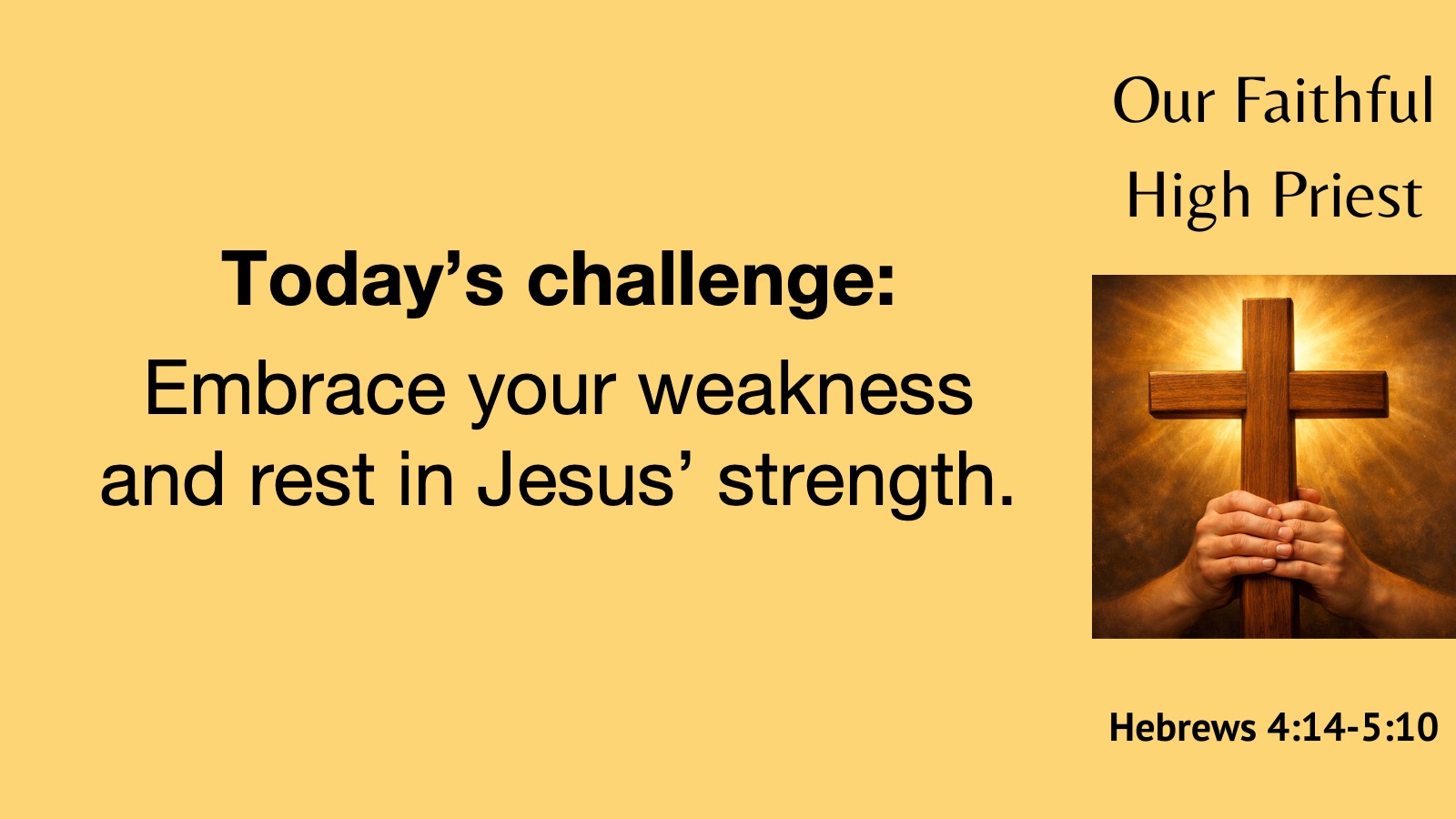
So the challenge I want to leave with you today is this: Embrace your weakness and rest in Jesus’ strength. Remind yourself of how helpless you really are on your own, but also how blessed you are to be living life with Jesus. And then, when those feelings of helplessness come, and they will, you will have already established the pattern of your life. You have a high priest who has been tempted in every way just as you are, yet without sin. And you rely on him with confidence, knowing that he is your faithful source of mercy and grace to help in every time of need. Amen.
Watch the full sermon: Faithful to the End 2: Our Faithful High Priest
[i] Dane Ortlund, Gentle and Lowly: The Heart of Christ for Sinners and Sufferers (Wheaton IL: Crossway, 2020), 49.


