

Years ago, before I entered the path toward becoming a pastor, Susan and I had our own business selling fuel and fertilizer to farmers and small commercial businesses. With that came lots of advantages: all the expenses for one of our vehicles were paid for by the business, each year we would buy a 4-H calf for advertising that would end up in our deep freeze, and anything that could be a legitimate business expense was paid for by the business. And yet, despite all these advantages, we were living hand to mouth financially, and it seemed like a struggle to pay all the bills each month. That didn’t make sense to me.
But what was far more baffling to me was what happened later, when I was going through university and seminary to become a pastor and neither of us were working full-time: all our monthly bills got paid, we had plenty of food to eat and clothes to wear, and we had some of the best Christmases we ever had. I could only conclude that God’s math was different from ours.
Fast forward a few years. By this time, both Brandon and Morgan were graduating from high school. We were still living in Saskatchewan, but we knew we were going to move to Langley so I could serve as a pastor here. One day, Morgan came to Susan and me and said, “Mom and Dad, I saw how you trusted in God to provide for us when God called Dad to become a pastor, and he did. And just like that, I believe God is calling me to go to Trinity Western University, and I am going to trust in him to provide for me to do that, just like you did.” I remember sucking in my breath sharply at the thought of how expensive that could be, and suddenly realizing two things: first, my son had been watching Susan and me and learning from our example in a way I hadn’t realized before; and second, I didn’t have as much faith in God for Morgan’s path through Trinity Western as he did. Thankfully, God is faithful, and he did provide for Morgan to go to Trinity.
That’s twice that I experienced God’s faithful rescue in profound ways, and there have been many, many other times when God has rescued me and my family over the years. So you would think that my faith in God would be rock solid and able to meet any new challenge with an unshakeable confidence in God. But that’s not what happened. For I am a frail and flawed human being. Other challenges did come: health challenges, financial challenges, relational conflicts, and the prolonged illness and death of a parent. And every time, I felt overwhelmed and alone, like I was in a deep, dark pit with no way out.
The challenge of trusting in God for whatever we may need in life seems to start fresh with every new problem that arises. We may have had several past experiences of God’s love, faithfulness, and rescue, but whenever we face a crisis in this present moment, we wonder, “Will God rescue me this time?” and our heart fills with fear over the possibility that he might not. There has to be a better way to live. But how do we live with a more confident faith in God? As we think about that question today, and we kick off a new series called “When God Restores Us,” let’s dig into Psalm 40 for God’s answer. If you have a Bible or a Bible app nearby, I invite you to turn there now.
Remembering God’s Gracious Rescues in the Past
As we open this psalm, the heading tells us that this is another psalm of David. There is nothing in the psalm to indicate a connection with a specific situation in David’s life, but there are hints that he is already the king of Israel. In verse 7, a scroll is mentioned, and this could be referring to the personal copy of the Torah that the king was required to keep, read, and internalize (see Dt. 17:18-19). In verse 9, the author mentions playing a leading role in worship, and this was something David did as king.
The probability that David was king when he wrote Psalm 40 is significant. We modern folk tend to think that having enough power, wealth, or beauty will protect us from calamity. In Psalm 40, we can see that you could be the richest, most powerful, and best-looking person in the land—David was all of these things—and troubles will still come upon you.
But note how David deals with the challenge he is facing. First, he reflects on times in the past when God rescued him:
I waited patiently for the Lord;
he turned to me and heard my cry.
He lifted me out of the slimy pit,
out of the mud and mire;
he set my feet on a rock
and gave me a firm place to stand. (Psalm 40:1-2)
David is remembering a time in the past when he was totally helpless in a pit which would have destroyed him, yet God faithfully lifted him out of that pit and placed him on solid ground. The result of that rescue?
He put a new song in my mouth,
a hymn of praise to our God.
Many will see and fear the Lord
and put their trust in him. (Psalm 40:3)
David sang a song of praise to God, a new song that God had given him. Others had witnessed both the rescue and the result, and the tangible evidence of God’s saving action caused their faith to grow.

Being rescued also caused David’s faith to grow, and he can see evidence of that growth in his own life. Though he faithfully participates in the sacrificial system God set up centuries before, David knows that making those sacrifices is not the most important thing. They are only one outward way that David lives out the inner faith God has given him in his heart. It’s the alignment of David’s inner desires with God’s desires that is most important. David is responding to God’s faithful rescues of the past by conducting his life as a living sacrifice (see Romans 12:1-2). He knows he is flawed and imperfect, he knows he is utterly helpless to escape the muck and the mire of the pits life sends our way, and he knows that he is totally unworthy of being rescued. And yet, again and again, because of his faithfulness and his lovingkindness, God has rescued his people throughout the centuries past, and David throughout his lifetime.
It’s the enormity of God’s mercy and grace that moves David to proclaim God’s faithfulness before others:
I proclaim your saving acts in the great assembly;
I do not seal my lips, Lord,
as you know.
I do not hide your righteousness in my heart;
I speak of your faithfulness and your saving help.
I do not conceal your love and your faithfulness
from the great assembly. (Psalm 40:9-10)
Sometimes we are afraid to share what God has done in our lives for fear of what others might think. Gratefulness for God’s rescue overcomes any such fears in David’s heart.
Crying Out from the Depths of a Self-dug Pit
And then, with verse 11, a new threat emerges. David begins to lament, but he does so in faith:
Do not withhold your mercy from me, Lord;
may your love and faithfulness always protect me.
For troubles without number surround me;
my sins have overtaken me, and I cannot see.
They are more than the hairs of my head,
and my heart fails within me. (Psalm 40:11-12)
Once again, David finds himself in a deep and dangerous pit. This time it’s a pit that David himself has dug. His many sins have caught up to him, and the dark weight of his guilt and shame is crushing his heart. And yet he still cries out to God for rescue and vindication:
But as for me, I am poor and needy;
may the Lord think of me.
You are my help and my deliverer;
you are my God, do not delay. (Psalm 40:17)
We patiently trust in God to Rescue Us Because of Who He is & What He Does
And therein lies the key to this psalm and to our entire faith: we can patiently trust in God for a rescue we need but do not deserve, not because of who we are or what we do, but because of who God is and what he does. God is full of grace and mercy that flows from his faithful lovingkindness. The many times he rescued us personally in the past provided evidence that caused our faith to grow. We can see evidence of that growth in the ways the Holy Spirit has transformed us: moving us to want the things God wants, helping us to offer our bodies as living sacrifices, holy and pleasing to God, not to try to earn our rescue, but in profound thankfulness for the amazing rescue we have already been given.
God is totally different from the world, and so God relates to us in a way that is totally different from the world. With God, past results do indicate future performance. As we journey through life and begin to accumulate real-life examples of God saving us, we treasure those divine rescues in our heart, and we practice remembering them, so the next time we are stuck in a pit, we naturally say to ourselves, “Remember how God rescued me in the past? He has already demonstrated his faithful lovingkindness toward me, and he will do it again.”
But the ultimate indication of God’s faithful lovingkindness, and our greatest source of hope for rescue, is not found in our own lives, but in the life of Jesus Christ. The writer of Hebrews quotes Psalm 40:6-8 from the Greek version of the Old Testament and puts those words in the mouth of Jesus. So imagine Jesus saying these words to his Father:
“Sacrifice and offering you did not desire,
but a body you prepared for me;
with burnt offerings and sin offerings
you were not pleased.
Then I said, ‘Here I am—it is written about me in the scroll—
I have come to do your will, my God.’” (Hebrews 10:5-7)
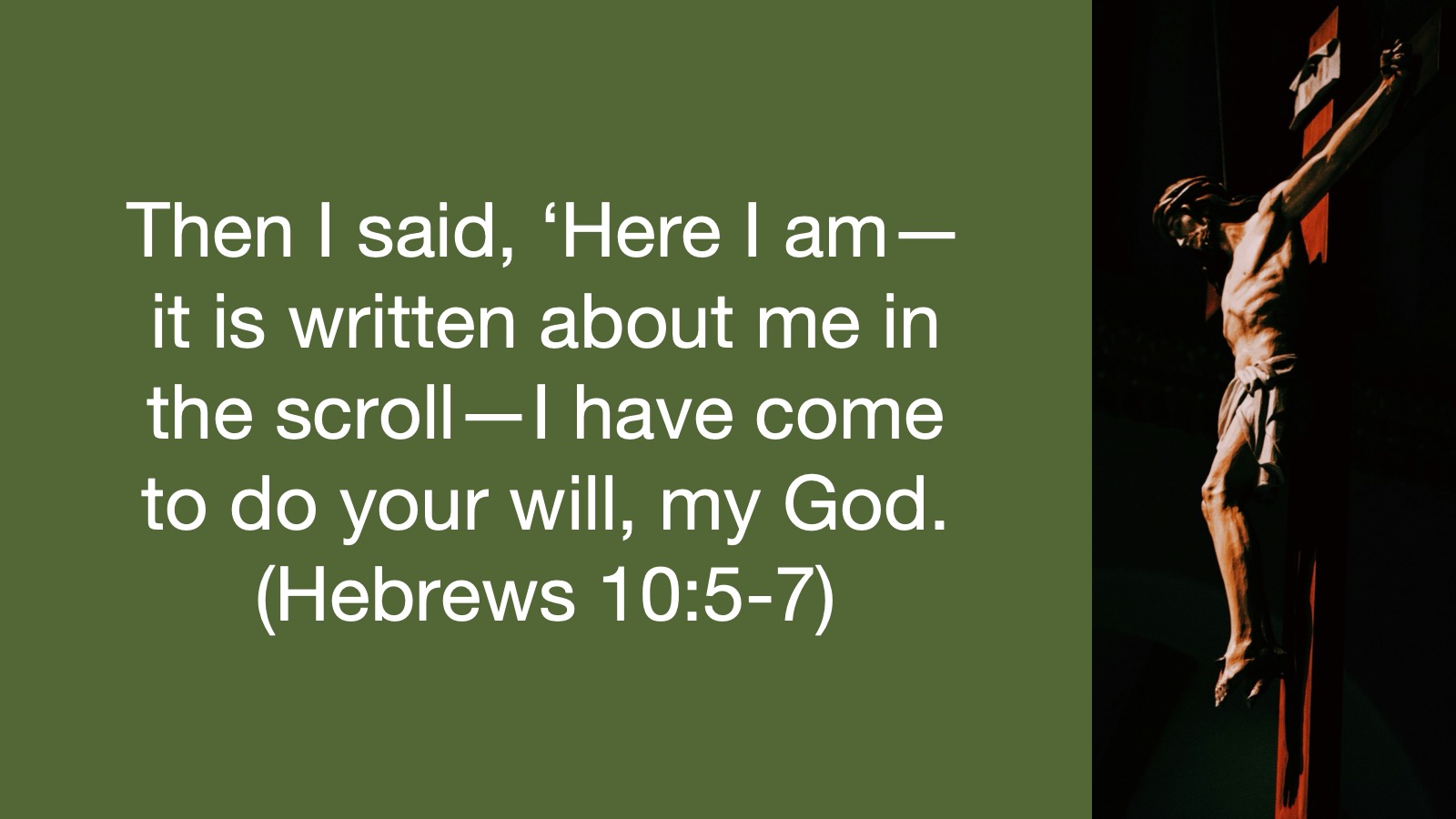
David was a flawed and imperfect human, just like us, whose sin dug deep pits of destruction. But not Jesus. In accordance with all foretold of him in God’s Word, he is God the Son who miraculously came into this world and became fully human to save us and all creation. Out of love for us and a deep desire to do his Father’s will, Jesus willingly descended into a deep and terrible pit dug by the sins of all humanity. On a cross outside Jerusalem, Jesus suffered what we deserve so he could give us what he deserves: unconditional love, grace, and acceptance by his heavenly Father; life with God that lasts forever; and a destiny in paradise, where all creation, including us, will be fully healed and restored.
Jesus’ life, death, and resurrection are the reason we can cry out to God for rescue, even when we don’t deserve it—especially when we don’t deserve it. Jesus’ faithful lovingkindness, which has already been demonstrated to us, is the reason we can patiently wait for God to lift us out of whatever pit we are in. The salvation Jesus has won for us—including forgiveness for all our sins, new life with God, and complete restoration to come in the future—is already ours, and nothing can ever take it away from us. Therefore, every day we sing a new song of praise to God, and we pray that the life of faith that we live may move others to also put their trust in the Lord.
Live as a Rescued Person
So here is the challenge that I am setting before you today: live as a rescued person.
First, treasure the incredible rescue Jesus has already given you. Through his life, death, and resurrection, Jesus has rescued you from sin, eternal death, and everlasting condemnation. It’s a rescue you didn’t deserve or earn, and yet Jesus gave it to you as a free gift because he loves you. It’s yours. Remember that ultimate rescue daily, and make it the foundation of all you are and all you do.
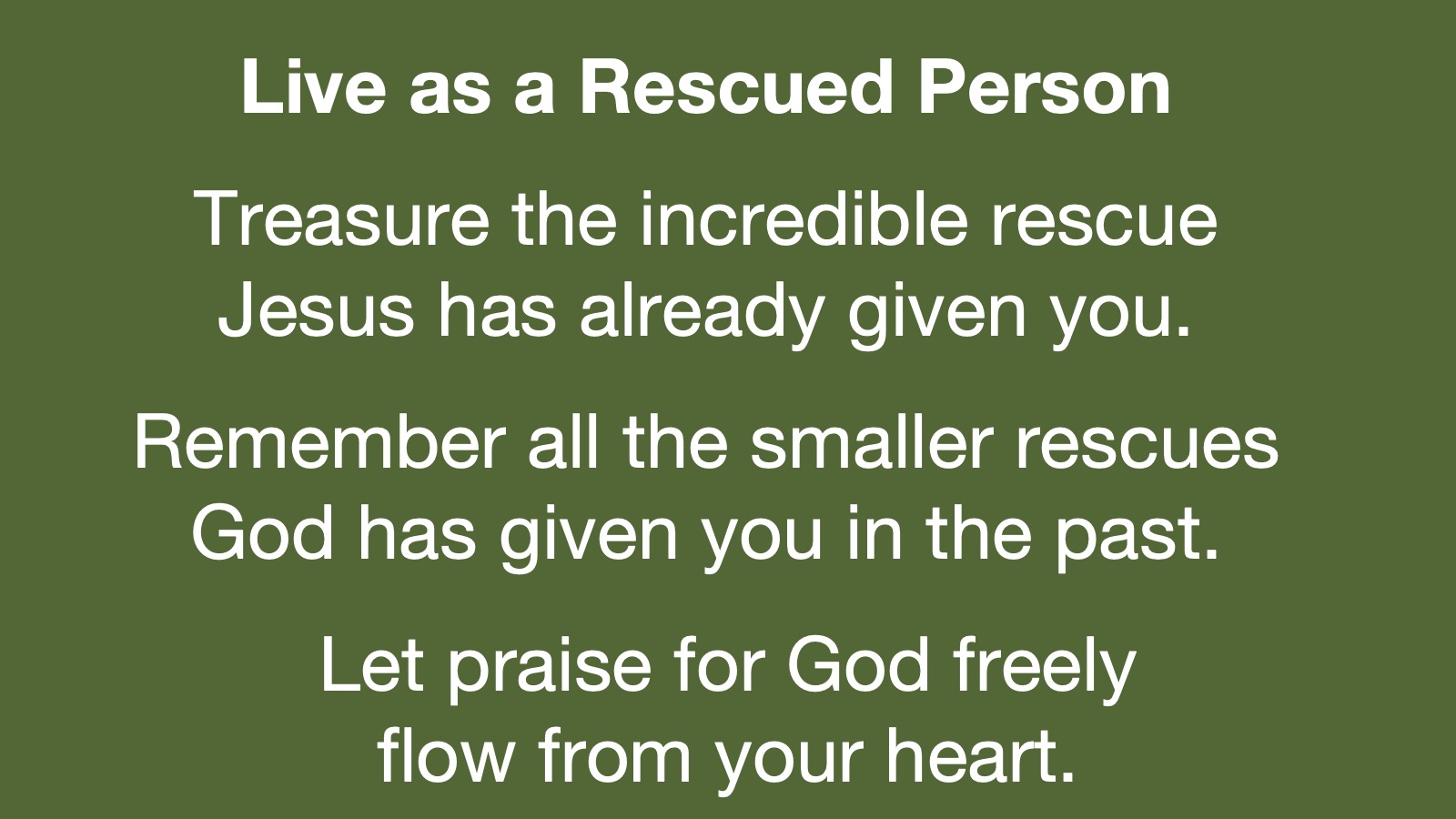
Second, remember all the smaller rescues God has given you in the past—like the times when you narrowly avoided a terrible disaster, but you had nothing to do with it; or you made a small, random decision and it led to something incredibly good for you; or you sense God is leading you in a direction where things shouldn’t work out, but they do. All these minor rescues are supportive evidence of God’s love, mercy, and grace applied to you personally.
And finally, let praise for God freely flow from your heart. The evidence of what God is doing in your life may be exactly what someone else needs to trust in Jesus and receive the amazing rescue that he freely gives. Amen.


