

The loneliest I have ever been in my life was during the years after I graduated from Olds College, when I lived on a ranch my family bought south of Coronation. Up to that point I had always lived surrounded by family and friends. At the ranch, it was just me and the hired men. All my neighbours were married; I was single. They had lived in the area for years; I was new. Other than ranching, I had nothing in common with those around me, and I felt very lonely. I was revived by going home for special occasions or road trips to see college buddies, but otherwise, I was miserable.
However, God used this time of loneliness to awaken a deeper and more important longing: a thirst for him. I spent long evening hours by myself in the cellar of the house, reading the Bible given to me when I was confirmed. After four lonely years, I found a longing in my heart to go back to church again. My youngest brother and I drove 45 minutes to the nearest Lutheran church in Hanna, but we arrived just as people were coming out.
Even so, the desire to worship remained — soon I was driving home to Provost nearly every weekend to attend church there, and when Susan and I started dating a short time later, worship was part of our relationship from the start.

It is a great blessing to be surrounded with wonderful people who love you, to enjoy good health, and to have an abundance of food, clothing and shelter. In our Western culture, this describes what we call “the good life,” and we tend to think that if we have it, we have everything we need. But when we think this way, we make a huge category mistake: we mix up the Gifts, which are blessings, with the Giver who gives them. When we make the Gifts the ultimate things in our life, we set ourselves up for a terrible fall, for the Gifts can never carry us through the dark valleys of life.
Because of this, the absence of those gifts, whether it is in times of loneliness, exile, or isolation, can be a blessing to us because they wean us off our addiction to the Gifts, and help us recognize our need for the Giver. Turns out we humans need a good crisis now and then to help us grow into becoming more like Jesus.
So let’s consider this question: Where do we turn when loneliness, distance, or crises leave our heart and mind filled with turmoil? Today, as our series When Life Falls Apart draws to a close, let’s turn to Psalms 42 and 43 for God’s answer to this question.
We All Face Loneliness and Isolation (Psalm 42:3, 6, 9-10)
As we do that, we see that there is a heading for Psalm 42, but not for Psalm 43. This suggests that these two Psalms were likely one Psalm at some point. The heading for Psalm 42 tells us this psalm was written “to the Choirmaster” by “the sons of Korah” — those are Levites responsible for the Tabernacle’s holy items and for leading God’s people in song. You could think of them as being like the men’s choir in a church. So this is a song God’s people have sung in worship for centuries.
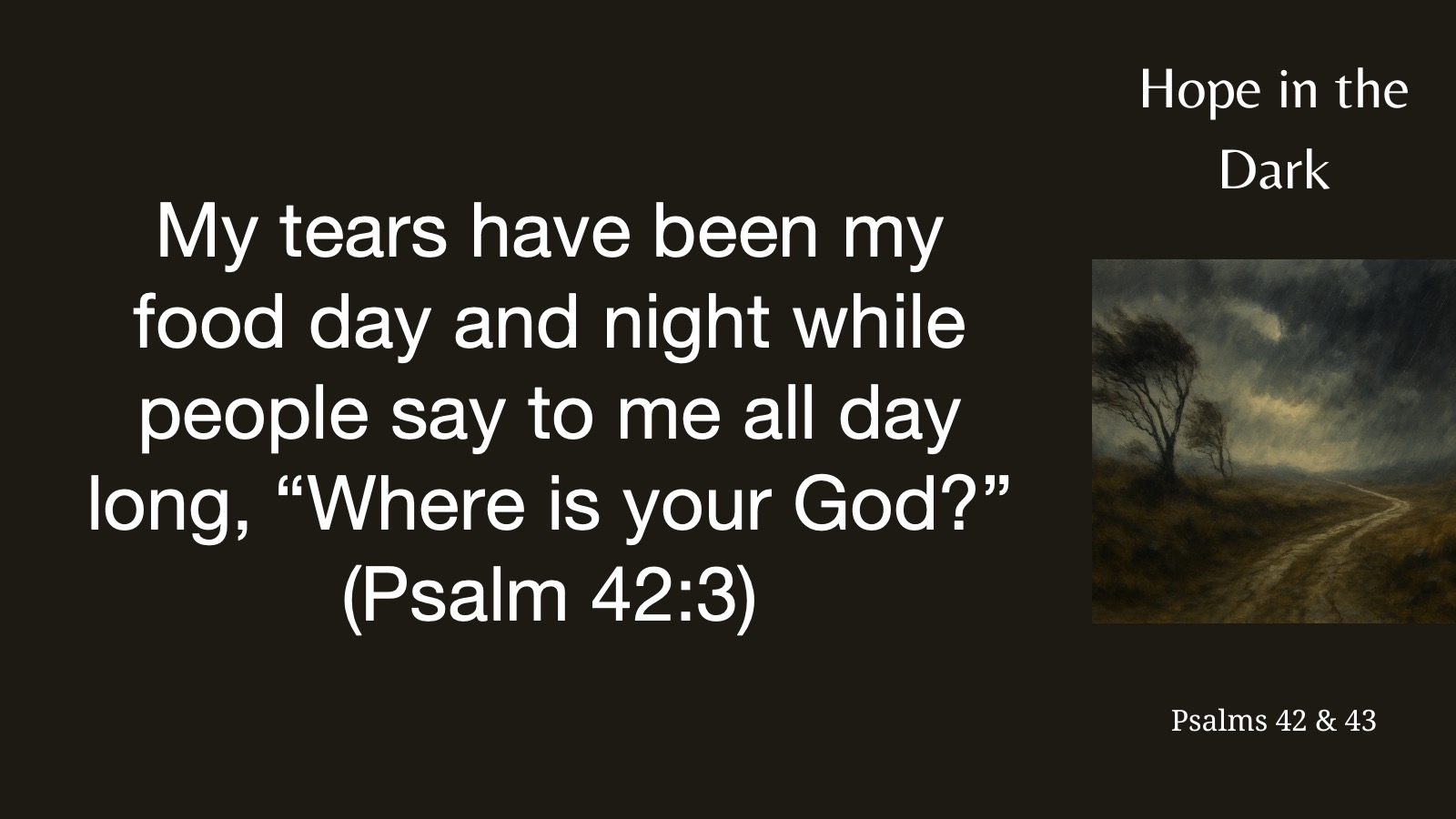
We don’t know for certain who wrote it, but the content suggests it was probably someone from the clan of Korah who was carried off far from Jerusalem, likely during a Syrian invasion (see 2 Kings 12:17-18) — The author is cut off from the worship he loved and taunted by his captors. He writes, My tears have been my food day and night while people say to me all day long, “Where is your God?” (Psalm 42:3)
We may never be kidnapped and taken into exile in a faraway land, but we will all know this kind of loneliness and isolation. Relationships can fall away because of distance, seasons of life can separate us from the people who once surrounded us, and we can find ourselves new in a place where everyone else has known each other for years — Perhaps we are single while everyone around us is married. Whatever the reason, we are out of step with a community we long to belong to.
And if we live long enough, eventually our health will fade, and one day we will face our own impending death: Death is the ultimate loneliness, since none of our human companions can walk with us to the edge of that abyss and beyond. As we face death, all the gifts we enjoyed in life — the relationships, the comforts, the possessions — will be stripped away. Physical and relational pain may even come together and cause us to cry, My bones suffer mortal agony as my foes taunt me, saying to me all day long, “Where is your God?” (Psalm 42:10)
As death approaches, we may feel alone and isolated, far from where we long to be, just as the psalmist remembers the people and places he loves …from the land of the Jordan, the heights of Hermon—from Mount Mizar. (Psalm 42:6) These are places that are far from Jerusalem. Perhaps in our innermost thoughts, we may wonder to God, “Why have you forgotten me? Why must I go about mourning, oppressed by the enemy?” (Psalm 42:9)
For some of us, that isolation comes wrapped in mockery, just as it did for the psalmist — people who question our faith out loud or attack us for it. For others, it’s quieter: no one taunting us, just the ache of distance and the silence of a season nobody else can see. Either way, we are not alone in it.
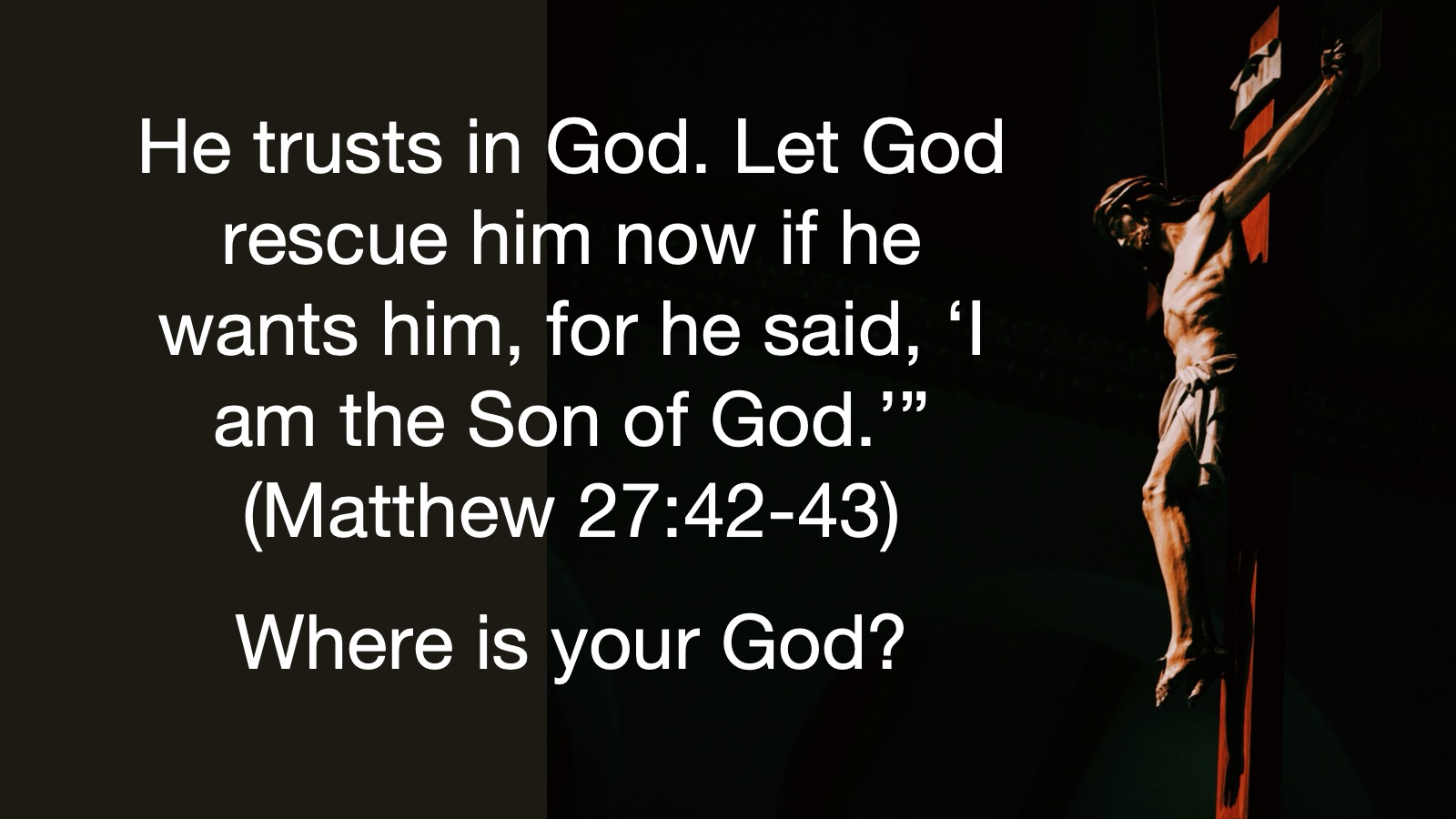
For on the cross, Jesus endured the very taunt the psalmist describes. As he hung there, those passing by hurled insults at him: “He saved others,” they said, “but he can’t save himself! He’s the king of Israel! Let him come down now from the cross, and we will believe in him. He trusts in God. Let God rescue him now if he wants him, for he said, ‘I am the Son of God.’” (Matthew 27:42-43) It’s the same taunt in a different voice: Where is your God?
Whether our isolation is loud or quiet, Jesus has already been there — mocked for trusting his Father in the middle of suffering, yet still the Son of God, still loved by the Father, even in the silence. It’s the same with us. In Jesus, we remain beloved, forgiven children of God even when the darkness makes it feel otherwise.
Our Soul is Recalibrated for Hope through Worship (Psalm 42:1-2, 5, 11; 43:1, 4)
Here in Psalms 42 & 43, as we see in other psalms, raw emotions are directed with unvarnished honesty toward God — but then there is something new. Three times the psalmist dialogues with himself: Why, my soul, are you downcast? Why so disturbed within me? Put your hope in God, for I will yet praise him, my Savior and my God. (Psalm 42:5)
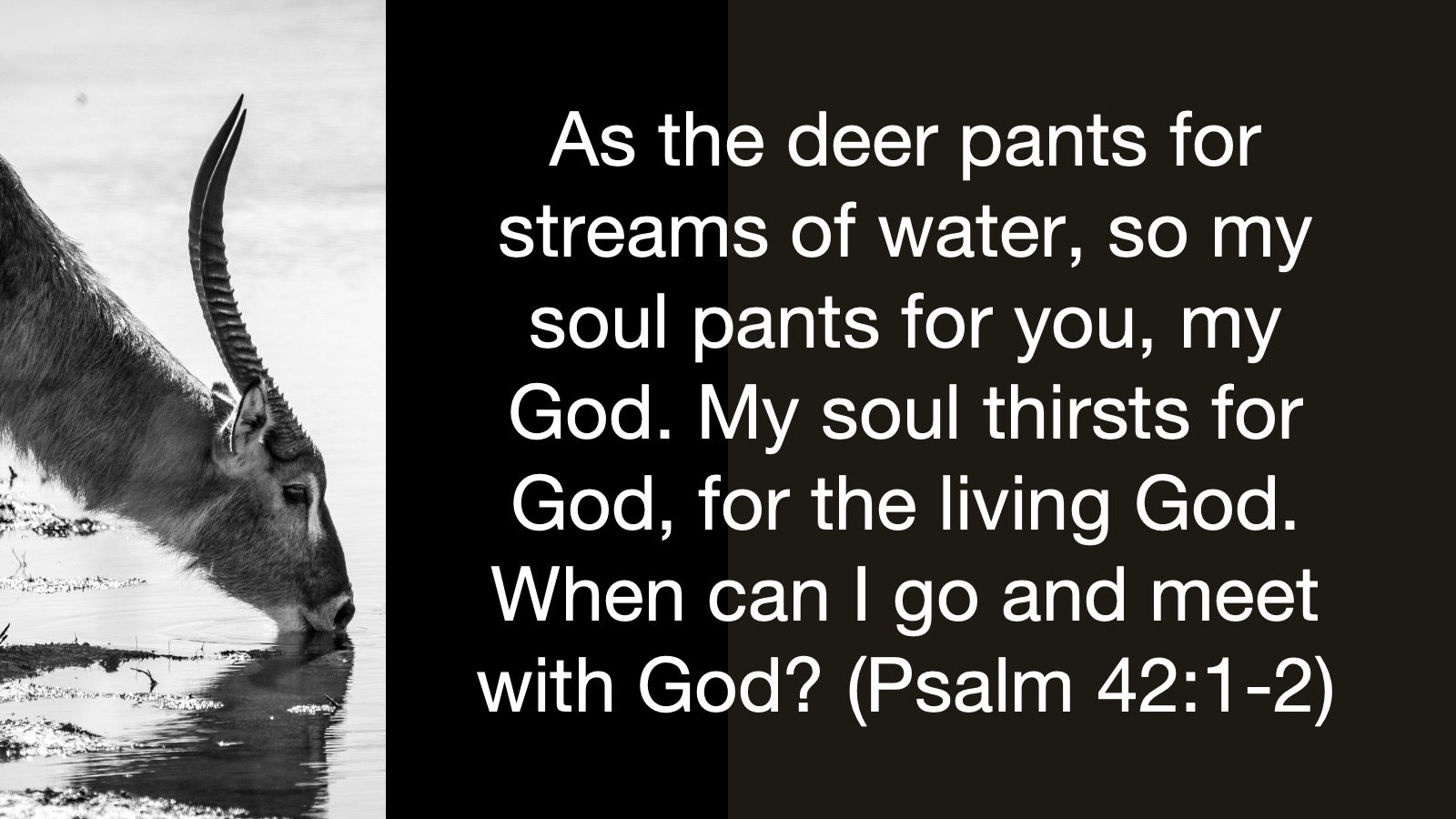
And despite all the losses, the loneliness, the pain and grief, the writer keeps yearning for God: As the deer pants for streams of water, so my soul pants for you, my God. My soul thirsts for God, for the living God. When can I go and meet with God? (Psalm 42:1-2)
And that heartfelt desire for God craves the freedom to express itself in worshipping God. Vindicate me, my God, and plead my cause against an unfaithful nation. Rescue me from those who are deceitful and wicked.… 4 Then I will go to the altar of God, to God, my joy and my delight. I will praise you with the lyre, O God, my God. (Psalm 43:1, 4)
The Psalmist is not only pleading for rescue — his ultimate longing is for the Lord himself, a reunion fulfilled through worship. This takes us back to the tension we named earlier: when the Gifts we love are stripped away, what’s exposed is the truth of what we’ve been worshipping all along.
As Paul David Tripp writes in Instruments in the Redeemer’s Hands, “Human beings by their very nature are worshipers… Everybody worships; it’s just a matter of what, or whom, we serve.” [i]
Our innate tendency to worship things other than God distorts everything we are and do; but worship of the one, true God recalibrates our life’s focus and satisfies our heart’s deepest longings. Even complaints and petitions, like those of the psalmist, are worship, providing we express them looking up to God and not down. Honest complaints can help us by clearing the way for our heart to be opened toward God.
Jesus gives us the full picture of what this worship looks like when he prays to his Father: I have given them the glory that you gave me, that they may be one as we are one — I in them and you in me — so that they may be brought to complete unity. Then the world will know that you sent me and have loved them even as you have loved me. (John 17:22-23) The world sees the glory of God when his people worship him — especially when they do so from a place of darkness.
Three Moves for Us from the Psalmist
So where do we turn when loneliness or crisis leaves us in turmoil, cut off from the people and worship we love, wondering if God has gone quiet? Whether our darkness is quiet, like mine on that ranch, or loud, filled with voices that taunt us by saying, “Where is your God?”, the psalmist gives us three moves that we can make.
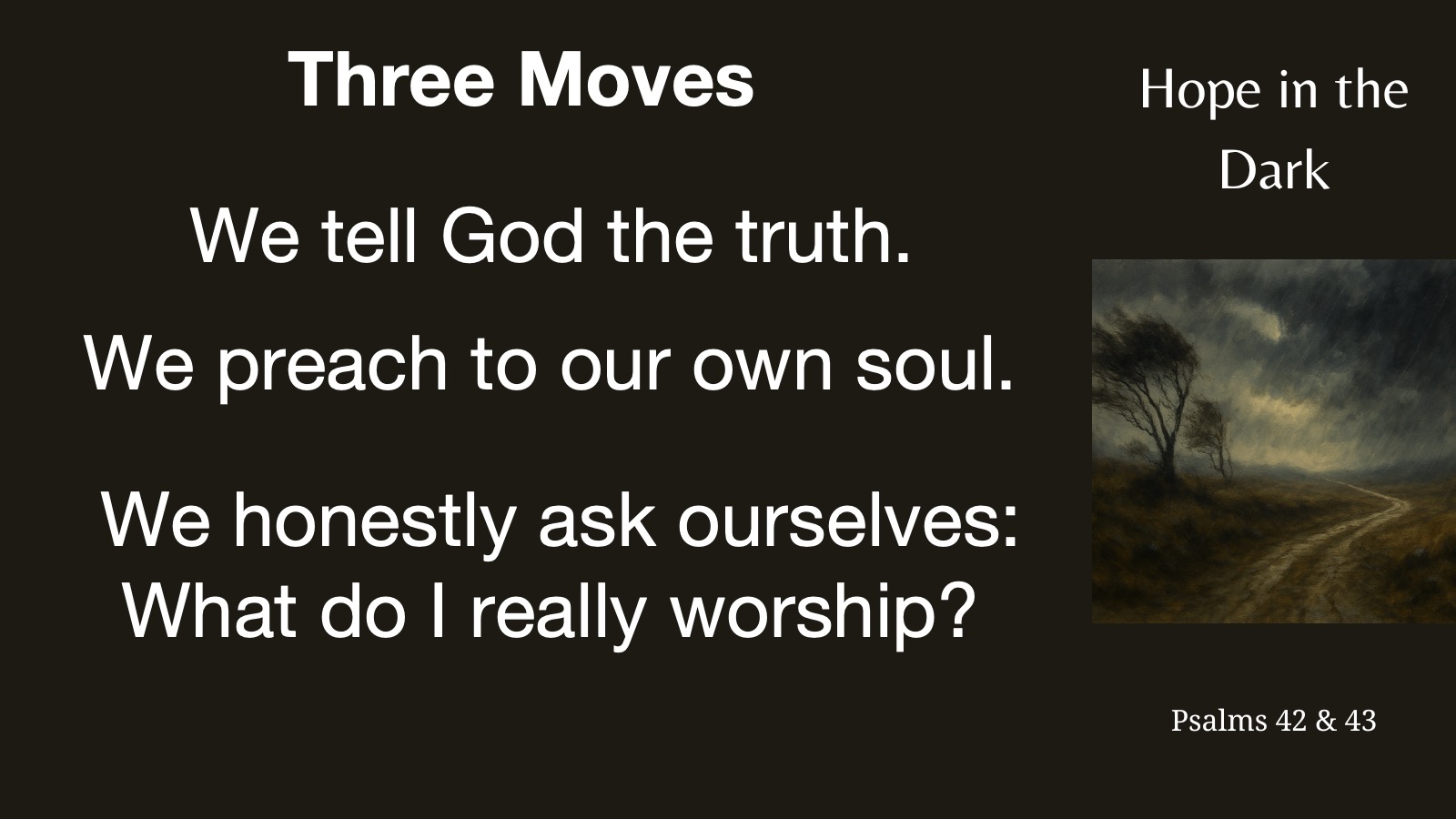
First, we tell God the truth. The psalmist doesn’t perform a faith he doesn’t feel — he names his grief, his memories, his sense of abandonment, out loud to God. We can do the same, in prayer, in journaling, in honest conversation with a friend. Suppressing pain doesn’t make us more spiritual; it just leaves it to fester in the dark.
Second, we preach to our own soul, the way the psalmist does mid-lament: “Why, my soul, are you downcast? Why so disturbed within me? Put your hope in God.” (Psalm 42:11)
You might think to yourself, “Preaching to my own soul? That sounds like a strange thing to do. I don’t think I can do that.” If you know how to worry, which nearly all of us do, then you know how to preach to your own soul. All you have to do is change the script.
The psalmist doesn’t wait for the feeling of hope to show up before he speaks the truth of it. And we know more about God and his plans and purposes for us than the psalmist does. Because of the life, death and resurrection of Jesus, we have a rock-solid hope that doesn’t depend on our circumstances in any way.
In Jesus, we have God’s promise that we have new life with him, we are adopted into his family as his child, we are forgiven of all our sins and filled with the Holy Spirit, and we are headed toward a wonderful future in which Jesus will restore and renew all things, including us. This is the hope that we need to continually speak into our own soul.
Third, we strip away all our layers of self-focus and self-protection and we honestly ask ourselves: What do I really worship? Our emotions can give us clues. We can ask ourselves questions like: What does my heart love most? What do I fear losing? When I get angry, what is being threatened? The answer to these questions often is our object of worship.
Consider the psalmist. His deepest ache isn’t comfort or rescue — it’s reunion with God at the altar (see Psalm 43:4). Worship isn’t the reward we get after the darkness lifts; it’s often the means God uses to bring the dawn. Direct your heart to worship God and let him restore your aching soul.
Jesus Has Already Walked This Dark Road Ahead of Us
Dear reader, please be comforted by this good news: Jesus has already walked this dark road of loneliness and isolation ahead of us, in both its quiet and its loud form.
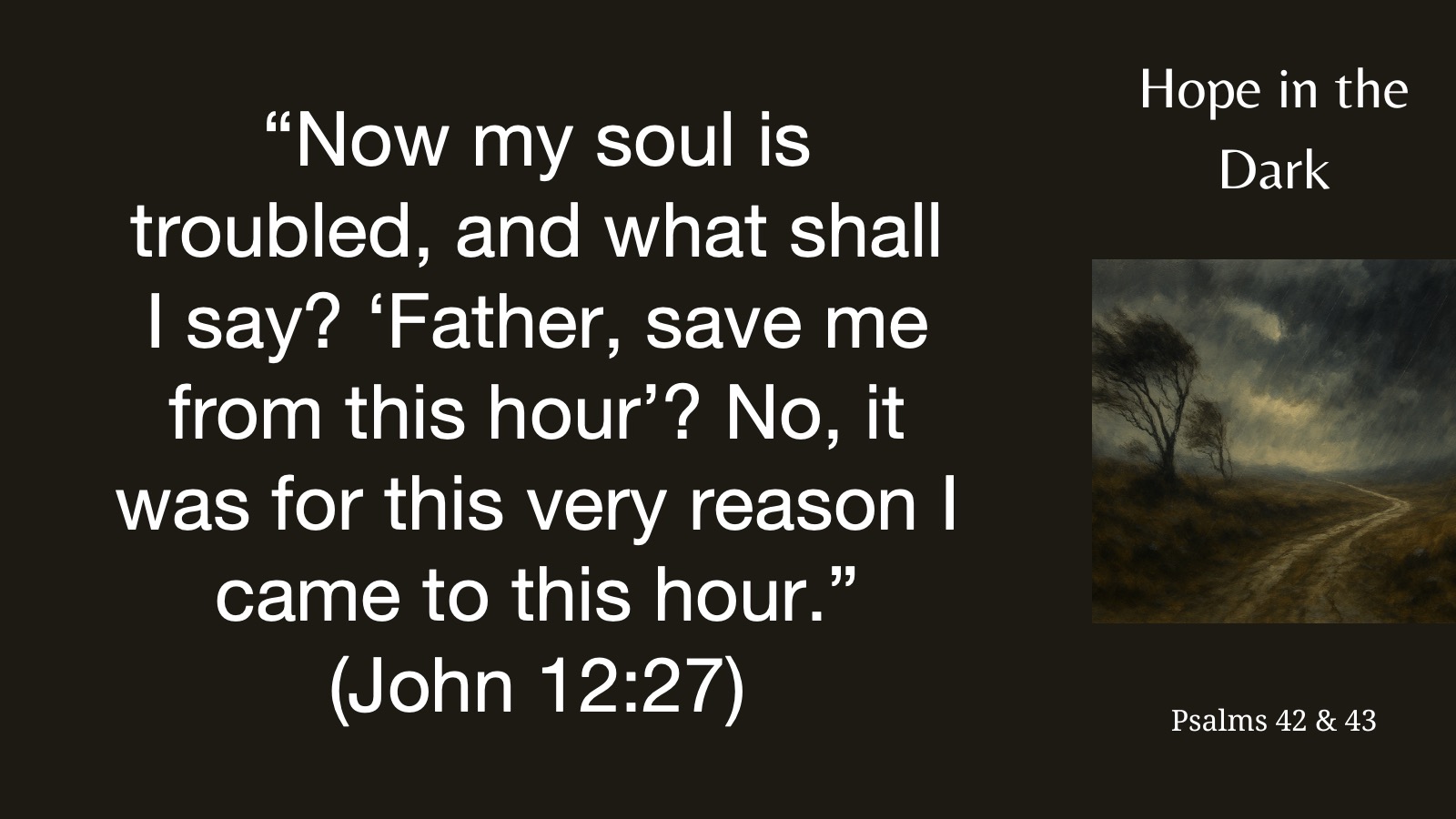
Approaching the cross, he said, “Now my soul is troubled, and what shall I say? ‘Father, save me from this hour’? No, it was for this very reason I came to this hour.” (John 12:27)
Jesus uses the same self-dialogue as the psalmist — his soul disturbed, yet he spoke directly into that disturbance rather than let it have the last word. He anchors his hope in the Father’s purpose rather than the relief of escape.
That resolve carried him through the mockery of the cross and into three dark days in the tomb, with no visible evidence yet of the dawn. Mine took four years.
But Jesus’ isolation ran all the way through death itself — his resurrection is the reason our hope is not wishful thinking, but a promise with a proven track record. The darkness broke, and the God who seemed absent was revealed as never having left. It was true for Jesus, and it is also true for us no matter how long the darkness lasts.
I think about those long, lonely evenings alone in that cellar at the ranch, reading a Bible I hadn’t opened in years. God’s presence was real there, and it sustained me — the same way it sustained the psalmist and carried Jesus through his own dark hours. But I needed more. Like the psalmist, I wasn’t just thirsting for God in private; I was thirsting to meet with him among his people, a thirst that eventually led me back to church, back to worship, and to Susan.
Hope in the dark isn’t a feeling we manufacture. It’s a person, who has already walked through the deepest dark there is and come out the other side singing.
Sing Before the Dawn
Dear friends, the words we speak to ourselves are very, very important. So the challenge that I am setting before you this week is to speak hope from Jesus into your own soul. You may have patterns of negative self-talk that will need to be rooted out and replaced with God’s truth, and that is not easy. But it will be worth it.
You might need to surround yourself with sticky notes of Bible passages that echo God’s hope. Whatever it takes, however long it takes, make it a pattern to encourage your soul with the Good News of Jesus. It’s that Good News that transforms us into people who sing praises to God like the psalmist:
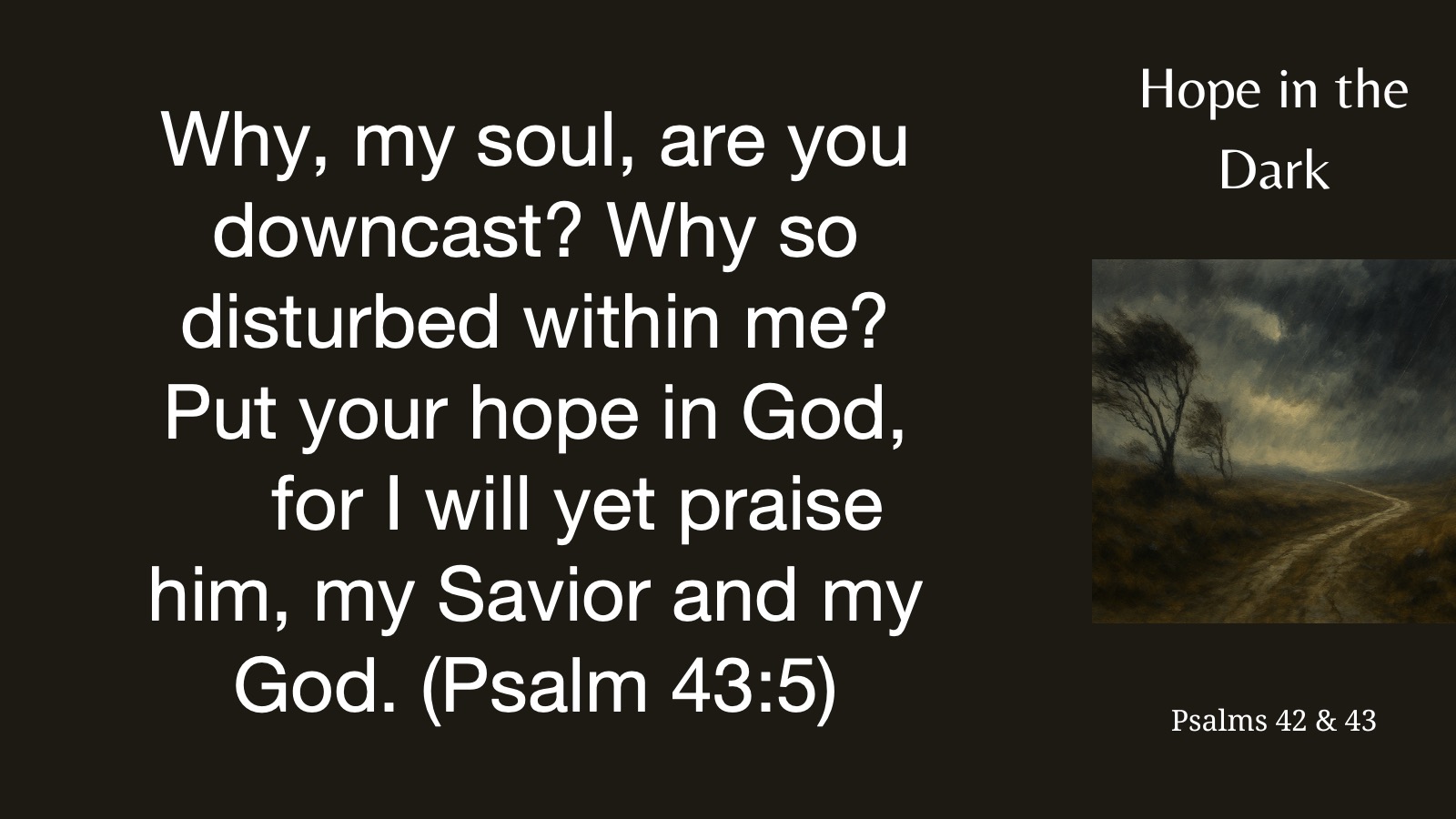
Why, my soul, are you downcast?
Why so disturbed within me?
Put your hope in God,
for I will yet praise him,
my Savior and my God. (Psalm 43:5) Amen.
[i] Paul David Tripp, Instrument’s in the Redeemer’s Hands, quoted in “Instruments in the Redeemer’s Hands,” Goodreads.com (https://www.goodreads.com/work/quotes/204382-instruments-in-the-redeemer-s-hands-people-in-need-of-change-helping-pe; accessed August 6, 2026).


