

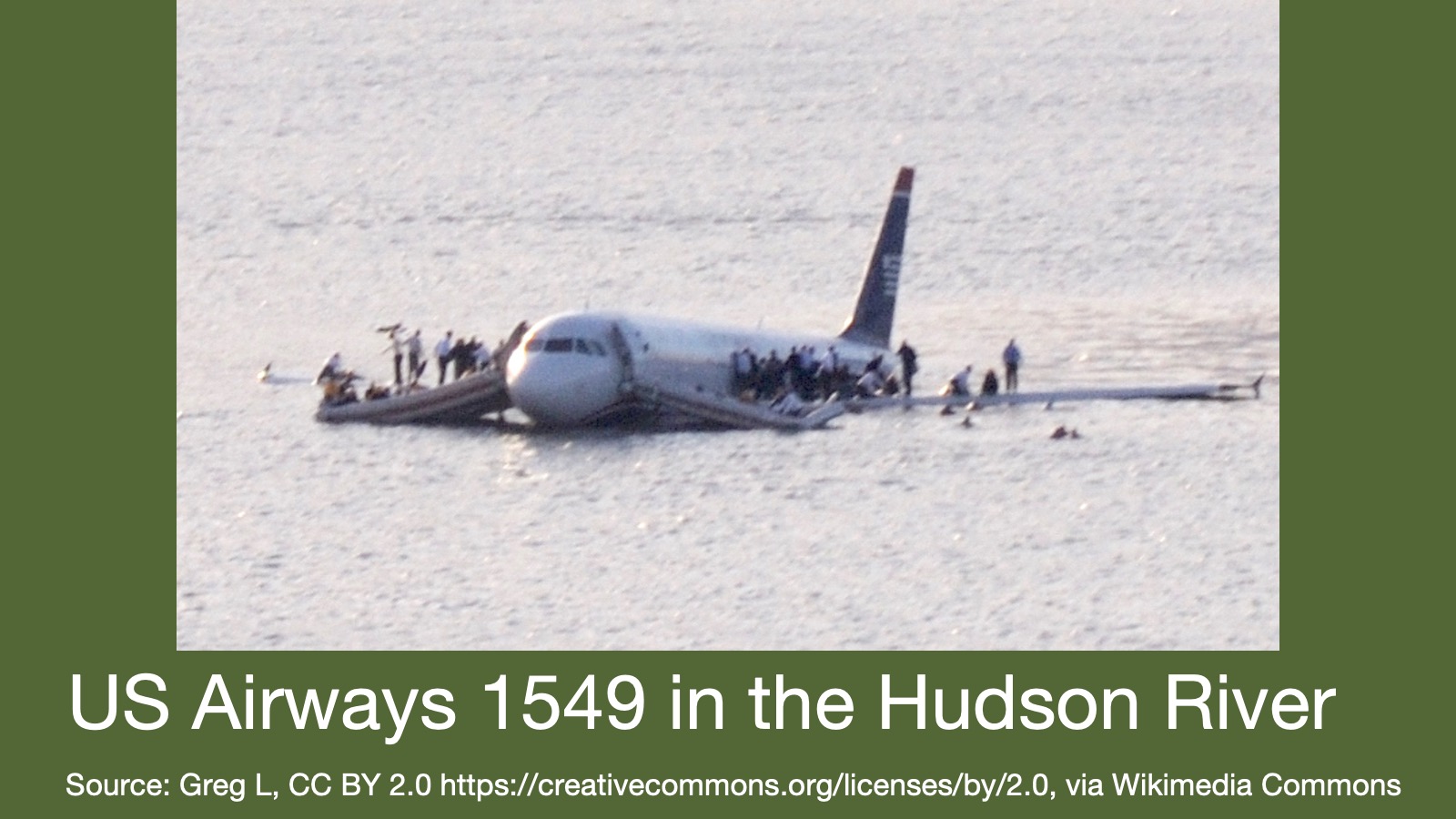
On January 15, 2009, the twin-engined A320 jet flown by Captain Chesley “Sully” Sullenberger and his co-pilot, Jeffrey Skiles, hit a flock of Canada geese shortly after takeoff from LaGuardia Airport. Both engines were knocked out, and the plane began to glide quickly toward the ground. LaGuardia cleared a runway for them, but Sullenberger, or “Sully” as he was known, quickly realized that they couldn’t make it back to LaGuardia. The only smooth, flat surface where they could possibly land was the Hudson River. “We’re gonna be in the Hudson,” Sully radioed back to the tower. He went on the intercom and told his passengers to brace for impact. Then, with the cockpit uncharacteristically silent, he calmly made an emergency water landing in the Hudson River. All 155 people on board were safely rescued. After searching the aircraft twice to make sure no one else was left on board, Sully was the last to leave the plane.
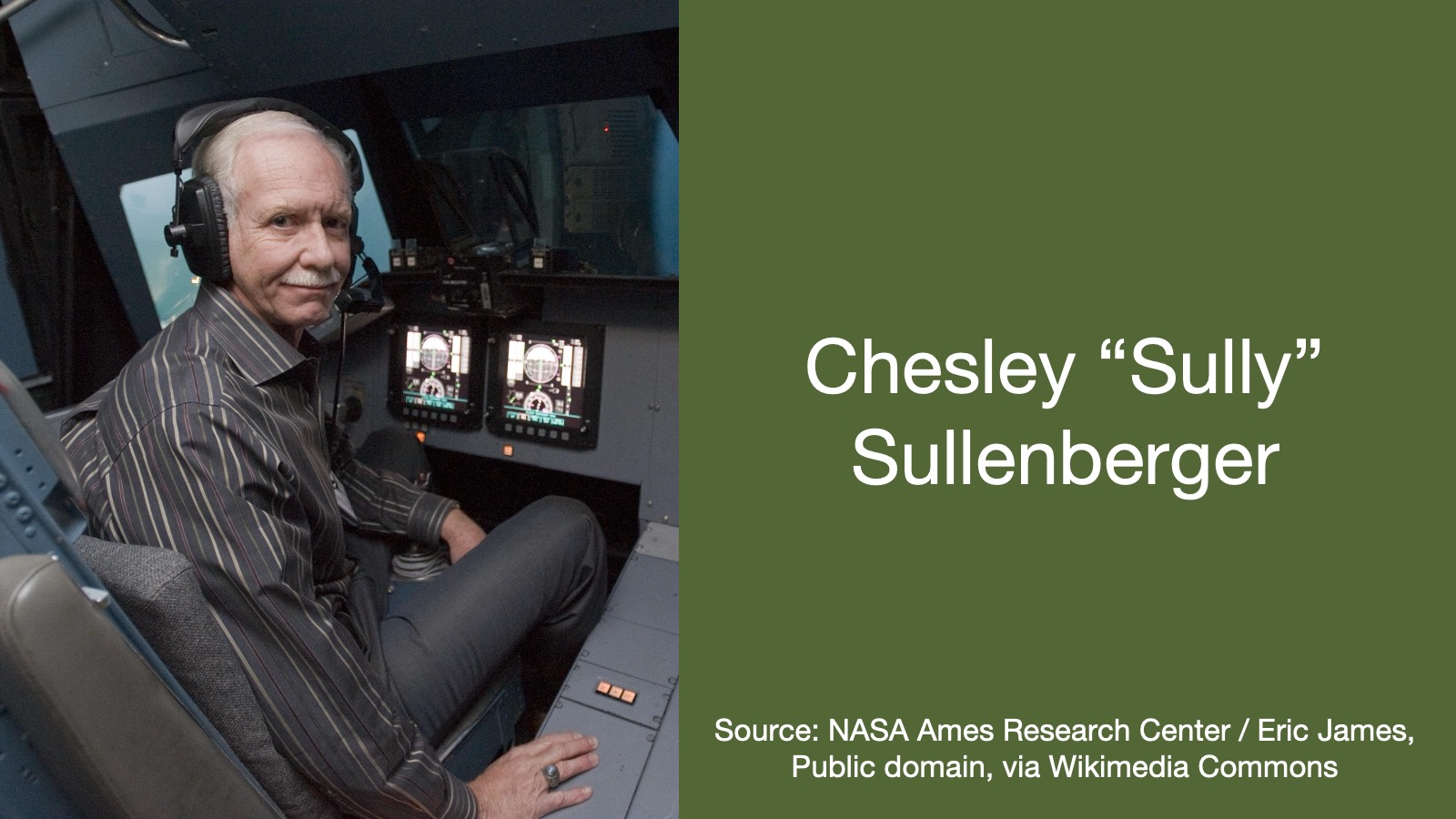
When the cockpit voice recorders were analyzed by investigators, what amazed them was the calmness of Sully’s response. The chaos thrown at him by the loss of both engines was not something he could control. All he could control was how he responded. Much of that calmness came from Sully’s experience. By the time of that fateful flight, Sully had flown more than 20,000 hours in military and civilian aircraft. But he had never landed a powerless passenger plane in the Hudson River before. And yet, he was able to do so with remarkable coolness and composure.
The way Sully landed that plane in the Hudson is an inspirational story of the calm collectedness that human skill and experience can produce. But Sully’s actions probably won’t give us a pattern that we can follow in our own times of crisis. His crisis came while flying a plane, something he had been doing since he was 16 years old, and over the years, had done in a wide variety of aircraft and situations. He was a certified flight instructor for gliders and both single- and multiple-engined aircraft. He also worked to improve airline safety through work with his union and the National Transportation Safety Board. Though the bird strike put Sully in a situation where he had to do something he had never done before, he had all those years of experience in the field of aviation which prepared him to face the chaos with calm. He said, “One way of looking at this might be that for 42 years, I’ve been making small, regular deposits in this bank of experience, education and training. And on January 15, the balance was sufficient so that I could make a very large withdrawal.” [i]
That’s not how things tend to work for most of us. Our chaos tends to come in realms outside our area of experience or expertise. A routine scan or blood test reveals a serious health risk, and we have no medical training. A registered letter warns of a devastating legal dilemma, and we aren’t a lawyer. And then there are crises for which no one can prepare. A relationship we treasure crumbles into ashes, and there is nothing we can do, even if we are a trained counselor. And who can prepare for recent events like wildfires that force thousands of people from their homes or vacation properties, including some from our own church family? Or the trade war between Canada and the United States which threatens to disrupt commerce between the two countries and have serious impacts for businesses and the workers they employ?
So where do we turn when there is chaos at our door and we have no personal resources to help us respond? To answer that question, let’s continue our series When God Restores Us and turn to Psalm 93 for God’s solution.
The Cosmic King is Our Source of Hope When We Have Nothing
As we do that, it will help us to know that Psalm 93 is part of a collection of psalms called the Enthronement Psalms, that were gathered here to answer God’s people in the wake of exile and the apparent failure of David’s throne. Theologian J. C. McCann, Jr. calls Psalms 93 and 95-99 “the theological heart of the Psalter.”[ii] We tend to seek comfort in psalms that sing of God’s gentle, personal care, like Psalm 23, rather than in defiant declarations of God’s cosmic sovereignty. But imagine what that must have been like for those who followed Yahweh in faith. The Babylonian army conquered their country, killed thousands of their people, struck down the royal line of David, ruined their capital city, destroyed their temple, and took the best and brightest of those who survived into exile in Babylon. Can you imagine the overwhelming turmoil God’s people were facing? From a human perspective, there was nothing left. And yet, God inspired his people to write and sing songs of praise about the one thing that would carry them through this dark and dreadful time: The Lord reigns. (Psalm 93:1)
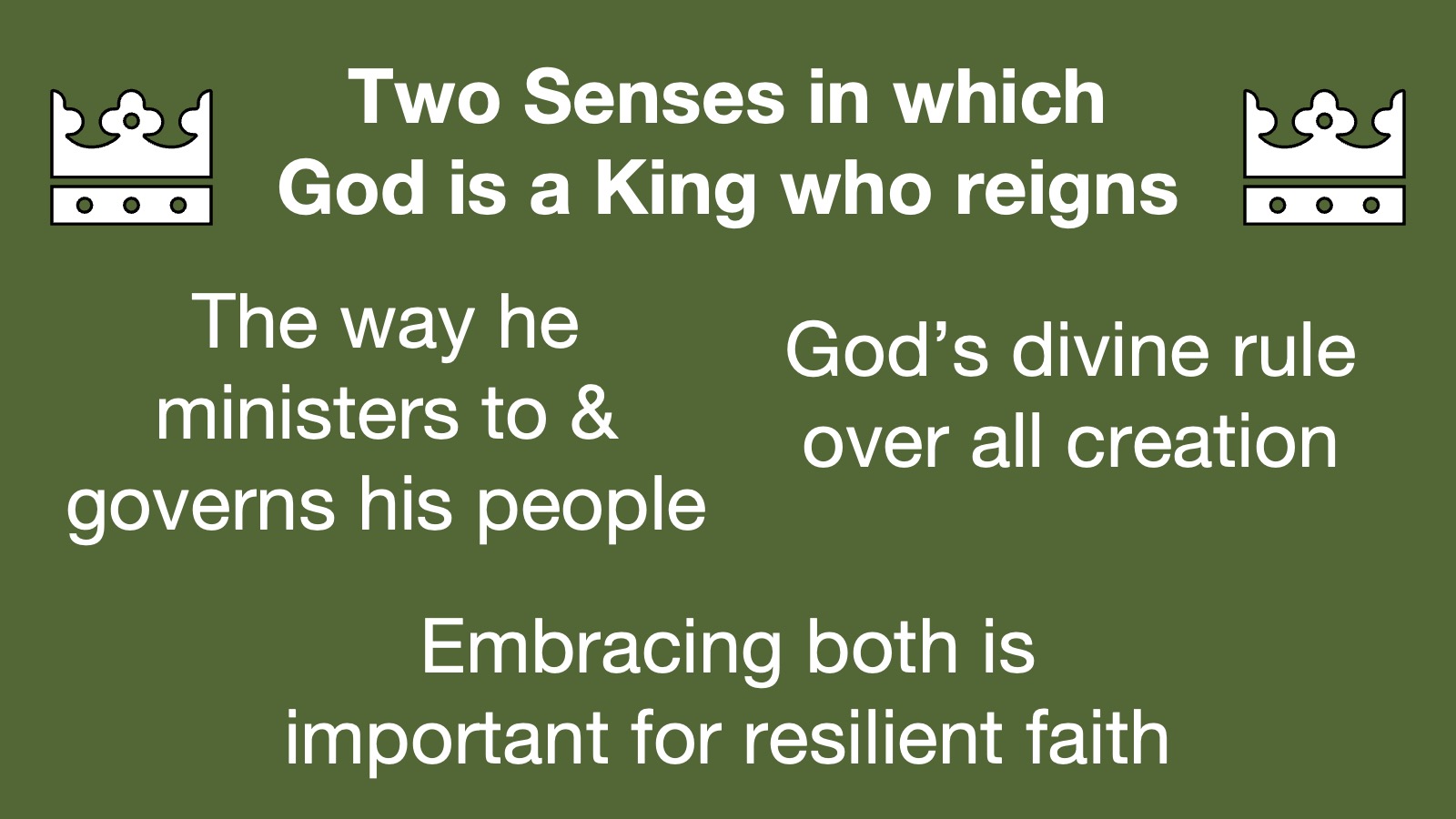
In the Bible, there are two senses in which God is a king who reigns. Most often, God’s kingship refers to the way he ministers to and governs his people throughout history especially, from New Testament times onward, through his Son, Jesus Christ. But here, in the Enthronement Psalms, the emphasis is on God’s divine rule over all creation. These two ways in which God is king are, of course, connected, for the God we worship as king in our hearts is the same divine king who spoke this world into existence at the beginning of time, who sustains it with his presence throughout history, and is working toward healing all its brokenness and restoring it to his rightful rule at the end of time. Informed by the Bible, we can say that God is king in an objective, universal sense, and God is king in a personal, subjective sense. Embracing both of the ways that God is king is important for having a resilient, holistic faith that endures.
But the second of these two aspects of God’s kingship is especially important when tremendous turmoil in the world overwhelms us. For God’s people during the Exile, absolutely everything that could have provided some sense of security and normalcy was stripped away. There was nothing in their everyday lives that indicated that things were going to be okay. They were strangers in a strange land, dominated by a pagan superpower, with nothing to call their own but their lives.
And yet, it is right here, at the very lowest point of human life, that belief in God’s infinite power over all things is so essential. For nothing else will give us hope when a loved one hangs between life and death in a hospital operating room, or a family member is gripped by an addiction they seem powerless against, or a mental or physical illness is causing your life to come unraveled and there is nothing you can do to stop it. At times like this, in the face of the forces arrayed against us, we have nothing. No hope. No courage. No strength. No personal resources at all to help us get through the next minute, the next hour, or the next day. That’s when God’s divine power to stand between us and the chaotic, evil forces that seek to destroy — and defiantly declare, “You shall not pass!” — is most needed. And that is exactly what we see in Psalm 93.
The Ultimate King is More Powerful Than the Chaos
It begins in this way:
The Lord reigns, he is robed in majesty;
the Lord is robed in majesty and armed with strength;
indeed, the world is established, firm and secure.
Your throne was established long ago;
you are from all eternity. (Psalm 93:1-2)

Immediately, we recognize that this is a hymn of praise to the eternal, invincible, universal reign of God. God is and always has been the ultimate King. This was true even before anything else existed. As the first words in the Bible declare: In the beginning God created the heavens and the earth. (Genesis 1:1) It is because “…the universe was formed at God’s command,…” (Hebrews 11:3) that we can embrace the Psalmist’s assurance that “…the world is established; it shall never be moved.” (Psalm 93:1)
Like the psalmist, we can see that chaos rises up all around us. The psalmist writes The seas have lifted up, Lord, the seas have lifted up their voice; the seas have lifted up their pounding waves. (Psalm 93:3) In the Ancient Near East, the deep and unpredictable sea was seen as a source of chaos and danger. And despite the dark waves that threaten us and the powerful storms that threaten to drown us, there is One more powerful still.
When we are secure in the king above all kings, and our hearts are rooted in him, then the psalmist’s praises become our own:
Mightier than the thunder of the great waters,
mightier than the breakers of the sea—
the Lord on high is mighty. (Psalm 93:4)
And the security we have in God’s cosmic kingship changes how we live. We take seriously what God says in his Word, and we seek to align our lives with it, so that God may be glorified among us. As the Psalmist writes:
Your statutes, Lord, stand firm;
holiness adorns your house
for endless days. (Psalm 93:5)
Creation and Christ are Proof that Our King Reigns
Now, you might be thinking to yourself, “Pastor, those are nice sounding words, but when my life is totally falling apart, I need something more substantial to hang onto. How can I take to heart Psalm 93’s assurance of God’s divine cosmic reign?”
If that’s what you are thinking, I get it. We all need a rock-solid foundation to carry us through the storms of life. But know this: The promises God gives us in Psalm 93 were not written in a vacuum. Look around and see the wonder of God’s kingly power in creation: the majestic mountains that surround us, the sun that energizes the world by day and the moon that directs the tides and the seasons at night. See God’s incredible wisdom in the intricate complexity of interconnected systems throughout creation, down to the inner workings of a single human cell. The seas may “…roar and foam and the mountains quake with their surging…” (Psalm 46:3), but they all have their limits which were placed on them by the God who created them.
That same kingly rule that set limits on the chaotic sea at creation didn’t stay locked in the past — it stepped into history in the person of Jesus Christ. The very waters the psalmist sang about show up again, this time with Jesus asleep in the back of a boat with his disciples as they sailed across the Sea of Galilee. Mark tells us what happened in his Gospel:
The disciples woke him and said to him, “Teacher, don’t you care if we drown?”
He got up, rebuked the wind and said to the waves, “Quiet! Be still!” Then the wind died down and it was completely calm.
He said to his disciples, “Why are you so afraid? Do you still have no faith?”
They were terrified and asked each other, “Who is this? Even the wind and the waves obey him!” (Mark 4:38-41)
Jesus is telling us that our fears reveal the areas where our faith is lacking, and it’s God’s power to calm the storm that strengthens the faith he gives us in our feeble hearts. The king who rules over creation gives us his power to stand firm in the chaos and glorify him with our lives.
Conclusion
In the first movie of the Lord of the Rings trilogy, The Fellowship of the Ring, as Gandalf the Grey and the rest of the Fellowship flee through the Mines of Moria, they are pursued by orcs. As they cross the Bridge of Khazad-dûm, a Balrog, a demonic monster of shadow and fire, comes after them. Gandalf defiantly declares to the Balrog, “You shall not pass,” and drives his staff into the bridge. The bridge collapses under the Balrog’s weight and he falls into the depths below.
As Gandalf turns to rejoin the group, the Balrog’s flaming whip reaches up from the depths and wraps around Gandalf’s ankle. Gripping the stone ledge, Gandalf looks into Frodo’s eyes and stops struggling. He says, “Fly, you fools!” Then he lets go and falls into the abyss with the Balrog. [iii]
That’s a picture of what Jesus has done for you. He placed himself between us and the epitome of chaos and evil. He stretched out his arms on a cross as his declaration of “You shall not pass.” And when the power of sin and evil was fully spent, only then did Jesus give up his life and die. He saved us at the cost of his own life. He fell into the grave that we deserve, and it looked like all was lost.
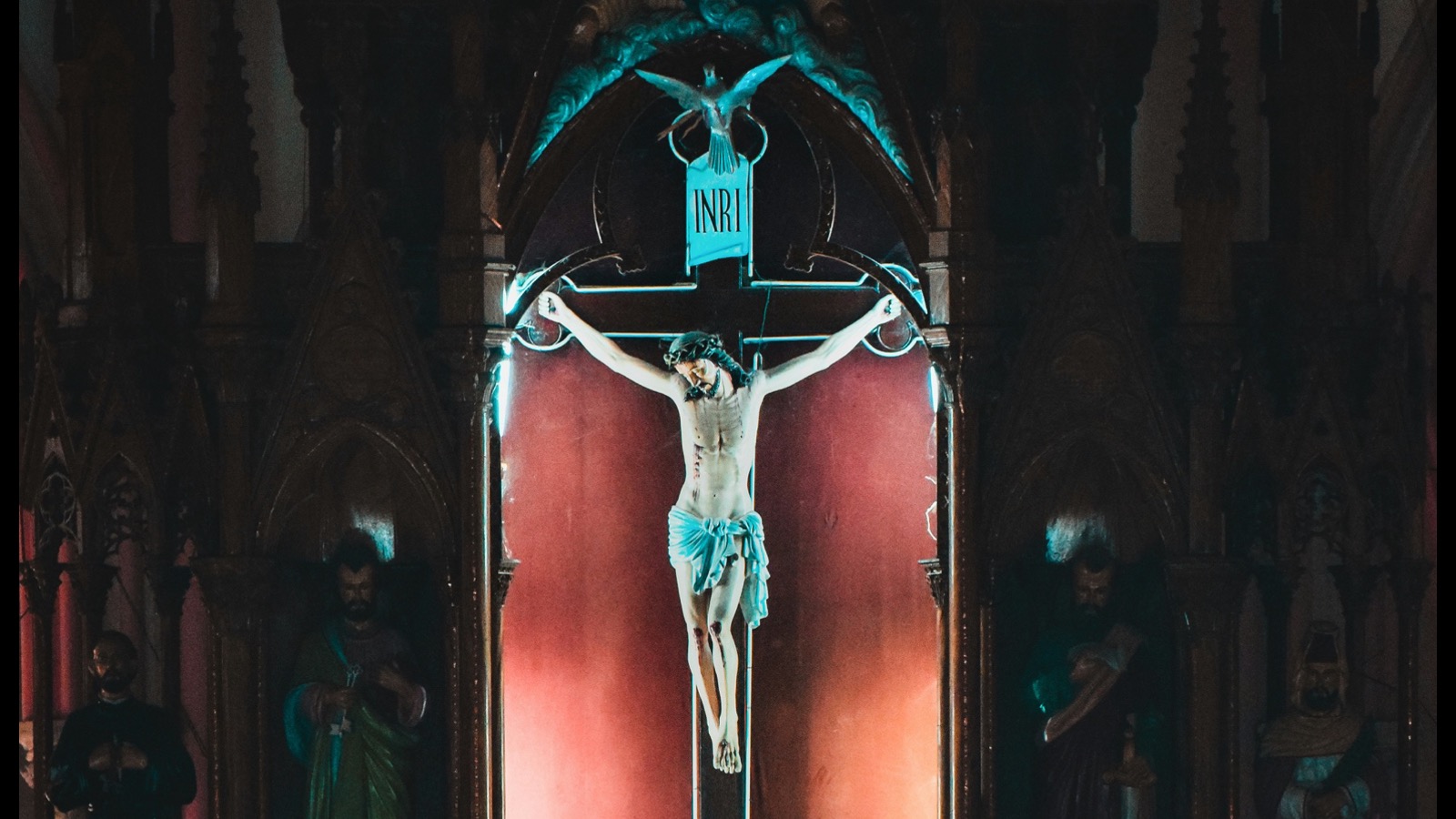
But God was still king, even though it looked like evil had won. On the third day that followed, God the Father showed his ultimate power over life, death and the entire cosmos by raising Jesus back to life. And that is only the beginning, for Jesus’ resurrection signals the start of the renewal of all things, including us, and the restoration of the rightful rule of God that will be fulfilled at the end of time.
Dear friends, at some point in your life, chaos is going to come knocking at your door. To help you prepare for chaos whenever it shows up, here is the challenge that I am setting before you this week.
First, identify an area of your life where you are still relying on yourself. Maybe it’s the test result you’re managing alone, the letter you haven’t opened, the relationship you’re trying to fix through sheer effort, or the uncertainty of the trade war you’re just gritting your teeth through. We all have a part of our lives where we want to be a hero like Sully, so we trust in our own calm, our own competence, and our own control, instead of resting in the King who already reigns over it. Name that part of your life and give it to Jesus.
Second, immerse yourself in Psalm 93 and let it soak into your soul. Maybe even memorize the first part of verse one: The Lord reigns, he is robed in majesty; (Psalm 93:1) Then, when fear rises and your personal resources run out, say it out loud. Not because it makes the chaos disappear — the storm was still real for the disciples in that boat — but because it reminds you who is actually in the boat with you. Focus on the cosmic glory and majesty of King Jesus who loves you, is with you, and carries you through the chaos and into eternity with him.
You don’t need special training or experience to survive the chaos. You need a King who’s already reigning over it and all things. And Jesus is.
Amen.
[i] “Sully Sullenberger,” Wikipedia: The Free Encyclopedia (https://en.wikipedia.org/wiki/Sully_Sullenberger; accessed September 6, 2026).
[ii] J. Clinton McCann Jr., The Book of Psalms, in The New Interpreter’s Bible, vol. 4 (Nashville: Abingdon, 1996), 1053, quoted in Walter Brueggemann and William H. Bellinger Jr., Psalms (Cambridge: Cambridge University Press, 2014), 402.
[iii] “23. The Bridge of Khazad-dûm,” The Lord of the Rings Movies: The Fellowship of the Ring (https://www.tk421.net/lotr/film/; accessed September 6, 2026).


