

Some of the best times of my life have been at wedding celebrations. It’s the celebration of a moment when a man and a woman promise to join their lives together for as long as they both shall live on this earth. Family and friends gather from near and far to enjoy good food and share in laughter, conversation and joy.
And yet, even though the exchange of public promises before God and those gathered is very important, more than just that is being celebrated at a wedding. A wedding is also a celebration of the past and the parents who brought the bride and groom into this world and instilled in them the values which define and guide them. And it is a celebration of anticipated future blessings like mutual love, support and encouragement, the joint celebration of shared milestones, and perhaps children and grandchildren. I find that wedding celebrations tend to fill my heart to overflowing with thanksgiving, love and joy. Perhaps they do the same for you?

It is well and good that we celebrate things like weddings, birthdays, and other milestones. But not everyone gets to celebrate a wedding of their own, not every marriage results in children, and not every relationship endures the way we hope. Yet all of us are invited into a much bigger celebration that reaches downward far deeper and upward far higher: to join with the rest of creation in loud public praise of God’s marvelous deeds, past, present and future.
So why do so many of us feel silent on the inside, standing outside that song, unable to join in? The inherent brokenness both within us and in the world means our soul is not naturally calibrated for celebration. Fear, worry, sorrow, and grief loom largest within us, and our outer lives echo the guarded, muted state of our hearts. We experience only momentary flickers of confidence, connection, or joy. The burdens of life overwhelm us, and hope for a better future starts to feel foolish. Instead of adding our voice to creation’s chorus, we feel like there’s a black hole within us that swallows the joy out of every moment and every relationship — so we go quiet. We keep it to ourselves. We privatize what was always meant to be sung out loud.
So how does a muted, broken soul find its voice again and join the song creation is already singing? For God’s answer, let’s turn to Psalm 98.
God’s Righteousness Was Always Proven in Public
As we do that, I want to draw your attention to a word in this Psalm that can help our faith in God to grow. And that word is “righteousness.” It isn’t a word that we often use in our everyday language today, so we may not truly understand what it means. And even if we do have a definition for the word “righteousness,” we may not understand the biblical meaning of the word. We might think of righteousness as doing the right thing by some objective standard, but that is not how the Bible uses the word.
In both the Old and New Testaments, the word “righteousness” means doing the right thing within the context of a relationship. With this view in mind, when a person fulfills the obligations of a relationship, they are righteous.
So for a marriage relationship, a person would be called “righteous” when they fulfill the promises they made on their wedding day, to take the other person as their husband or wife from that day forward, to join with them and share all that is to come: for better, for worse, for richer, for poorer, in sickness and in health, to love and to cherish, until death parts them.
In the Old Testament, God’s righteousness is based on his covenant with Israel, and his righteousness is displayed in his many public acts to save Israel. Chief among these was God’s rescue of his chosen people out of slavery in Egypt, which God did before the entire world.
As the Psalmist sings,
The Lord has made his salvation known
and revealed his righteousness to the nations.
He has remembered his love
and his faithfulness to Israel;
all the ends of the earth have seen
the salvation of our God. (Psalm 98:2-3)
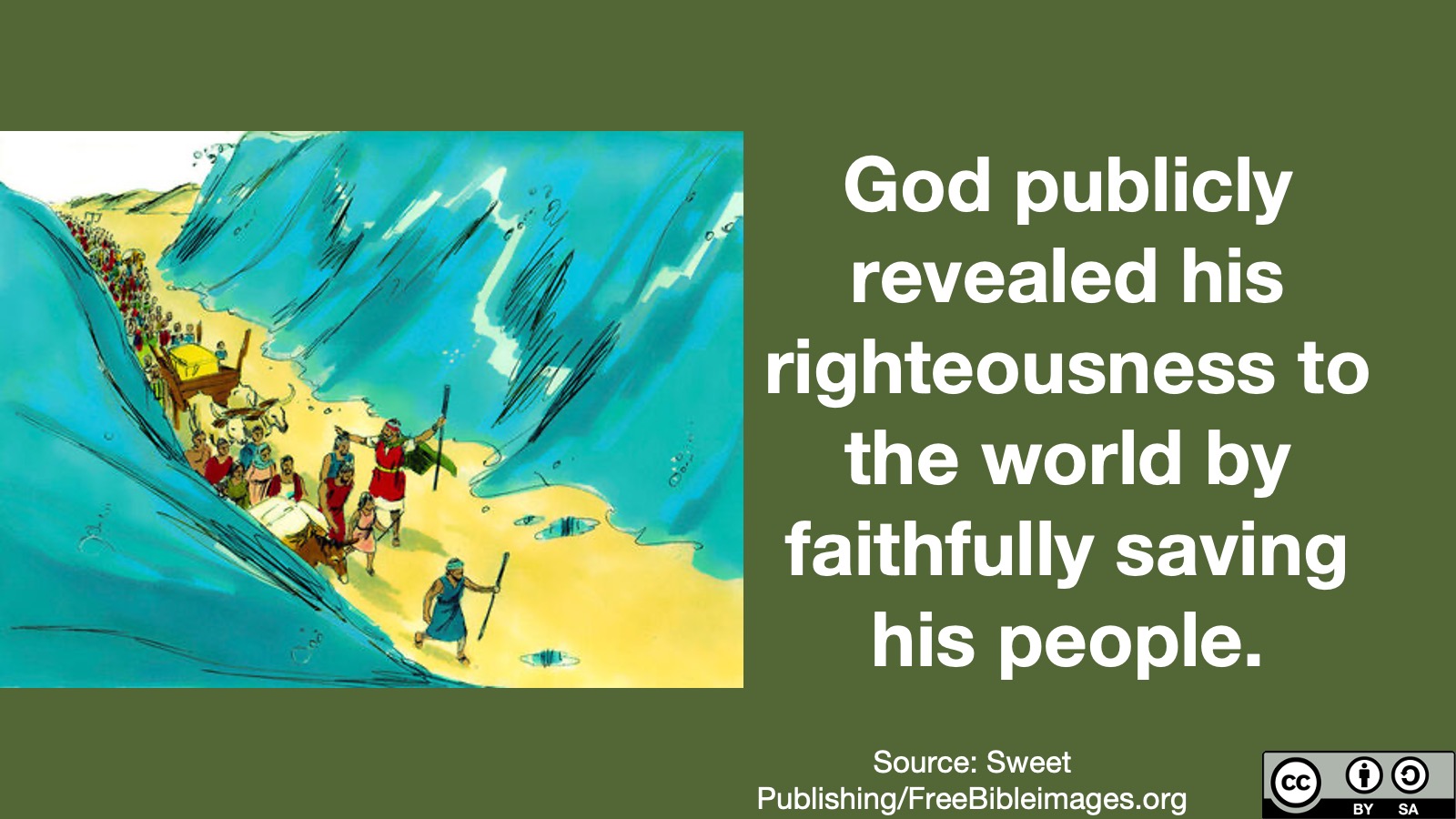
In other words, God publicly revealed his righteousness to the world by faithfully saving his people. Please remember this point for it is very, very important and I’m going to refer to it again later.
According to the Bible, God’s people can also be called righteous, but not because they are upright in their actions and moral character. Instead, they are righteous when they trust in God to save them, even when their actions or character indicate that they don’t deserve God’s saving action, and when they continue to trust in God for salvation even when God’s saving action has not yet happened.
The Israelites in Egypt were righteous because they cried out to God for rescue while they suffered under the bondage of slavery. Even in the Old Testament, faith in God for salvation is what makes humans righteous. And we see both the faith and relational aspects of righteousness in Exodus 2:
The Israelites groaned in their slavery and cried out, and their cry for help because of their slavery went up to God. God heard their groaning and he remembered his covenant with Abraham, with Isaac and with Jacob. So God looked on the Israelites and was concerned about them. (Exodus 2:23-25)
So even before Christ ever came, God’s people found their righteousness the same way we do today: not by earning it, but by trusting the God who had already proven himself faithful, in public, for the whole world to see.
God’s Righteousness Is Fully Revealed in Jesus
I promised earlier that I would circle back to my first main point, and here is where it leads us. Those dual aspects of faith and relationship continue in the New Testament where God formed a new covenant with humanity, one that includes both Jews and Gentiles, through faith in God the Son, Jesus Christ. Again, God publicly revealed his righteousness to the world by faithfully saving his people.
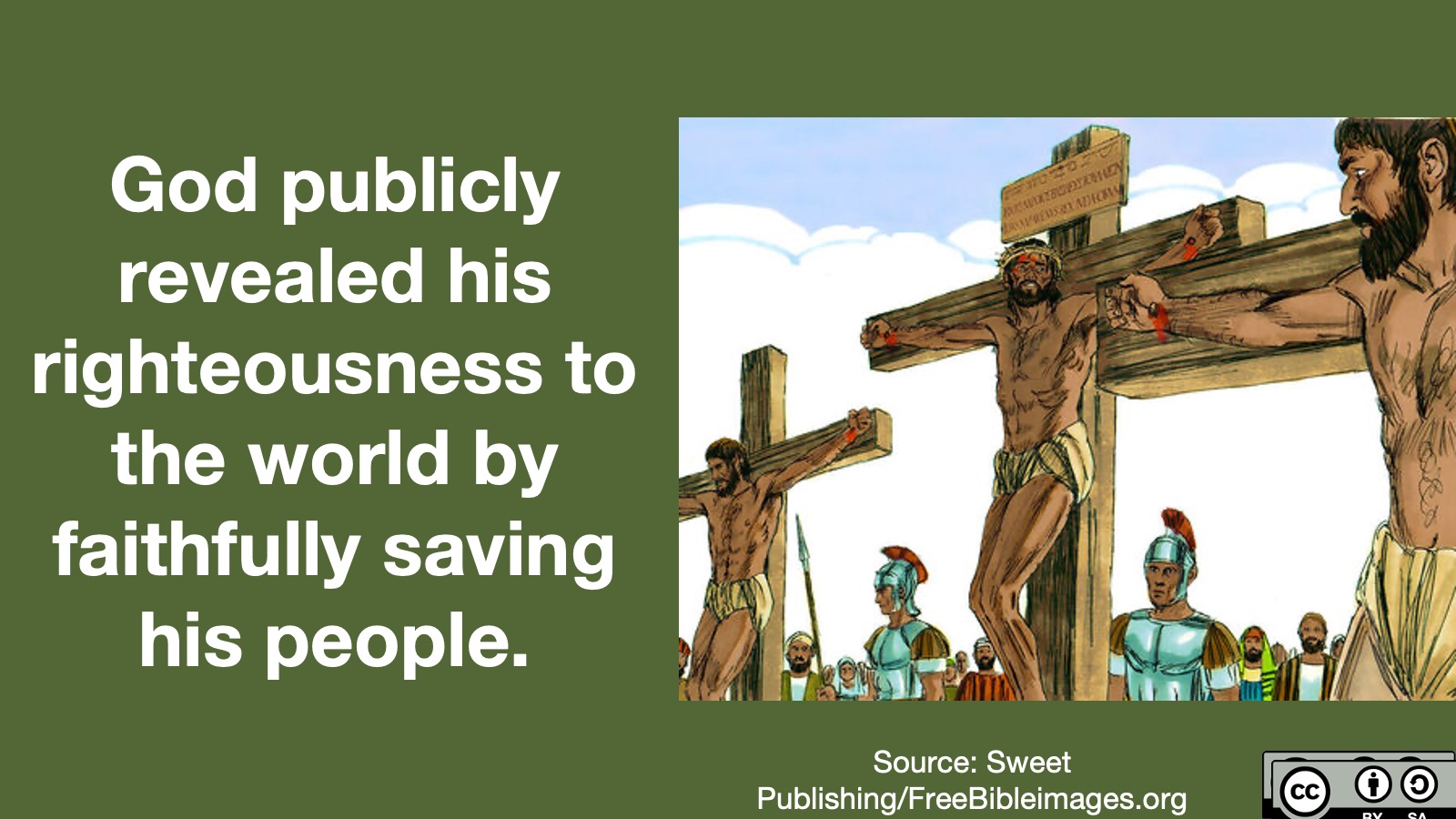
God the Son came into this world more than 2,000 years ago and became fully human in Jesus of Nazareth. Jesus demonstrated his identity through his teaching and miracles, which he did in public with witnesses numbering in the thousands. Then, when the time was just right, the God-human Jesus performed the greatest salvation act in history by sacrificing his own life to pay the full cost of forgiveness for the sins of all humanity. This he did in public when he was nailed to a cross beside a main road on a hill outside Jerusalem. It cost Jesus his life, but we were set free, and the proof of our salvation was set before the world on the third day after his death, when Jesus rose from the dead. Over the next forty days, he appeared to hundreds of witnesses. Jesus is where we now see God’s righteousness displayed.
And again, just as in the Old Testament, faith in God for salvation is what makes humans righteous.

In his book, The Freedom of a Christian, Martin Luther provides a beautiful illustration of this by asking us to imagine a wedding between a rich and powerful groom and a poor and helpless bride. In the moment when the marriage bond is formed, everything that belongs to the bride—her poverty, her debt, and her disgrace—becomes his, and everything that belongs to the groom—his wealth, his honour and his righteousness—becomes hers. In their married life together, the groom is righteous because he faithfully continues to share all he has with his bride. And the bride is righteous because she continues to trust in her groom for all that he has given her.
You are that bride, and Jesus is your groom.
The public, faith and relational aspects of righteousness are all displayed for us in Ephesians 2:8-10:
For it is by grace you have been saved, through faith—and this is not from yourselves, it is the gift of God—not by works, so that no one can boast. For we are God’s handiwork, created in Christ Jesus to do good works, which God prepared in advance for us to do. (Ephesians 2:8-10)
And that is how a muted, broken soul finds its voice again — not by working up a confidence we don’t have, but by trusting the God whose righteousness has already been proven, in public, on our behalf: first at the Red Sea, and then at an empty tomb outside Jerusalem. The silence starts to break, because the new song Psalm 98 calls us to sing was never about our own performance. It is simply the truest possible response to a God who has kept every promise he ever made, in full view of the world.
A Divided Heart Cannot Sing a Whole Song
So what does this mean for us? We live in a world that continually bombards us with ways of thinking and being that conflict with what God teaches us in the Bible: ideas about how life began, what life is all about, and what kind of people should we be? And these ideas are not presented to us as alternatives to consider, they are presented as factual truths that we should accept. They are woven into the fabric of our culture and form its framework, and we need to somehow be able to navigate the culture in which we live.
I think that what many of us have done, and I have lived this way at various points in my life, is divide our lives up into compartments. In one compartment, and usually it is the biggest compartment, we accept the ideas of the world as true, and we live according to them. And then we have another compartment, let’s call it the faith compartment, where we let God and his love and truth guide our heart and mind. This is the compartment in which we live on Sunday morning and other select times of the week. Now living a compartmentalized life may seem to work. But it doesn’t really.
Jesus was talking about money when he said this, but it applies to anything we let govern our life.
“No one can serve two masters. Either you will hate the one and love the other, or you will be devoted to the one and despise the other. You cannot serve both God and money. (Matthew 6:24)
And then Jesus’ brother, James, refers to the danger of believing with only partial faith when he writes,
Such a person is double-minded and unstable in all they do. (James 1:8)
What’s needed is for our heart to be fully converted. Have any of you watched the opening credits of The Chosen? As the credits begin, you see a bunch of dark fish all swimming in the same direction. Then strangely a turquoise fish appears, and it is swimming in the opposite direction. Then a dark fish turns turquoise, changes direction and also swims in the other direction. And then another and another. By the end of the credits, there are several turquoise fish swimming, and all of them are swimming in the opposite direction of all the dark fish. That’s a beautiful picture of conversion.

We start off swimming along in the same direction as the rest of the world, and then, for reasons we cannot fully explain or understand, except to say that it is a work of God, we completely change and start swimming in the opposite direction because our heart has been captured by a love greater than we have ever known before, and yet it is the love we always knew we desired. And then we only have one compartment in our lives, it’s a compartment of faith, and everything else goes inside it.
The Healing of a Compartmentalized Life
Dear friends, we cannot convert ourselves, only God can fully convert us. But we can put ourselves in a position where God can do his best work within us.
From the time when I was a teenager until I was in my thirties, I believed that the earth and all we see came into being through naturalistic forces, and I lived my life with two compartments, one guided by the world and the other guided by God. But then I was invited to a conference by my sister where the evidence for the world and all that exists coming into being by special creation by God was presented, and it totally blew away all my worldly presuppositions.
It was as if scales fell from my eyes and I was then able to see evidence of God’s role in creation everywhere I looked. The dividing walls between the various compartments began to crumble and I was on my way towards living a more integrated, holistic, and authentic life.
Let God Dissolve the Walls Between Your Compartments
That’s one example of one kind of compartmentalization that God healed. But your life will look different, and you might have compartmentalization in the areas of finances, relationships, sexuality, work, leisure, or many other areas. God’s process is the same.
So the challenge that I am setting before you today is this: Ask yourself if there are portions of your life in which you are following the world instead of God? If there are, then ask yourself another question: What are the worldly beliefs that are guiding me in this portion of my life? Once you have identified those beliefs, then consider this question: How do these beliefs compare to the publicly available evidence of what God has done in the past and the biblical proclamation of what God will do in the future?
You see, the world cannot save itself. But God can save the world. For he is a righteous God who faithfully saves his people. We see that most clearly in the person of Jesus Christ, who suffered, died and rose again to save us from sin, death and eternal condemnation. And Jesus will complete his saving work when he returns in the future to judge, or set right, all things, including us.
Let God percolate his love, truth and grace throughout your heart, soul and mind so that the compartments in your life are dissolved. Because God heals and restores us, we sing new songs for his new mercies.
As we read in Lamentations 3:
Because of the Lord’s great love we are not consumed,
for his compassions never fail.
They are new every morning;
great is your faithfulness. (Lamentations 3:22-23)
It is because of God’s love and his righteousness that we join creation’s song of praise to the Lord with our entire life, just as the Psalmist describes:
Let the sea resound, and everything in it,
the world, and all who live in it.
Let the rivers clap their hands,
let the mountains sing together for joy;
let them sing before the Lord,
for he comes to judge the earth.
He will judge the world in righteousness
and the peoples with equity. (Psalm 98:7-9)
Amen.


